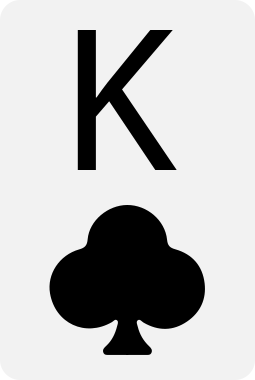
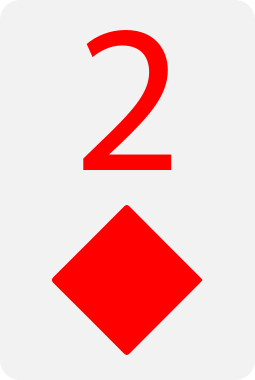
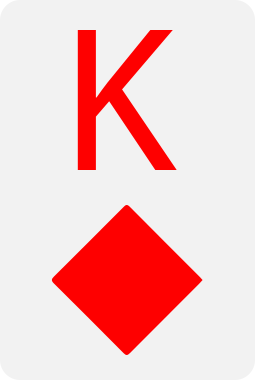
Jack-Two Suited is the weakest suited jack-x hand in Texas Hold’em, and it sits right at the boundary of hands that have any theoretical argument for being played at all. The Jack provides a recognisable high card, but the two is the lowest possible kicker, offering no connectivity, no straight potential in any practical sense, and no ability to improve the hand beyond basic pair combinations. The suited nature is the only feature that separates J2s from a straightforward muck, and even that advantage is narrow.
Understanding J2s is largely an exercise in understanding where the floor of suited hand playability lies. It is not unplayable in every conceivable situation, but the conditions under which it has positive expected value are specific enough that most players – including many experienced ones – are better off simply folding it and moving on.
What These Odds Show for J2s
The draw odds are almost identical to J3s across most categories, which is expected given that swapping a three for a two changes very little about how the hand develops. On the flop, 53.04% of runouts produce just a high card. Pair equity by the river sits at 43.67%, marginally higher than J3s at 43.54% – a negligible difference that reflects rounding rather than any meaningful distinction.
Two pair arrives at 22.26% by the river, three of a kind at 4.37%, full house at 2.22%, and four of a kind at 0.13%. All of these are consistent with other jack-x suited hands and do not distinguish J2s in any way.
The straight odds are where J2s reaches its absolute floor. A straight is impossible on the flop at 0.00%, arrives just 0.63% of the time by the turn, and reaches only 2.54% by the river. This is the lowest straight percentage of any jack-suited hand, and it represents the practical reality that a Jack and a Two share no board texture that naturally connects them into a straight. The 2.54% figure by the river is essentially a statistical artefact – it captures the tiny number of runouts where five community cards happen to form a straight that includes one or both of your hole cards in a way that does not require them to connect with each other. In terms of actual straight draw situations on the flop or turn, J2s generates almost none.
Compare this progression across the jack-x suited family: J6s reaches 3.19% by the river, J3s reaches 2.89%, and J2s falls to 2.54%. Each step down in kicker rank removes a small but real slice of straight potential, and J2s represents the end of that progression.
The flush odds hold steady at 0.84% on the flop, 2.93% by the turn, and 6.57% by the river – figures that are essentially identical across the entire suited jack-x family regardless of the second card. This is the mathematical reality of suited hands: the flush potential depends only on the suit, not on the rank of the second card. J2s and JTs have the same flush draw odds. The difference between them is everything else.
The straight flush odds fall to just 0.01% by the river, the lowest in the jack-x suited family, which reflects the near-impossibility of the two contributing to a straight flush combination with the Jack.
The overcard table is identical to J3s and J6s: 56.96% on the flop, 67.95% by the turn, and 76.31% by the river. The Queen, King, and Ace will appear on the board in roughly three quarters of all hands played to the river, meaning the Jack will regularly not be the top card. And when you pair the two, you are making the weakest possible pair against a board that almost certainly contains higher cards.
Hand Strength Summary
- Hand type: Weakest suited jack-x hand
- Relative strength: Bottom tenth of all starting hands
- Potential: Flush draws only; straight potential is negligible in practice; pair outcomes are weak
- Main vulnerability: Two is the worst possible kicker; no straight connectivity; overcards appear frequently; Jack-high flush can lose to higher flushes
J2s is a hand with one feature – the flush draw – and every other aspect of its profile ranges from weak to irrelevant.
How Jack-Two Suited Wins
The range of ways J2s wins is narrow even by the standards of weak speculative hands:
- Completing a flush against opponents who cannot fold one pair or an overpair
- Flopping top pair with the Jack on a board where Ace, King, and Queen are absent and opponents hold weaker holdings
- Making two pair using both hole cards on a board that pairs both the Jack and the two – an outcome that requires a very specific board and is one of the most disguised two pair combinations possible
- Flopping a set of twos or jacks, extracting value from opponents who cannot read the hand correctly
- Winning uncontested pots through preflop aggression in late position against passive or wide blind ranges
The two pair scenario involving the deuce is worth a brief acknowledgement. A board of J♥ 2♠ 7♦ gives J2s top two pair in a way that is almost impossible for opponents to put you on. Against an opponent holding top pair with any jack, or a hand like pocket sevens, this can result in a significant pot. It is rare, but when it happens, J2s extracts maximum value through pure concealment.
Main Weaknesses
J2s has weaknesses that compound one another:
- The two is the worst kicker in the deck. It loses to every other card if both players pair their second card, and it contributes nothing to straight combinations with the Jack
- Straight potential is effectively zero. No realistic flop texture gives J2s a meaningful straight draw
- Top pair with a two kicker is one of the most vulnerable top pair combinations in poker, losing to any opponent holding a jack with a better kicker – which is almost every other jack-x holding
- The flush it makes is Jack-high, which can lose to queen, king, or ace-high flushes from opponents drawing in the same suit
- Overcards arrive on the board 76.31% of the time by the river, undermining the Jack’s value as a top card in the majority of hands
Best and Worst Flop Textures
Strong flops
- Two cards of your suit, giving a flush draw worth pursuing with correct pot odds
- Jack-high boards containing only low cards, where Ace, King, and Queen are absent and the two is an unlikely kicker match for any opponent
- Boards that pair both hole cards simultaneously – rare, but extraordinarily well concealed when they occur
- Low boards where a set of twos is flopped, giving a strong hand with no obvious tell
Dangerous flops
- Any board containing an Ace, King, or Queen – which happens more than half the time on the flop alone
- Boards in a different suit where you pick up no flush equity and are left with Jack-high on a board that is likely to have connected with opponents
- Jack-high boards where opponents can reasonably hold a jack with a better kicker, making top pair with a two kicker extremely difficult to play for significant money
- Boards where you pair the two and face any bet at all – a pair of twos is almost never the best hand
How It Plays by Position
- Early position: A fold without exception in any standard game. There is no situation in which J2s is a correct early position open.
- Middle position: Still a fold. The hand’s single viable draw and high overcard exposure make it unprofitable against middle position calling ranges.
- Late position (cutoff/button): The one position where J2s occasionally has a theoretical argument, specifically as a steal against wide or passive blind ranges. Even here it sits below the threshold that most thoughtful players draw for suited jack-x hands, with J3s, J4s, and J5s all representing meaningfully better options.
- Blinds: Completing from the small blind in an unraised pot is the most defensible spot for J2s – the price is minimal and the flush draw potential justifies seeing a flop. Defending against a raise from either blind is not recommended.
Position matters with every hand, but with J2s it is not even a question of getting value from position – it is about minimising losses. The hand requires a very specific flop to continue, and out of position that assessment becomes harder to make correctly.
Common Mistakes with Jack-Two Suited
- Treating it as equivalent to other suited jack hands simply because it shares the flush odds – the straight potential and kicker quality are not equivalent
- Continuing past the flop with top pair and a two kicker when facing any meaningful resistance
- Calling raises because of the suited nature, when the correct adjustment is to require a cheaper price than other hands, not to call raises
- Pursuing the flush draw without pot odds, particularly on boards where a Jack-high flush could still lose
- Playing it from any position other than late position or a cheap small blind completion, and convincing yourself the flush draw justifies it
Comparison to Similar Hands
- Stronger than: J2o, which loses the flush equity that is J2s’s only saving feature
- Weaker than: Every other suited jack hand – J3s, J4s, J5s, J6s, J7s, J8s, J9s, JTs
- Broadly similar to: Q2s, K2s, T2s – other suited hands with the worst possible kicker for their top card
The step from J3s to J2s is the smallest meaningful distinction in the jack-x suited family, but it is still a step in the wrong direction. J3s already has almost no straight potential, but J2s has less. J3s has a marginally better kicker in the rare spots where the kicker matters; J2s does not. At this level of weakness, the differences between J2s and J3s are academic – both are marginal hands – but J2s is definitively the inferior holding.
How Jack-Two Suited Performs in Multiway Pots
The multiway dynamics for J2s follow the same logic as other weak flush draw hands but with the weaknesses amplified:
- Multiway pots improve implied odds on flush completions, since more opponents can pay off a made flush
- However, more players in the same suit means a Jack-high flush is more frequently beaten by a higher flush
- Top pair with a two kicker is almost unplayable in multiway pots against any resistance – the range of hands that beat it is too wide
- The absence of any practical straight draw potential means J2s cannot benefit from the combo draw implied odds that make weak suited connectors tolerable in multiway spots
- Two pair and set hands, while well disguised, face a wider range of stronger holdings in multiway pots
The ideal multiway scenario for J2s is a cheap unraised pot in position where you can evaluate the flop clearly, pursue a flush draw with correct pot odds, and abandon the hand quickly when the flop offers nothing. Any other multiway scenario is likely to be unprofitable.
FAQ: Jack-Two Suited
Is J2s the worst jack-suited hand?
Yes. It has the weakest kicker and the lowest straight potential of any suited jack-x combination. The flush odds are identical to the rest of the jack-x suited family, but everything else points downward.
What is the realistic case for playing J2s?
A late position steal in the right game, or a cheap small blind completion in an unraised pot. In both cases the expectation is to see a flop, assess whether a flush draw is available, and fold quickly if not.
How does J2s compare to J2 offsuit?
J2o is an almost entirely unplayable hand in standard games. J2s at least carries flush draw potential that can occasionally justify seeing a cheap flop. The suited tag is the only reason to distinguish the two.
Why does the two kicker matter when both players might not pair it?
Because when the Jack pairs on the board, the two is your kicker. Any opponent holding J3 through JA has you beaten in that spot. With a two kicker there is nowhere lower to go – you lose to every other jack-x holding at showdown on a jack-high board.
Related Hands