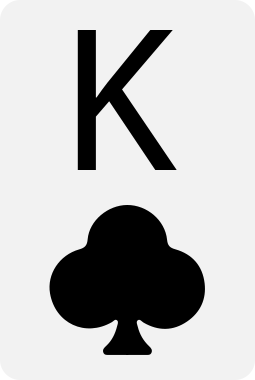
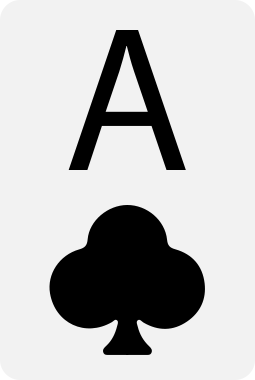
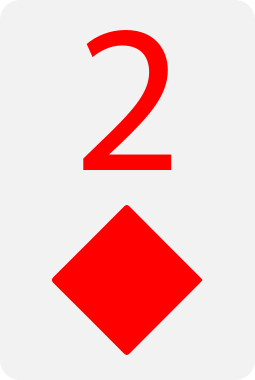
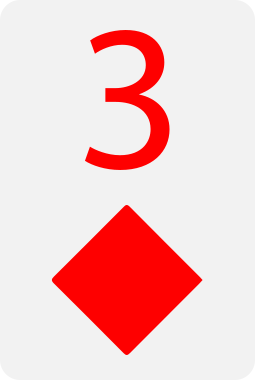
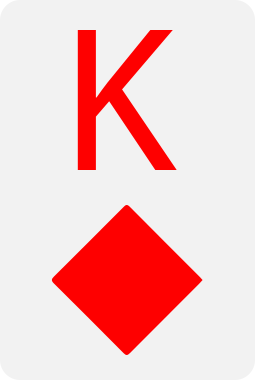
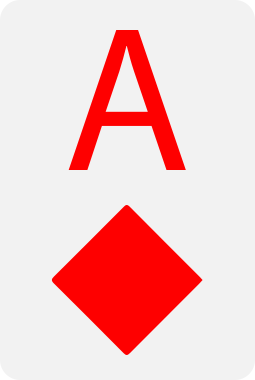
King Two Suited is the lowest suited king in the deck. It shares the same fundamental structure as K3s, K4s, and K5s — King-high flush potential, a low overcard rate, and a kicker that contributes almost nothing at showdown — but the Two pushes the kicker weakness to its absolute extreme. There is no hand that K2s dominates on kicker strength alone. If the King pairs and faces any resistance, the hand is almost certainly behind.
It is the end of the suited king line, and it should be played with that clearly in mind.
What These Odds Show for K2s
The draw odds are consistent with the rest of the suited king family, with small variations that reflect the Two’s position at the bottom of the rank sequence. High card remains the best holding on the flop 53.04% of the time, falling to 18.66% by the river — marginally higher than K4s at 18.22% and K5s at 18.01%, a trend that reflects the slightly reduced connectivity of lower kicker cards across all runout combinations.
The flush odds remain stable at 6.57% by the river, unchanged from K4s and K5s. The suited nature contributes the same equity regardless of kicker rank, and the King-high flush remains the nut flush in almost every situation it arrives. This consistency is the defining feature of the suited king category — whatever the kicker, the flush draw is always the same quality.
Straight potential reaches its lowest point in the suited king family at 1.83% by the river. The gap between King and Two is as wide as any two-card combination can produce, and the few straights that are possible require extremely specific board runouts involving Ace, Three, Four, and Five — the wheel straight and its neighbours. This is not a consideration worth factoring into post-flop decisions.
The overcard table is identical to every other suited king — 22.55% on the flop, rising to 35.30% by the river. Only an Ace produces an overcard to the King, which remains the structural advantage of the entire hand category. The problem, as always, is that the Two kicker means top pair King is dominated by every other King in the deck without exception. K2s has the worst kicker of any suited king, which means its top pair holding is the most vulnerable of the category.
Hand Strength Summary
- Hand type: Weak suited king — the lowest in the deck
- Relative strength: The most marginal of the suited kings; value concentrated almost entirely in the flush draw and steal equity
- Strengths: King-high nut flush potential, identical overcard rate to all suited kings, King blocker value
- Main vulnerability: Two kicker is dominated by every other King without exception — top pair King with a Two kicker has no kicker protection whatsoever
How King Two Suited Wins
The winning paths for K2s are the narrowest of any suited king:
- Completing a King-high flush, which remains the nut flush and is the hand’s primary route to a large pot
- Semi-bluffing with a flopped flush draw and taking the pot before showdown
- Stealing blinds and small pots in late position using the King’s high card presence as a credible bluffing range
- Winning uncontested pots where no opponent has connected with the board and the hand does not reach showdown
The hand essentially cannot win a contested pot at showdown through pair strength. Every other King in the deck has it dominated on kicker, and the Two provides no secondary value of any kind.
Main Weaknesses
- The Two kicker is dominated by every possible King combination — K3 through KA all have K2s beaten on kicker when the King pairs
- Straight potential at 1.83% by the river is the lowest of any suited king and should be disregarded entirely as a strategic consideration
- Without the flush draw, K2s is K2o — one of the weakest playable hands in the deck with almost no post-flop route to winning
- The hand has zero kicker protection, meaning any board that pairs the King and generates aggression is almost always a fold situation
Best and Worst Flop Textures
Strong flops
- Two cards in your suit — the flush draw transforms K2s from a nearly unplayable hand into an aggressive semi-bluffing vehicle with the nut draw
- King-high boards in heads-up steal situations where the pot is taken down before the kicker is ever relevant
- Very low boards (e.g. A♣ 2♦ 7♠) where the Two gives bottom pair in a spot with no further investment required — though this is a marginal outcome at best
Dangerous flops
- King-high boards with any opponent who has shown interest — the Two kicker means top pair is dominated by virtually the entire range of hands that would continue on a King-high board
- Any board that generates significant aggression without providing a flush draw, leaving the hand with no equity and no credible continue
- Multiway pots on any board texture — the kicker weakness and absence of drawing alternatives make multiway play with K2s extremely difficult to navigate profitably
How It Plays by Position
- Early position: A fold in all but the most unusual game conditions — there is no standard situation where K2s justifies an early position open
- Middle position: A fold in most games; the hand requires too much cooperation from position and board texture to play profitably from middle spots
- Late position / Button: The only position where K2s has genuine value — blind stealing, controlled flop access with the intention of seeing a flush draw, and fold equity with the King as a credible bluffing card
- Blinds: Defensible from the big blind at a significant discount given the King blocker and nut flush potential, but requires the most disciplined post-flop play of any hand in the suited king category
Common Mistakes with King Two Suited
- Continuing with top pair King against any meaningful aggression — with a Two kicker, the hand is dominated by every other King and should almost never go to showdown in a contested pot
- Opening from early or middle position where the hand cannot realise its limited equity
- Treating K2s as equivalent to higher suited kings — while the flush draw is the same quality, the complete absence of kicker protection makes the hand meaningfully more difficult to play profitably
- Calling bets on the turn without a flush draw in progress, holding only a paired King with no backup equity
Comparison to Similar Hands
- Stronger than: No suited king — K2s is the lowest suited king in the deck
- Weaker than: K3s and every higher suited king; the descent from K3s to K2s is the final step in a gradual narrowing of the hand’s post-flop options
- The practical difference between K2s, K3s, and K4s is very small — all three hands play almost identically, with the flush draw as the primary equity source and the kicker largely irrelevant in uncontested pots
- Against non-king suited hands of comparable rank, K2s trades drawing connectivity for the nut flush potential and King blocker, a trade that favours K2s in the right game conditions
How King Two Suited Performs in Multiway Pots
K2s is among the least suited hands for multiway pots of any hand in the suited king category. The nut flush draw remains its most valuable feature and does benefit from larger multiway pots when it completes, but the complete absence of kicker protection makes every other aspect of the hand deteriorate rapidly with additional players. Top pair is essentially unplayable in multiway situations, straight draws are negligible, and the chance of being outdrawn even on the flush draw increases with more opponents. K2s should almost exclusively be played in heads-up pots where the flush draw is the central plan and the hand never needs to rely on pair strength.
FAQ: King Two Suited
Is King Two Suited worth playing at all?
In the right conditions — late position, heads-up pots, with implied odds for the flush draw — yes. It is a marginal hand with a clear and narrow game plan. Outside of those conditions it should be folded without hesitation.
How does K2s differ from K3s or K4s in practice?
Very little. The straight potential decreases slightly with each step down the kicker scale, but the flush draw equity is identical and the core game plan is the same. The main practical difference is that K2s has zero kicker protection against any King combination, while K3s and K4s are dominated by marginally fewer hands — a small but real distinction in close spots.
Why is the nut flush still valuable with such a weak kicker?
Because the flush draw’s quality is entirely determined by the King, not the Two. A King-high flush beats every other possible flush in the deck except an Ace-high flush, regardless of what the second hole card is. The Two is irrelevant once the flush is made.
At what point should you give up on K2s post-flop?
Without a flush draw on the flop, and without taking the pot down with a continuation bet, the hand should almost always be abandoned against any resistance. With no kicker protection and no draw equity, continuing is a losing play in the vast majority of situations.
Related Hands