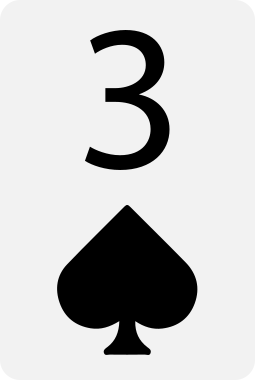
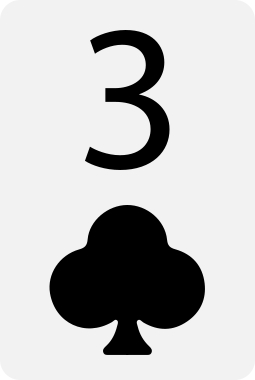
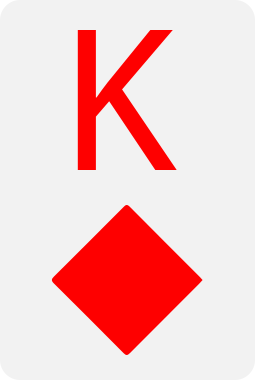
King Three Suited sits between K2s and K4s in the suited king sequence — a position that tells you almost everything you need to know about it. The hand shares the same structural profile as its neighbours: King-high nut flush potential, a low overcard rate driven entirely by the King, and a kicker so weak that top pair is nearly indefensible in any contested pot. The Three contributes marginally more than the Two but meaningfully less than anything from K5s upward.
It is a hand defined almost entirely by what its King can do, not what its Three can.
What These Odds Show for K3s
The draw odds slot neatly between K2s and K4s across every category, continuing the gradual trend visible throughout the suited king family. High card remains the best holding on the flop 53.04% of the time, dropping to 18.44% by the river — sitting between K2s at 18.66% and K4s at 18.22%, differences so small they carry no strategic meaning.
The flush odds are again identical to every other suited king at 6.57% by the river. This consistency is the through-line of the entire category — the flush draw is always King-high, always the nut draw in almost every situation, and always the hand’s most reliable path to a large pot. A flopped flush draw with K3s is exactly as powerful as a flopped flush draw with K9s.
Straight potential comes in at 2.19% by the river, sitting between K2s at 1.83% and K4s at 2.54%. The Three opens up a small number of additional straight combinations compared to K2s — wheel-adjacent boards involving Ace through Five — but these remain too infrequent and too specific to influence post-flop decisions. Straight draws with this hand should not be part of the strategic framework.
The overcard table is identical to every suited king — 22.55% on the flop, 35.30% by the river. The low overcard rate is structural, driven by the King alone, and it is the same regardless of whether the kicker is a Two or a Nine. What changes as the kicker descends is not the overcard rate but the value of top pair when the King connects — and with a Three kicker, that value is close to zero in any contested situation.
Hand Strength Summary
- Hand type: Weak suited king
- Relative strength: Marginal — one step above K2s, one step below K4s, with no meaningful practical difference between the three
- Strengths: King-high nut flush potential, low overcard rate, King blocker value in steal situations
- Main vulnerability: Three kicker is dominated by every King from K4 upward — top pair has no kicker protection in almost any realistic scenario
How King Three Suited Wins
K3s wins through the same narrow set of routes as its suited king neighbours:
- Completing a King-high flush, which is the nut flush and the hand’s primary route to a large pot at showdown
- Semi-bluffing with a flopped flush draw, either taking the pot immediately or completing the draw by the river
- Stealing blinds and uncontested pots in late position where the King provides sufficient high card credibility
- Winning small pots before showdown in spots where the board has not connected with any opponent and a single bet ends the hand
Top pair with a Three kicker is not a reliable winning hand in any contested situation and should not be treated as one.
Main Weaknesses
- The Three kicker is dominated by K4 through KA — virtually every King combination in the deck has K3s beaten on kicker when both pair the King
- Straight potential at 2.19% by the river is negligible and should not factor into post-flop decisions
- Without the flush draw the hand is K3o, a hand with almost no playability in standard game conditions
- The hand has no kicker protection and no meaningful secondary drawing equity — it is the flush draw or nothing
Best and Worst Flop Textures
Strong flops
- Two cards in your suit — converting K3s into a King-high flush draw is the ideal outcome on any flop, giving the hand full semi-bluffing capability and a clear plan through the river
- King-high boards in heads-up steal pots where no aggression is anticipated and the kicker never becomes relevant
- Very low boards where a continuation bet can take the pot uncontested and the hand does not need to improve
Dangerous flops
- King-high boards with multiple opponents or with any opponent who continues with aggression — the Three kicker means the hand is dominated by an extremely wide range
- Boards without a flush draw component where the hand is left with only a marginal pair or a high card holding and no credible equity
- Any board that generates significant betting where continuing without a flush draw in progress becomes an expensive mistake
How It Plays by Position
- Early position: A fold in all standard situations — K3s cannot be played profitably from early position in any conventional game format
- Middle position: A fold in most games; the hand requires too much from position and board texture to justify an open from middle spots
- Late position / Button: The hand’s natural and essentially only profitable position — stealing blinds, seeing cheap flops with the flush draw as the primary plan, and applying fold equity in position
- Blinds: Defensible from the big blind at the right price given the King blocker and nut flush potential, but demands strict post-flop discipline given the complete absence of kicker strength
Common Mistakes with King Three Suited
- Continuing with top pair against any meaningful resistance — with a Three kicker, folding top pair to aggression is almost always correct
- Opening from early or middle position where the hand’s weaknesses are fully exposed against tight ranges
- Conflating the quality of the flush draw with the overall quality of the hand — K3s has a strong flush draw and a very weak everything else
- Calling turn bets with only a paired King and no flush draw in progress, hoping the river improves a hand that has no real equity remaining
Comparison to Similar Hands
- Stronger than: K2s — marginally, with the Three opening a small number of additional straight combinations and providing one rank of kicker improvement that almost never matters in practice
- Weaker than: K4s and every higher suited king; the ascending kicker scale gradually opens up more post-flop scenarios where top pair is defensible
- The three hands K2s, K3s, and K4s are functionally interchangeable in most situations — the differences between them are smaller than the difference between any of them and K7s or higher
- Among all suited kings, the lower half of the kicker range (K2s through K5s) should be thought of as a group rather than individually ranked hands — the flush draw is always the same and the kicker almost never changes the outcome
How King Three Suited Performs in Multiway Pots
K3s deteriorates quickly in multiway pots for the same reasons as K2s and K4s. The nut flush draw retains its value in large pots — completing it against multiple committed opponents is highly profitable — but every other aspect of the hand becomes less viable with more players involved. Top pair with a Three kicker in a three or four-way pot is essentially a bluff-catcher at best and a dominated hand at worst. The King blocker provides some value in multiway steal situations, but K3s should be played with a strong preference for heads-up pots where the flush draw plan can be executed cleanly.
FAQ: King Three Suited
How does K3s differ from K2s in practice?
Almost not at all. The straight potential increases very slightly from 1.83% to 2.19% by the river, and the Three provides one rank of kicker improvement — but in practice, being dominated by K4 through KA versus K3 through KA is a negligible distinction. The hands play identically in the vast majority of situations.
Is there any scenario where the Three kicker matters positively?
Occasionally in very specific board runouts — a board of A-2-4-5 gives K3s a straight, for example, where K2s would not. But these situations are rare enough (2.19% by the river) that building a strategy around them is not productive.
Why do suited kings remain playable despite such weak kickers?
Because the King-high flush draw is always the nut flush draw, and the King itself provides steal equity and blocker value that lower-ranked suited hands cannot replicate. The kicker weakness is a significant post-flop constraint, but the flush draw and preflop equity partially compensate in the right conditions.
Should K3s ever be played for value preflop?
No. K3s is a speculative hand played for its drawing potential and steal equity, not for its raw hand strength. Any preflop investment should be sized with the intention of seeing a cheap flop, not building a large pot before the flush draw has arrived.
Related Hands