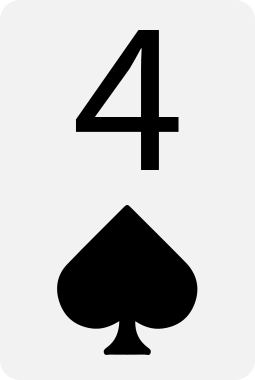
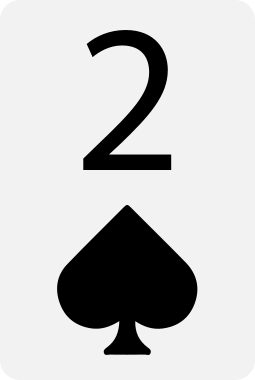
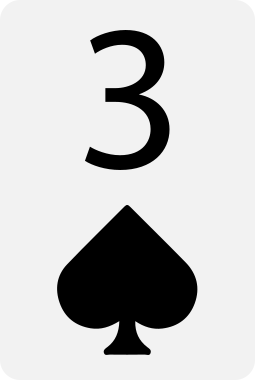
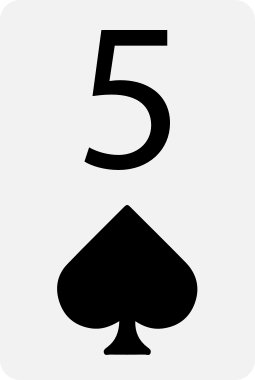
King Four Suited is the third in a descending sequence of weak suited kings, sitting just below K5s and sharing most of its characteristics. The King provides the same high card strength and low overcard rate that makes this hand category interesting, the suited nature adds the same King-high nut flush potential, and the Four contributes even less than the Five did in K5s. The gap between the two hole cards is now wide enough that straight potential has effectively disappeared from consideration entirely.
K4s is a hand with a clear ceiling and a clear game plan. The question is always whether the conditions justify executing that plan.
What These Odds Show for K4s
The draw odds are nearly identical to K5s across every category, which reflects how little the kicker rank affects the core probabilities for this hand type. High card remains the best holding on the flop 53.04% of the time, falling to 18.22% by the river — marginally higher than K5s at 18.01%, a difference so small it is practically irrelevant.
The flush odds hold steady at 6.57% by the river, confirming that the suited nature contributes the same equity regardless of the kicker. A King-high flush remains the nut flush in almost every situation, and the flush draw itself — arriving on roughly 10% of flops — continues to be the hand’s most reliable and profitable drawing mechanism.
Straight potential drops to 2.54% by the river, down from 2.89% with K5s. The Four is far enough from the King that meaningful straight combinations are extremely rare, and this figure should be treated as statistical noise rather than a genuine feature of the hand. No strategic decision should be based on straight draw potential with K4s.
The overcard table is identical to K5s — 22.55% on the flop, rising to 35.30% by the river. This remains the defining structural advantage of the suited king category. Only an Ace outranks a King, so the hand produces top pair on the vast majority of boards it connects with. The kicker, however, is now a Four, which makes that top pair holding even more precarious than it was with a Five. Any opponent holding K5 through KA who has also paired their King has K4s completely dominated at showdown.
Hand Strength Summary
- Hand type: Weak suited king
- Relative strength: Marginal — slightly weaker than K5s and K6s, primarily playable as a steal and flush draw hand
- Strengths: King-high nut flush potential, low overcard rate, King blocker value in steal situations
- Main vulnerability: Four kicker is near-worthless at showdown — top pair King with a Four kicker is dominated by an extremely wide range of hands
How King Four Suited Wins
K4s wins through a narrow set of routes:
- Completing a King-high flush, which is the nut flush and almost always the best hand when it arrives
- Semi-bluffing with a flopped flush draw, taking the pot immediately or completing by the river
- Winning uncontested pots in late position using the King’s high card strength and the suited nature as a credible bluffing range
- Occasionally winning small pots with top pair in situations where opponents have also missed and the pot is taken down before the kicker becomes relevant
The further down the kicker scale these suited king hands descend, the more their value concentrates into the flush draw and the steal equity — and K4s is close to the point where those are essentially the only two things it is doing.
Main Weaknesses
- The Four kicker is the most significant weakness. Top pair King with a Four kicker is dominated by K5 through KA — a very wide range — and even two pair with Kings and Fours loses to any King with a better kicker who makes two pair with the board
- Straight potential is negligible and should be ignored in decision-making
- Without the flush draw the hand plays identically to K4o, which is a hand with very limited playability in most game conditions
- The hand becomes increasingly difficult to continue with on any board that generates aggression from an opponent who has connected with a King
Best and Worst Flop Textures
Strong flops
- Two cards in your suit — a King-high flush draw is the ideal outcome on any flop, turning a marginal hand into an aggressive semi-bluffing vehicle
- King-high boards in heads-up uncontested pots where the kicker is irrelevant and fold equity is high
- Very low boards (e.g. 4♦ 2♣ 7♠) where the Four gives bottom pair on a board opponents are unlikely to have connected with meaningfully
Dangerous flops
- King-high boards with multiple opponents where kicker domination is a near-certainty against at least one player
- Boards where the flush draw is present but not in your suit, adding opponent pressure with no corresponding equity gain
- Any board that generates significant aggression, where continuing with a dominated top pair becomes an expensive mistake
How It Plays by Position
- Early position: A fold in virtually all situations — the kicker weakness and speculative nature cannot be overcome without the positional advantages that early position denies
- Middle position: Generally a fold; occasionally playable in loose passive games but not a reliable open
- Late position / Button: The hand’s only genuinely profitable position — blind stealing with King-high, controlled flop access, and semi-bluffing capability with flush draws in position
- Blinds: Defensible from the big blind at a sufficient discount given the King blocker and flush potential, but requires strict post-flop discipline
Common Mistakes with King Four Suited
- Treating top pair as a strong hand — with a Four kicker, top pair King is one of the most dominated holdings in the game when facing continued aggression
- Opening from early or middle position where the hand cannot realise its equity profitably
- Calling turn and river bets with a paired King when the board and betting pattern strongly suggest the opponent holds a better King
- Overestimating the hand’s playability due to the low overcard rate — the low overcard rate is a real advantage, but it does not compensate for the kicker problem in contested pots
Comparison to Similar Hands
- Stronger than: K3s, K2s — marginally, with the differences between these hands being almost entirely academic in terms of practical play
- Weaker than: K5s, K6s and all higher suited kings; the kicker decline from K6s through K4s represents a gradual narrowing of the situations where top pair is defensible
- The difference between K4s and K5s is smaller than the difference between K5s and K9s — the lower kicker cards blur together, while higher kickers open up genuinely different post-flop scenarios
- Against non-king hands of comparable rank, K4s has high card dominance but relies on the flush draw to produce the kind of equity that makes it worth playing at all
How King Four Suited Performs in Multiway Pots
K4s becomes increasingly unattractive as more players enter the pot. The nut flush draw retains its value — more players means a bigger pot when it completes — but every other aspect of the hand deteriorates in multiway situations. Top pair with a Four kicker is close to unplayable against multiple opponents, the chance of at least one player holding a better King rises sharply, and the hand has no secondary drawing equity to fall back on when the flush draw does not arrive. K4s is best played in heads-up pots where the flush draw can be leveraged cleanly and the top pair question rarely becomes relevant.
FAQ: King Four Suited
How different is K4s from K5s in practice?
Very little separates them in terms of how the hand should be played. The straight potential drops slightly and the kicker is marginally weaker, but the core game plan — flush draw equity, steal potential, fold when the flush draw misses and aggression arrives — is essentially identical.
Is the King-high flush still the nut flush with K4s?
Yes, in almost all situations. Only a player holding the Ace of the same suit would have a higher flush, and the King-high flush is strong enough to be played for maximum value in the vast majority of cases.
At what point do suited kings become unplayable?
There is no hard cutoff, but the playability of suited kings decreases as the kicker descends. K2s through K4s are the most marginal of the category and should generally only be played from late position or as big blind defends. The flush draw remains constant throughout, but the declining kicker value gradually removes the other routes to winning.
Should you ever slowplay a flush with K4s?
Generally no — the hand has limited post-flop strength outside of the completed flush, and slowplaying risks giving opponents free cards to improve to a hand that beats even a King-high flush in specific board runouts. Building the pot quickly when the flush completes is the higher expected value approach in most situations.
Related Hands