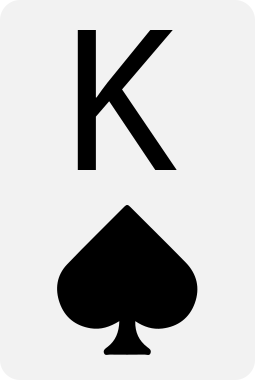
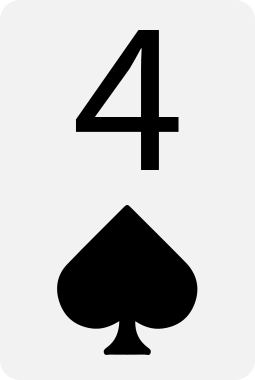
King-Four offsuit is the point at which the weak king family stops producing any meaningful variation between hands and becomes a single repeating argument. K4o, K5o, and K6o share the same overcard table to the decimal place, near-identical pair and two pair rates, and no straight or flush potential worth considering. What separates K4o from those hands is not a structural difference but a marginal further step down the kicker ladder — and by this point in the range, that step carries almost no practical significance at the table. The hand is defined entirely by the king, and the four is, for most purposes, irrelevant.
What These Odds Show for K4o
The draw odds table for K4o is the most consistent with its predecessor hands of any covered so far. High card on the flop at 53.88%, pair by the river at 46.00%, two pair at 22.79%, three of a kind at 4.45% — these figures are either identical to K5o and K6o or differ by a single decimal place. The straight rate drops slightly to 2.72% by the river, down from K5o’s 3.10% and K6o’s 3.05%, reflecting the slightly weaker connectivity of a four compared to a five or six. The straight flush rate falls to 0.01% — effectively zero — down from 0.02% in the hands above.
The overcard table remains unchanged at 22.55% on the flop, 29.14% by the turn, and 35.30% by the river. This figure is identical across all king-high hands regardless of kicker, for the same reason it has always been: the only card that can appear as an overcard to a king is an ace, and the probability of an ace appearing on the board does not change based on what the second hole card is.
The one number that quietly distinguishes K4o from the hands above it is the pair by the river figure, which edges up to 46.00% compared to K5o and K6o’s 45.86%. This is a rounding effect rather than a meaningful difference, and it should not be interpreted as the hand improving. The marginal uptick reflects statistical variation in how the draw odds are computed across slightly different card removal scenarios, not any genuine strengthening of the hand.
Hand Strength Summary
- Hand type: Weak offsuit king
- Relative strength: Near the bottom of the weak king family — effectively equivalent to K5o in most practical scenarios
- Best case: King-high board with no ace, heads-up, unopened pot, late position
- Main vulnerability: Dominated by every king with a five kicker or higher, no straight potential, no flush equity, four has no independent value
K4o has arrived at the point in the weak king sequence where the kicker has become a placeholder rather than a card. The four contributes nothing to straights at any realistic stack depth, nothing to flushes, and nothing to pair value that any other low card would not contribute equally.
How King-Four Offsuit Wins
The routes to winning with K4o are identical in structure to K5o and K6o, and they are narrow:
- Pairing the king on a board with no ace, heads-up against an opponent who cannot continue with their holding
- Making two pair specifically on a king-four board — a configuration that requires both cards to connect simultaneously
- Winning uncontested pots preflop through a late-position steal where the king provides high-card credibility
- King-high holding up in a checked-down or low-pressure pot where no opponent pairs
The four’s contribution to any of these routes is effectively zero except in the two pair scenario, and even there, a K-4-x board is not a common occurrence. K4o wins when the king does the work, and it loses when the king needs support that the four cannot provide.
Main Weaknesses
K4o’s weaknesses are the accumulated problems of the entire weak king family, now without even the marginal kicker mitigation that K6o or K5o offered:
- Dominated by any opponent holding K5 through KA — a range so wide that it covers virtually everything a reasonable player would voluntarily enter a pot with that contains a king
- The four as an independent card has no board presence. A pair of fours on any standard board texture is not a hand that wins pots in contested situations
- Straight rate of 2.72% by the river is the lowest of any hand covered in this series so far, reflecting the four’s poor connectivity across the straight-forming range
- No flush equity whatsoever
- The kicker gap between K4o and the hands that dominate it is now large enough that even in low-pressure situations, any postflop confrontation involving a king tends to end badly
- High card only on 53.88% of flops, with no draw available to compensate in the overwhelming majority of cases
Best and Worst Flop Textures
Strong flops:
- King-high boards with no ace and low, dry side cards — K-3-2 or K-2-2 rainbow textures where the hand has the best possible high card and opponents are unlikely to have connected
- King-four boards giving immediate two pair, though the specific requirement for both hole cards to connect limits how often this occurs
- Low, uncontested boards in position where a single continuation bet can take the pot regardless of connection
Dangerous flops:
- Any ace-high board — occurring on 22.55% of flops and immediately reducing the king to second-best high card, with the four contributing nothing
- King-high boards with a strong side card — K-Q-J type textures where top pair fifth kicker is essentially unplayable for multiple streets
- Boards where opponents are likely to hold better kings, which in raised pots covers most of the range that would contest the hand
- Any coordinated board where drawing equity would be required to continue and K4o has none to offer
How It Plays by Position
Early position:
A fold in every standard situation. K4o from early position is a clear leak regardless of table conditions or stack sizes.
Middle position:
Still a fold at a full ring table. The hand’s limited equity cannot justify the multi-way exposure that middle position entails at a full table.
Late position:
The only circumstance where K4o earns any consideration. From the button or cutoff in an unopened pot, the king provides blocker value against AK, KK, KQ, and KJ, and the credibility of a late-position raise does not require the second card to be strong. A single steal raise is the hand’s primary use case.
Blinds:
In the big blind with pot odds against a single late-position raise, K4o sits at the very edge of defensible. The pot odds may justify one call, but postflop the hand is almost always check-fold unless it connects with two pair or better. From the small blind, folding is correct in most situations.
The position argument for K4o is the same as for K5o and K6o, repeated one more time. The king does the positional work. The four is irrelevant to that work. This is equally true for K3o and K2o, which is why the weak king family collapses into a single strategic framework below K7o or so.
Common Mistakes with King-Four Offsuit
The mistakes with K4o are familiar, but one error becomes more pronounced at the weaker end of the kicker range:
- Playing the hand for multiple streets after flopping top pair, not recognising that the four kicker loses to essentially every king in a reasonable opponent’s range
- Limping from middle position because the king feels like a real hand, then finding it impossible to continue postflop without a specific and unlikely two pair
- Overcalling in multiway pots because the pot odds appear to justify it, while the hand’s postflop playability does not warrant the investment
- Treating the low overcard rate as a broader indicator of hand strength rather than a narrow statement about ace exposure specifically
- Continuing past the flop on boards where the hand has connected with a pair of fours, which has no realistic claim to best hand in a contested pot
Comparison to Similar Hands
- Stronger than: K3o and K2o, where the kicker is slightly weaker — though the practical difference between K4o, K3o, and K2o is minimal in most situations
- Weaker than: K5o, where the kicker has marginally more competitive value in kicker confrontations; K4 suited, which adds flush equity that transforms the hand’s playability entirely; K7o and above, where the kicker begins to hold its own in a wider range of scenarios
- Similar to: Q3o — a strong top card paired with a near-valueless kicker, with positional steal value as the primary use case and no drawing equity of any kind
By this point in the weak king sequence, the comparison to other hands in the same family is more instructive than comparisons across hand types. K4o, K5o, and K6o are functionally interchangeable for most strategic purposes. The player who treats all three identically — fold early, fold middle, steal late, check-fold most flops — is making fewer errors than the player who attempts to find nuanced differences between them that the draw odds do not support.
How King-Four Offsuit Performs in Multiway Pots
K4o’s performance in multiway pots follows the same pattern established by K5o and K6o, with the kicker problem slightly more acute:
- The probability of at least one opponent holding a better king increases with each additional player in the pot, and by K4o the range of hands that dominate the kicker covers almost everything a player would voluntarily enter with
- A pair of fours multiway has no showdown value under any standard board conditions
- The 2.72% straight rate means drawing equity is essentially absent as a compensating factor
- The low overcard rate provides the same false comfort it does for K5o — a board without an ace still leaves the kicker exposed against any opponent who holds a king
There is no multiway scenario where K4o should be building a pot. Its value, such as it is, is confined entirely to the specific conditions of a late-position, heads-up, steal-or-fold dynamic.
FAQ: King-Four Offsuit
At what point does the kicker on a weak king stop mattering?
Practically speaking, below K7o or K8o the kicker ceases to meaningfully differentiate hands at the table. K4o, K5o, and K6o all lose to the same overwhelming majority of king-containing hands that opponents would play, and the draw odds confirm this by producing nearly identical statistics. The strategic approach is the same across all three.
Is there any board where the four becomes useful?
Specifically on a K-4-x board, the four creates two pair. Outside of that narrow scenario and the rare three-of-a-kind on a 4-4-x board, the four has no meaningful contribution to the hand’s outcome.
How does K4o compare to the low connectors like 54o and 75o?
K4o has a significantly lower overcard rate — 22.55% on the flop versus 92.14% for 75o and 98.14% for 54o. However, the low connectors have substantially higher straight potential that gives them a genuine path to winning big pots. K4o has no equivalent compensating mechanism, making it arguably less playable than a low connector in deep-stacked situations with implied odds.
Why does the straight rate drop slightly from K5o to K4o?
Because a four has fewer straight-forming combinations available in the full range of possible boards than a five does. A five can contribute to the wheel (A-2-3-4-5) and to several mid-range straights. A four’s combinations overlap less with common board textures, producing the marginal reduction from 3.10% to 2.72% by the river.
Related Hands