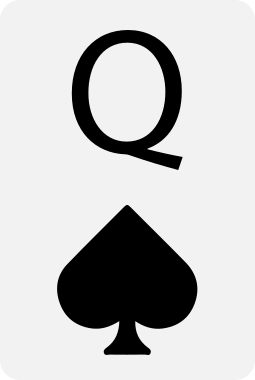
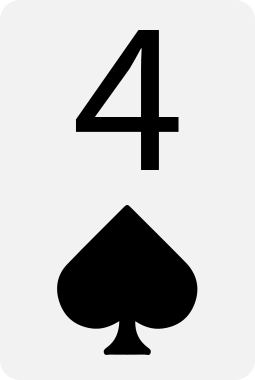
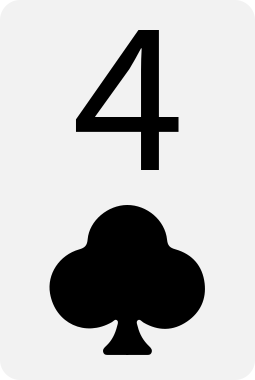
Queen–Four offsuit is a hand that has been described, in all but name, by every weak queen entry that preceded it. The draw odds table for Q4o is nearly indistinguishable from Q5o, Q6o, and Q7o across every category, and the overcard table is identical to all three. By this point in the weak queen sequence, the exercise of analysing each hand individually is less about discovering new strategic territory and more about confirming that the territory does not change. Q4o is Q5o with a four instead of a five, and the strategic conclusions are the same to a degree that the numbers themselves make explicit.
What These Odds Show for Q4o
The draw odds table for Q4o reproduces the weak queen pattern without variation in most columns. High card on the flop at 53.88%, two pair at 22.79%, three of a kind at 4.45%, full house at 2.22% — all identical to Q5o, Q6o, and Q7o. The pair by the river is 45.86%, matching Q7o exactly and sitting marginally above Q6o’s 45.71% and Q5o’s 45.71% — a rounding effect rather than a meaningful trend.
The straight rate is 0.00% on the flop, 0.77% by the turn, and 3.10% by the river. This figure matches K5o exactly — a numerical coincidence that reflects the similar gap structure between a queen and a four versus a king and a five, and the equivalent board textures required to form their respective straight combinations. Q4o can form straights running six–to–ten, seven–to–jack, eight–to–queen, and through specific configurations involving the four — though the four’s straight–forming range is limited compared to a five or six. The 3.10% figure is marginally lower than Q5o’s 3.47% and Q6o’s 3.43%, continuing the general decline in straight potential as the kicker drops below five.
The overcard table remains fixed at 41.43% on the flop, 51.40% by the turn, and 59.85% by the river — unchanged from every other queen–high hand in this series and unchanged from what it will be for Q3o and Q2o. The queen is the top card, kings and aces are the only overcards, and their probability of appearing on the board does not respond to changes in the kicker.
Hand Strength Summary
- Hand type: Weak offsuit queen — approaching the bottom of the family
- Relative strength: Below average — equivalent to Q5o, Q6o, and Q7o for all practical strategic purposes
- Best case: Queen–high board with no king or ace, heads–up, late position, fold–or–steal dynamic
- Main vulnerability: Dominated by Q5o through QA, negligible straight potential, no flush equity, four has no independent board value
Q4o has reached the same point in the weak queen family that K3o represented in the weak king family — the kicker has declined far enough that describing its individual contribution to the hand requires acknowledging it has essentially none. The four is not a drawing card, not a competitive kicker, and not a card with any board presence in standard contested pots. It is the second hole card, occupying that slot while the queen does whatever work is available.
How Queen–Four Offsuit Wins
Q4o wins through routes identical to every other weak queen in this series:
- Pairing the queen on a board with no king or ace, heads–up, against an opponent who has missed entirely
- Making two pair on a queen–four board — a specific and infrequent configuration requiring both cards to connect simultaneously on a board that does not introduce threatening draws for opponents
- Winning uncontested pots preflop through a late–position steal where the queen’s rank carries the credibility of the raise
- Queen–high holding up in a fully passive, checked–down pot
The four’s contribution appears only in the two pair scenario and, theoretically, in the very limited set of straight draws that reach 3.10% by the river. In all other cases, Q4o wins or loses based entirely on the queen.
Main Weaknesses
The weakness profile for Q4o is the complete weak queen catalogue applied to its lowest viable kicker:
- Dominated by Q5o through QA — every queen–containing hand any reasonable opponent would voluntarily enter a pot with has Q4o outkicked
- The four as an independent card has minimal straight–forming value at normal board textures, contributing to the modest 3.10% straight rate that carries no strategic planning significance
- No flush equity in the offsuit version
- A pair of fours has essentially no showdown value on any board with overcard presence, which occurs on 59.85% of boards by the river
- High card only on 53.88% of flops with no compensating draw path available
- The complete absence of kicker competition means Q4o is not just behind good queens — it is behind every queen, with only Q3o and Q2o providing the theoretical exception of a hand it outkicks
Best and Worst Flop Textures
Strong Flops
- Queen–high boards with no king or ace and completely low, disconnected side cards — the hand’s closest approximation to a favourable texture, occurring less than half the time even when no overcard appears
- Queen–four boards giving immediate two pair on a dry, rainbow texture where opponents are drawing thin
- Low boards in late position where a single continuation bet ends the hand without requiring legitimate connection
Dangerous Flops
- Any board with a king or ace — occurring on 41.43% of flops and immediately rendering the queen second–best high card
- Queen–high boards with a strong side card, where top pair with a four kicker is indefensible against any resistance
- Any board texture in a multiway pot, where the kicker problem and absent draw equity compound across multiple opponents
- Any board where an opponent has shown genuine interest and the hand has not connected with two pair or better
How It Plays by Position
- Early position: Never. Q4o is a clear fold from early position without exception or qualification.
- Middle position: A fold at any standard table format. The hand has no compensating equity to justify exposure to multiple players yet to act.
- Late position: The only position where Q4o earns any consideration, and on the same terms that have applied across the entire weak queen series. From the button or cutoff in an unopened pot, the queen’s credibility as a steal card is independent of the four sitting alongside it. The fold equity of a late–position raise does not require the second card to be strong. A single raise, check–fold most flops, release without a strong connection — this is the complete strategic framework.
- Blinds: In the big blind with pot odds against a single steal raise, Q4o sits at the outer limit of a defensible call. One street of investment, draw–dependent postflop, check–fold without strong connection. From the small blind, folding is correct in most situations. These answers are identical to Q5o, Q6o, and Q7o.
Common Mistakes with Queen–Four Offsuit
The errors with Q4o mirror those of the weak queen family throughout, now applied to a kicker where certain traps become even more acute:
- Continuing after flopping top pair in any contested pot, where the four kicker loses to Q5 through QA — a range that covers the complete set of queens any reasonable opponent would play
- Treating Q4o as meaningfully different from Q5o or Q6o in strategic terms, when the draw odds confirm the hands are functionally equivalent across every practical scenario
- Playing the hand from early or middle position because the queen dominates the visual impression of the hand, without recognising that the four cannot support any multi–street play
- Calling 3–bets or facing significant preflop aggression without folding, where Q4o has no equity justification for continuing investment
- Slow playing two pair when it arrives — Q4o’s two pair on a queen–four board is the hand’s best realistic outcome and should be played for value immediately rather than allowing potentially dangerous board developments
Comparison to Similar Hands
- Stronger than: Q3o and Q2o, where the kicker falls to the absolute minimum — though the practical difference between Q4o, Q3o, and Q2o is negligible in all standard situations
- Weaker than: Q5o, where the kicker has marginally more straight–forming value and fractionally more competitive range in kicker confrontations; Q4 suited, which transforms the hand entirely with flush equity; Q8o and above, where the kicker begins to hold its own against a realistic range of queen–containing opponent hands
- Similar to: Q5o, Q6o, and Q7o — all three hands share an identical overcard table, near–identical pair rates, and a straight rate within a fraction of a percentage point of Q4o’s 3.10%
The comparison between Q4o and K4o is the most structurally direct pairing across the two weak–top–card families. Both hands share a four kicker, producing similar pair and two pair rates, and the same negligible straight potential at 3.10% by the river — a figure they share exactly. The difference is the overcard table: K4o sees an overcard on 22.55% of flops, Q4o on 41.43%. The king’s higher rank provides nearly double the board protection of the queen, translating directly into more boards where top pair is a viable holding. Q4o is a weaker hand than K4o not because of the four — they share the same kicker and the same limitations it creates — but because the queen is outranked more frequently, leaving the hand with fewer boards where its one pair value can be legitimately leveraged.
How Queen–Four Offsuit Performs in Multiway Pots
Q4o in multiway pots produces the same conclusions as Q5o, Q6o, and Q7o — with the kicker problem now covering the complete range of queens any opponent would voluntarily play:
- The probability of at least one opponent holding a better queen in a multiway pot is near–certain, leaving top pair with a four kicker in an untenable position
- A pair of fours multiway has no showdown value under any standard board conditions
- The 3.10% straight rate means drawing equity is absent as a compensating factor for being behind on pair value
- The 59.85% overcard rate by the river in a heads–up context becomes even more concerning multiway, where multiple opponents are more likely to hold the kings and aces that further diminish the queen’s value
There is no standard multiway scenario where Q4o builds a profitable pot through hand strength. Its sole value remains confined to the heads–up, positional, steal–or–fold dynamic where the queen does the work and the four is irrelevant.
FAQ: Queen–Four Offsuit
Is there any meaningful difference between Q4o and Q5o at the table?
Almost none. The straight rate drops from 3.47% to 3.10%, and the pair–by–river figure edges from 45.71% to 45.86% — rounding effects rather than structural differences. The overcard table is identical. The strategic approach is identical across every position and scenario. A player who treats Q4o and Q5o as the same hand is making no strategic error.
Does the four have any blocker value preflop?
Negligible. Holding a four removes one of the four fours from the deck, marginally reducing the probability that opponents hold A4s or 45s type combinations. This effect is so small as to have no influence on any preflop or postflop decision in standard play.
Why does Q4o share an identical straight rate with K5o?
Both hands have a similar gap structure — queen to four is a gap of seven, king to five is a gap of seven — and require board cards in a similar range to form their straight combinations. The identical 3.10% figure reflects equivalent straight–forming conditions rather than any deeper connection between the two hands. It is a numerical coincidence that illustrates how gap size, rather than card rank, drives straight potential for gapped offsuit hands.
At what point should the weak queen family be treated as a single strategic category?
From Q7o downward, the hands are strategically identical for all practical purposes. The overcard table does not change, the pair rates vary by fractions, and the straight rates differ by amounts too small to influence decisions. Fold early, fold middle, steal late, check–fold most flops — this framework applies without modification from Q7o through Q2o.
Related Hands