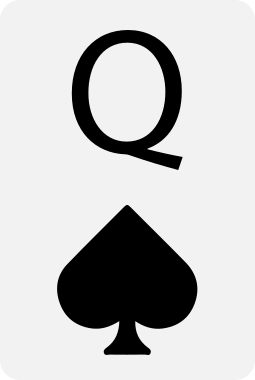
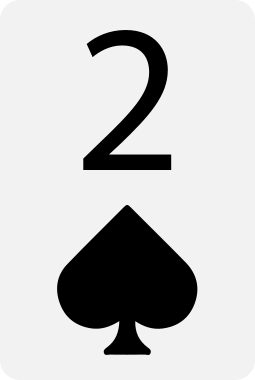
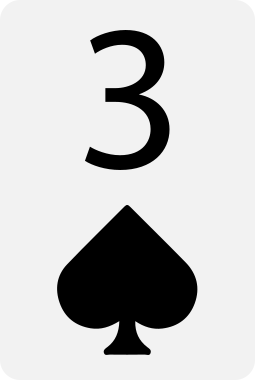
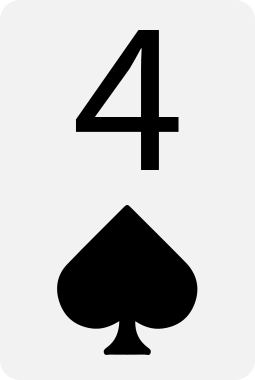
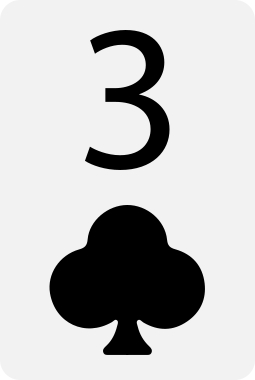
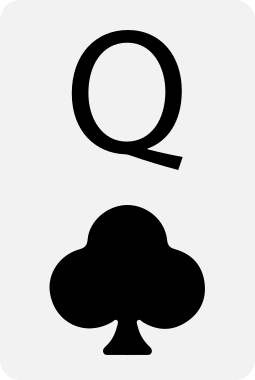
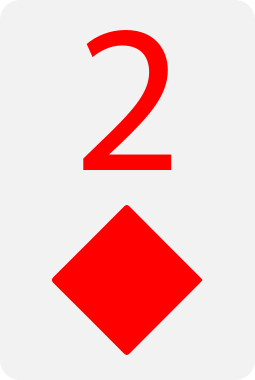
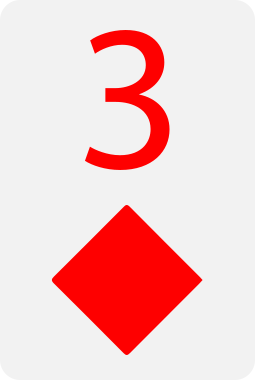
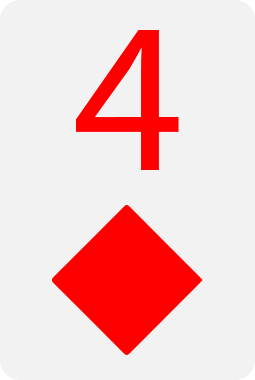
Queen Three offsuit is the penultimate entry in the weak queen family, and the draw odds table confirms what every preceding hand in this sequence has been building toward — that by this point the kicker has become so removed from the queen in both rank and function that the hand is defined by a single card operating alone. Q3o differs from Q4o in the same ways Q4o differs from Q5o: fractionally, statistically, and without strategic consequence. The three is not a four, but at the table it performs identically in every scenario that matters.
What These Odds Show for Q3o
The draw odds table for Q3o reproduces the weak queen pattern with the precision that has characterised this entire family. High card on the flop at 53.88%, two pair at 22.79%, three of a kind at 4.45%, full house at 2.22% — all unchanged from Q4o through Q7o. The pair by the river edges to 46.00%, matching K4o exactly and sitting marginally above Q4o’s 45.86% — a rounding artefact consistent with the gentle upward drift seen as the kicker decreases across both the weak king and weak queen families.
The straight rate continues its decline: 0.00% on the flop, 0.66% by the turn, and 2.72% by the river. This matches K4o’s straight rate exactly — the same numerical coincidence seen between Q4o and K5o earlier in this series, reflecting equivalent gap structures producing equivalent straight completion rates. Q3o’s three contributes to fewer straight combinations than a four or five, as the three’s straight–forming range is limited to the ace–to–five wheel, two–to–six, and three–to–seven configurations. Above that window, the three cannot contribute to straights alongside a queen. The straight flush rate drops to 0.01%, matching K4o and K3o, as the combinations required become increasingly rare.
The overcard table remains unchanged at 41.43% on the flop, 51.40% by the turn, and 59.85% by the river — identical to Q4o, Q5o, Q6o, and Q7o, and identical to what it will be for Q2o. This figure has not shifted by a single decimal place across the entire weak queen series, and it will not.
Hand Strength Summary
- Hand type: Weak offsuit queen — second from the bottom of the family
- Relative strength: Below average — strategically equivalent to Q4o, Q5o, Q6o, and Q7o
- Best case: Queen–high board with no king or ace, heads–up, late position, unopened pot
- Main vulnerability: Dominated by Q4o through QA, lowest straight rate of any queen–high hand covered so far, no flush equity, three has no independent board value
Q3o has one card that matters. The queen determines overcard exposure, pair value, steal credibility, and every meaningful postflop scenario. The three determines only which specific two pair combination is possible on the rare board that connects both hole cards simultaneously.
How Queen Three Offsuit Wins
Q3o wins through the same routes that apply across the entire weak queen family, now with the three as the second card rather than the four, five, six, or seven:
- Pairing the queen on a board with no king or ace, heads–up, against an opponent who has completely missed
- Making two pair on a queen three board on a dry, uncontested texture — the narrowest specific two pair configuration of any weak queen hand covered so far
- Winning uncontested pots preflop through a late–position steal
- Queen–high holding up in a fully passive, checked–down pot
The three contributes exclusively in the two pair scenario. In every other winning route, the outcome is determined entirely by whether the queen provides sufficient value, and the three is a bystander.
Main Weaknesses
Q3o’s weaknesses are the complete weak queen catalogue at their most concentrated, with the straight rate now at its lowest point in the family:
- Dominated by Q4o through QA — every queen–containing hand any reasonable opponent would voluntarily play has Q3o outkicked without exception
- The straight rate of 2.72% by the river is the lowest of any queen–high hand covered in this series, matching K4o but sitting below Q4o’s 3.10%, Q5o’s 3.47%, Q6o’s 3.43%, and Q7o’s 3.05% — the three’s limited straight–forming range produces the reduction
- No flush equity
- A pair of threes is one step above the lowest possible pair and has no showdown value in any contested pot
- High card only on 53.88% of flops with no compensating draw path available in the overwhelming majority of cases
- The straight flush rate dropping to 0.01% is a minor numerical signal of how far the hand has moved from any meaningful drawing potential
Best and Worst Flop Textures
Strong Flops
- Queen–high boards with no king or ace and completely low, disconnected side cards — the same narrow favourable texture that applies to every weak queen hand
- Queen three boards giving immediate two pair on a dry, rainbow texture — now requiring an even more specific board configuration than Q4o, since threes appear on boards somewhat less frequently in the contested postflop ranges where they matter
- Low boards in position where a continuation bet ends the hand without requiring legitimate connection
Dangerous Flops
- Any board with a king or ace — occurring on 41.43% of flops and immediately negating the queen’s top–card status
- Queen–high boards with any meaningful side card, where top pair third kicker from the bottom is unplayable for multiple streets
- Any board in a multiway pot
- Boards where opponents have shown genuine interest and the hand has not connected with two pair or better
How It Plays by Position
- Early position: Never. The answer has not changed across this series and will not change for Q2o.
- Middle position: A fold at any standard table. Q3o has no equity to justify middle–position entry.
- Late position: The queen’s steal value applies here on the same terms as Q4o through Q7o. From the button or cutoff in an unopened pot, a single raise uses the queen’s credibility regardless of the three accompanying it. The three is invisible to the fold equity calculation — opponents respond to the queen, not to what sits beside it.
- Blinds: In the big blind with pot odds against a single steal raise, Q3o is at the outer limit of a defensible call — one street of investment, check–fold without strong connection, continue only with two pair or better. From the small blind, a fold is correct against most raises. These answers are identical to every preceding weak queen entry.
Common Mistakes with Queen Three Offsuit
The pattern of mistakes with Q3o is the weak queen family’s error set in its final iterations before the absolute floor:
- Continuing after flopping top pair in any contested pot — the three kicker now loses to Q4 through QA without exception, a range that covers the complete set of queens any opponent plays voluntarily
- Treating the marginal straight rate of 2.72% as a draw worth pursuing, when the probability reflects an absence of meaningful straight potential rather than an occasional drawing opportunity
- Playing from positions other than late position because the queen appears to dominate the hand’s identity, without recognising that the three turns every postflop confrontation into a kicker problem when the queen pairs
- Investing in multiway pots based on pot odds alone, without accounting for the near–certainty of kicker domination in any scenario involving the queen pairing
- Slow playing two pair when it arrives on a queen three board — the hand’s best outcome and the one most requiring immediate value extraction before dangerous board developments materialise
Comparison to Similar Hands
- Stronger than: Q2o, the weakest queen — though the practical difference between Q3o and Q2o is negligible in all standard situations, as it has been across the bottom half of this family
- Weaker than: Q4o, where the kicker has fractionally more straight–forming value; Q3 suited, which adds flush equity that fundamentally changes the hand’s strategic character; Q8o and above, where the kicker holds genuine competitive value against a realistic range of opponent queens
- Similar to: Q4o and K4o — Q4o shares the same overall profile one kicker step higher; K4o shares the identical straight rate of 2.72% by the river, the same numerical relationship seen between Q4o and K5o earlier in this series
The comparison between Q3o and K3o completes a pattern that has run through both the weak king and weak queen families. Both hands share a three kicker, both have a 2.72% straight rate by the river — matching the figure from K4o as well — and both are defined by their top card rather than the three. The overcard table separates them: K3o sees an overcard on 22.55% of flops, Q3o on 41.43%. The king’s higher rank means top pair with a three kicker is a viable holding on more boards than top pair with a three kicker and a queen. The kicker is the same. The top card determines which hand is stronger, and by the same margin it has separated every comparable king–queen pairing in this series.
How Queen Three Offsuit Performs in Multiway Pots
Q3o in multiway pots has no standard profitable scenario that depends on the hand’s intrinsic value. The argument is identical to every preceding weak queen entry and does not change with the kicker:
- At least one opponent holding a better queen is near–certain in any multiway pot
- A pair of threes multiway has no showdown value under any board conditions
- The 2.72% straight rate means drawing equity is functionally absent
- The 59.85% overcard rate by the river becomes more consequential multiway, where multiple opponents are more likely to hold the relevant overcards
Q3o’s value, such as it is, remains confined entirely to heads–up, positional, late–position dynamics. It does not survive multiple callers, multiway action, or any scenario requiring the hand to generate value through made–hand strength.
FAQ: Queen Three Offsuit
Is there any practical difference between Q3o and Q4o?
Almost none. The straight rate drops from 3.10% to 2.72%, the straight flush rate from 0.02% to 0.01%, and the pair–by–river figure edges from 45.86% to 46.00% — a rounding effect. The overcard table is identical. The strategic approach across every position and scenario is the same. A player who treats Q3o and Q4o identically is making no error.
Why does Q3o share its straight rate with K4o?
Because both hands have a gap of eight between their two cards — queen to three is eight steps, king to four is eight steps — and require board cards in an equivalent window to form their straight combinations. The identical 2.72% figure reflects equivalent straight–forming conditions driven by gap size rather than the specific cards involved.
Does the three kicker have any preflop blocker value?
Negligible. Holding a three removes one of the four threes from the deck, marginally reducing the probability that opponents hold A3s or 34s type combinations. This effect has no practical influence on any decision in standard play.
Is Q3o better in tournaments or cash games?
The same dynamic that applies across the weak queen family applies here — tournaments with escalating blinds and shorter effective stacks give the hand marginally more value as a steal hand from late position, because fold equity increases relative to postflop playability. In deep–stacked cash games, the hand’s postflop limitations are more exposed. Neither format makes Q3o a hand worth seeking out.
Related Hands