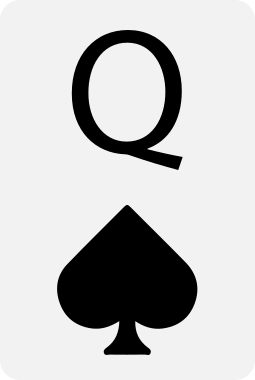
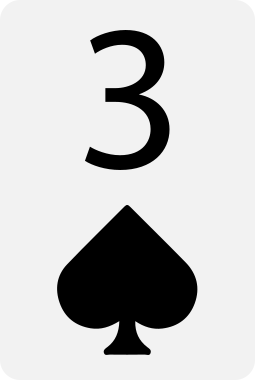
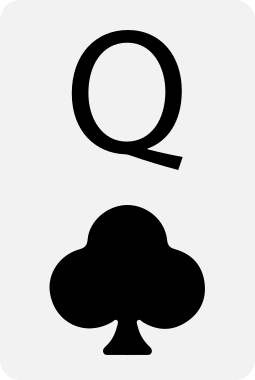
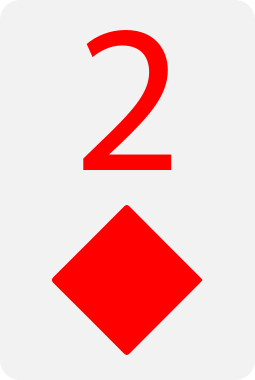
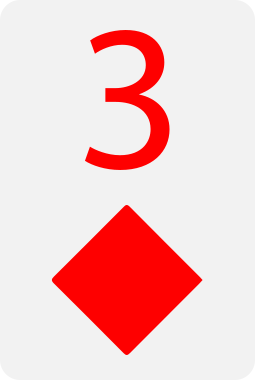
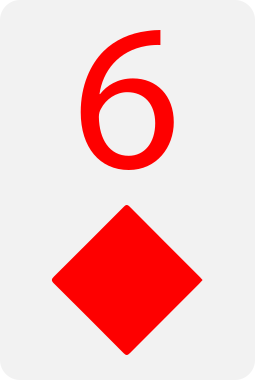
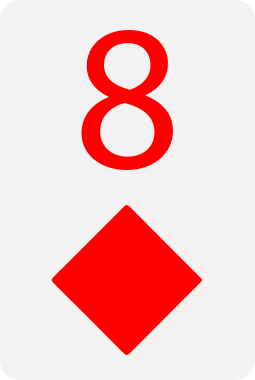
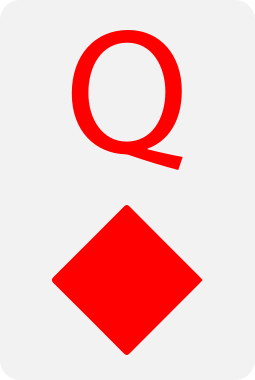
Queen Three Suited is where the Queen-x suited family crosses a meaningful threshold. The gap between Queen and Three is nine cards, and that distance finally renders straight potential so close to zero that it can be dismissed entirely as a factor in how the hand is played. What remains is a Queen with a flush draw – and while that combination has some value, Q3s is a hand that most players in most games should simply not be playing. Its place in the 169-hand rankings is near the bottom of the suited hands category, and the numbers justify that position clearly.
There is a version of Q3s that is playable – late position, cheap entry, deep stacks, the right table dynamics. But it is a narrow version, and the margin for error is slim.
What These Odds Show for Q3s
The straight odds complete the trend established across the Queen-x suited family. At 0.00% on the flop, 0.63% by the turn, and 2.54% by the river, Q3s has the lowest straight equity of any Queen-x suited hand covered so far, and that 2.54% figure represents such a constrained set of board runouts that it is effectively theoretical rather than practical. The straight flush odds of 0.01% by the river are the lowest yet in this family – a single hundredth of a percent, confirming that straight-related draws have no meaningful role in how Q3s should be played.
Flush equity lands at 6.57% by the river, consistent with the rest of the Queen-x suited family as expected. This remains the hand’s only reliable draw.
The overcard table is identical to Q6s, Q5s, and Q4s – 41.43% on the flop, 51.40% by the turn, 59.85% by the river. The pattern established with those hands continues here: the overcard calculation is determined entirely by the Queen, and the Three does nothing to change it. Every Queen-x suited hand from Q6s downward shares this overcard profile. The Queen is the hand, and the Three is along for the ride.
The high card figure of 53.04% on the flop – consistent across the entire Queen-x suited group at this gap level – confirms that Q3s leaves you with only high cards as your best hand on more than half of all flops.
Hand Strength Summary
- Hand type: Suited big-gap hand; approaching the unplayable end of the spectrum
- Relative strength: Weak; one of the least justified speculative hands in most player pools
- Main draws: Flush draws only; Queen top pair on Ace and King-free boards
- Main vulnerability: The Three is a dead card in virtually every situation; straight potential is functionally zero; kicker vulnerability when the Queen pairs is as severe as it gets
How Q3s Wins
Q3s wins through a limited set of scenarios, each dependent on very specific conditions:
- Pairing the Queen on boards without an Ace or King
- Completing a flush draw
- Making trips when a Three appears on the board, which requires specific circumstances and careful concealment
- Winning uncontested pots through late-position steals on boards that favour a Queen-high range
- Two pair in the rare runout where both the Queen and Three connect, which is uncommon enough to be a bonus rather than a plan
The Three’s contribution is minimal to the point of being negligible. In the overwhelming majority of hands where Q3s wins at showdown, the Three is irrelevant to the outcome. This simplifies the hand considerably – if the Queen has not connected and no flush draw is present, the decision to fold is almost always correct.
Main Weaknesses
- The Three is the weakest second card of any Queen-x hand with a theoretical straight combination, and even that combination is so constrained it is not worth considering
- River straight odds of 2.54% are functionally zero for planning purposes
- Kicker vulnerability when the Queen pairs is at its maximum for a Queen-x hand – the Three is the worst possible kicker, dominated by every other Queen-x combination in existence
- Flush draws are the hand’s sole equity source beyond pair potential, and that equity is vulnerable in multiway pots
- The hand has essentially no turn or river equity when neither the Queen nor the flush draw is in play – there is no third gear
Best and Worst Flop Textures
Strong flops
- Queen-high boards with very low disconnected cards (Q♠ 2♦ 4♣) – top pair, and the low board minimises the probability opponents have strong kickers
- Flush draw boards in your suit where the Queen also pairs, giving a made hand and a draw simultaneously
- Boards containing a Three where trips are available and opponents are unlikely to put you on it
Dangerous flops
- Ace or King-high boards – the Queen loses top-pair status and the Three is irrelevant
- Any coordinated board where opponents have draws and Q3s has no pair and no flush draw
- High two-tone boards in a suit you do not hold
How It Plays by Position
- Early position: Should not be opened under any standard conditions; the hand is too weak structurally and too difficult to play profitably from out of position
- Middle position: Fold in virtually all circumstances; there is no standard game condition that makes Q3s a reasonable middle-position open
- Late position / button: The only position with any legitimate case for playing it – steal equity from the Queen, position to manage post-flop decisions cheaply, and the ability to fold immediately when the flop provides nothing
- Blinds: A very marginal big blind defend against a single late-position raiser; the Queen gives it slightly more playability than Q2s, but against any significant aggression the hand’s one-dimensionality becomes a serious liability
Common Mistakes
- Opening Q3s from any position other than the button or cutoff based on the Queen’s rank alone
- Continuing past the flop without either the Queen pairing or a flush draw being present – there is genuinely no other reason to put more money in
- Overplaying Queen top pair against any serious resistance; the Three kicker is dominated by essentially every Queen-x combination an opponent might reasonably hold
- Calling continuation bets on Queen-high boards without considering that opponents with better Queens are value-betting into the hand’s weakest point
- Treating Q3s as a bluff-catching hand in spots where the flush draw has not materialised
Comparison to Similar Hands
- Stronger than: Q3 offsuit (the flush draw is the entire argument for Q3s existing as a playable hand at all; without it, Q3s has almost nothing), Q2s (the lowest Queen-x suited hand, with even less straight potential and the weakest possible kicker)
- Weaker than: Q4s (river straight odds improve from 2.54% to 2.89%, and the Four is a marginally better kicker in the rare situations where kicker value is relevant), Q5s, Q6s, and every Queen-x suited hand with a higher second card
The honest summary of the Queen-x suited family below Q7s is that each step down the rank ladder removes a little more of the second card’s contribution without changing the overcard profile, the flush equity, or the Queen’s pair potential. By Q3s, the second card’s contribution has reached its floor. The Three does less for Q3s than the Four does for Q4s, which already did almost nothing.
How Q3s Performs in Multiway Pots
Q3s is one of the weakest multiway pot hands in the suited hand category. Straight equity is effectively zero, eliminating implied odds as a justification for playing in large fields. Flush draw equity is real but becomes increasingly dangerous as more opponents may hold higher flush draws. Queen top pair deteriorates rapidly in multiway pots where the probability of being outkicked or outdrawn increases with every additional player.
This hand needs the pot to be small, the entry to be cheap, and the post-flop situation to be simple. Multiway pots provide none of those conditions reliably. The ideal scenario for Q3s is a heads-up steal situation where the pot is taken down preflop, or a clean Queen-high board heads-up where one continuation bet ends the hand.
FAQ: Queen-Three Suited
Is Q3s better than Q2s in any meaningful way?
Marginally. The Three provides a slightly higher kicker when the Queen pairs – Q3s is still dominated by the vast majority of Queen-x holdings, but it beats Q2s in that spot. The straight odds are also slightly higher, at 2.54% versus whatever Q2s produces, though both figures are negligible. In most decisions at the table the two hands play identically, with Q3s having a theoretical edge that rarely manifests in practice.
Why does the overcard table stay the same all the way from Q6s down to Q3s?
Because the overcard table measures how often a card higher than the Queen appears on the board, and the Queen is the highest card in all of these hands. The second card – whether Six, Five, Four, or Three – is always lower than the Queen, so it has no effect on the overcard calculation. The table is a function of the Queen alone.
At what point is Q3s the right fold?
Almost always. The specific conditions where Q3s is worth playing are late position, cheap entry, deep stacks, and a table where the pot is likely to be won preflop or on a single continuation bet on a Queen-high board. Outside those conditions, the hand’s structural weaknesses – dead second card, straight equity approaching zero, severe kicker vulnerability – make folding the correct default.
Does the flush draw ever make Q3s a semi-bluff candidate?
Yes, on the right board. If you have picked up a flush draw on the flop alongside a Queen-high board, Q3s has both a made hand and a draw, which is a legitimate semi-bluffing situation. The challenge is that the Queen top pair is vulnerable to better kickers and the flush draw is vulnerable to higher flushes, so the semi-bluff needs to be calibrated carefully against the specific opponent and board texture rather than applied indiscriminately.
Related Hands