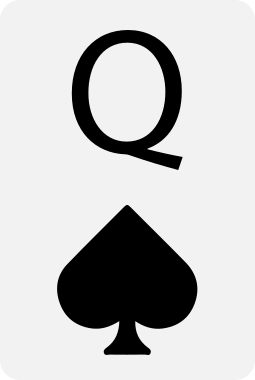
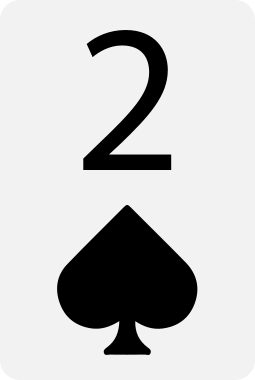
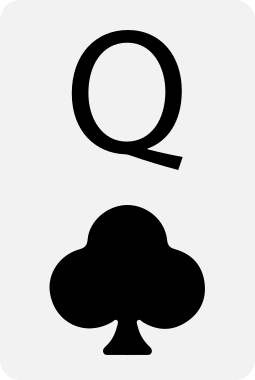
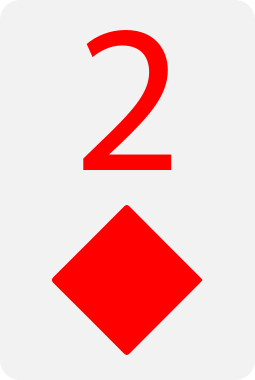
Queen Two Offsuit is among the weakest playable-looking hands in Texas Hold’em. The queen carries genuine high-card value and top pair potential, but the two contributes almost nothing – no connectivity, no straight draw prospects, and without the suited component, no flush draw either. What you are left with is a hand that relies almost entirely on the queen to do all the work, with a kicker so poor it regularly costs the pot when both players hit the same top card.
Q2o sits in the category of hands that many beginners overplay precisely because the queen looks strong in isolation. In reality, the overall combination is one of the least profitable starting hands you can be dealt.
What These Odds Show for Q2o
The draw odds for Q2o are nearly identical to Queen Two Suited, and that comparison is instructive. The high card outcome on the flop is 53.88% – more than half of all flops leave Q2o completely unimproved. By the river that drops to 19.95%, but through the natural process of more cards appearing rather than any genuine drawing power.
The pair probability on the flop is 40.41%, mirroring Q2s exactly, as suit has no bearing on pairing outcomes. The same contextual warning applies here with even more force: a paired queen is a reasonable hand, but a paired two is almost always a losing proposition, and Q2o has no flush draw to fall back on when neither card connects usefully.
The straight odds by the river reach just 2.35%, the lowest range among queen-x hands due to the extreme gap between queen and two. There is simply no realistic straight draw available using both hole cards – the two can contribute to a wheel-type board in theory, but the queen plays no part in those straights, and vice versa.
Where Q2o most clearly distinguishes itself from Q2s is in what is absent. The flush odds of 1.96% by the river appear in the table, but these represent the board delivering a flush independently of the hole cards – Q2o cannot contribute to a flush at all. That number is effectively irrelevant as a strategic consideration.
The overcard odds tell the same story as Q2s: a 41.43% chance of an ace appearing on the flop, rising to 59.85% by the river. Since the queen is the second highest card in the deck, any overcard means an ace, and an ace on the board immediately puts queen-high pairs in a difficult position against any opponent willing to apply pressure.
Hand Strength Summary
- Hand type: Weak offsuit hand, extreme kicker gap
- Relative strength: Bottom tier of starting hands
- Best feature: Queen provides top pair potential on ace-free boards
- Main vulnerability: No flush draw, no straight draw, dominated kicker, frequent overcard pressure
Q2o is weaker than Q2s in every practical sense. The queen does the same work in both versions, but Q2o arrives at the table without any of the secondary equity that the suited variant carries.
How Q2o Wins
Q2o has a very narrow set of winning scenarios:
- Flopping top pair with the queen on a board free of aces, where opponents hold weaker hands or miss entirely
- Making two pair on a queen-low board where the two also connects
- Winning uncontested pots through position-based aggression before showdown
- Opponents folding to pressure on dry boards where the queen represents strength
It almost never wins through drawing, and it rarely wins at showdown in contested pots unless it has improved to at least two pair.
Main Weaknesses
Q2o is structurally compromised in several ways:
- No flush draw potential whatsoever, unlike Q2s
- The two produces no useful straight draws in combination with the queen
- Top pair with a two kicker is one of the weakest versions of top pair possible – any opponent holding Q3 through QA has it dominated
- Overcard exposure of 59.85% by the river means the queen’s top pair value is frequently undermined before showdown
- In any contested pot where both players pair the queen, Q2o loses to every other queen-x combination except Q2s with a better board
Best and Worst Flop Textures
Strong flops for Q2o:
- Queen-high boards with small, disconnected low cards and no ace (Q♠ 7♦ 3♣), where top pair holds up without overcard interference
- Boards where both the queen and the two connect, giving two pair on a low texture
- Dry rainbow boards where positional aggression can win uncontested
Dangerous flops for Q2o:
- Any ace-high flop, which the overcard odds suggest will happen in more than four out of ten flops
- Coordinated boards where a pair of queens is vulnerable to straight and flush draws
- King-high boards where the queen is second best and facing a range that frequently contains kings
How It Plays by Position
Early position:
A clear fold. Q2o has neither the strength to withstand a raise nor the draw equity to justify speculative calls.
Middle position:
Still a fold in all but the most passive games. The hand simply does not have enough going for it to enter contested pots voluntarily.
Late position / button:
The only position with a marginal case for playing, and only in unraised pots against tight or passive blinds where a steal has some probability of success.
Blinds:
From the big blind it can see cheap flops in limped pots, but the hand should be abandoned quickly when it fails to flop top pair or better on an ace-free board.
Q2o needs position and a very specific set of circumstances to be viable. Without both, it is a losing hand to enter with.
Common Mistakes with Q2o
- Playing the hand because the queen looks like a strong card without considering the full combination
- Continuing after pairing the two in any contested situation
- Calling raises from any position – Q2o is a significant underdog against virtually every raising range
- Overcommitting on queen-high boards without accounting for how badly the two kicker performs when an opponent also holds a queen
- Treating Q2o similarly to Q2s, when in practice the absence of flush equity is a meaningful difference
Comparison to Similar Hands
- Stronger than: Hands with no high card presence at all, such as 72o, which is widely cited as the worst starting hand in Texas Hold’em
- Weaker than: Q2s in every practical situation, and weaker than Q3o through Q9o as connectivity and kicker strength incrementally improve
- Similar to: Other extreme-gap offsuit hands such as K2o or J2o, where one reasonable high card is paired with a near-useless low card and no suited compensation
The difference between Q2o and Q9o, for example, is substantial. The nine provides genuine straight draw potential alongside the queen, and the kicker gap is far less likely to cost the pot at showdown.
How Q2o Performs in Multiway Pots
Q2o is particularly ill-suited to multiway pots:
- Top pair with a two kicker becomes increasingly dangerous as more opponents are in the hand, since the chance of someone holding a better queen increases
- Without any draw equity, the hand cannot build a case for calling bets on the turn or river
- Fold equity, one of the hand’s only viable winning mechanisms, diminishes sharply as more players enter
- The two contributes nothing to multiway dynamics – it does not block straights, it does not offer backdoor value, and pairing it is almost always irrelevant
In multiway situations, Q2o needs to flop two pair or better to have any confidence continuing, and even then caution is warranted.
FAQ: Queen Two Offsuit
Is Q2o ever a playable hand?
Very rarely. The only realistic spots are late position steals in unraised pots or cheap big blind calls in passive limped games. In most situations it should be folded without hesitation.
How much weaker is Q2o than Q2s?
In practice, meaningfully weaker. The flush draw equity in Q2s provides a real secondary path to winning, particularly on two-suited flops. Q2o has no equivalent fallback and relies entirely on the queen to connect with the board.
What is the main reason Q2o loses so often?
The kicker. Whenever the queen pairs and an opponent also holds a queen, Q2o loses to every other queen-x hand. Since the queen is a card many opponents play, this scenario arises frequently enough to make Q2o a consistent money-loser in contested pots.
Why does Q2o have a lower straight percentage than J6o despite the queen being a higher card?
The gap between queen and two is larger than the gap between jack and six, meaning there are fewer board combinations that can involve both hole cards in a straight. The six at least sits closer to the middle of the deck where straights are more abundant.
Related Hands