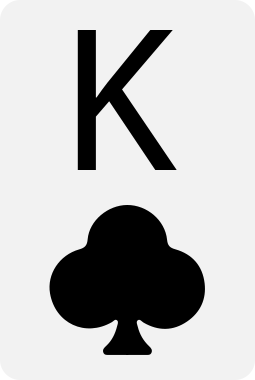
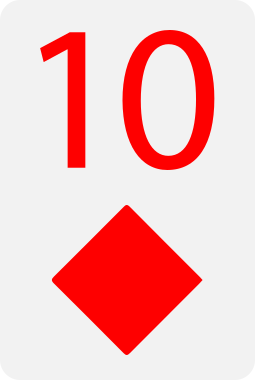
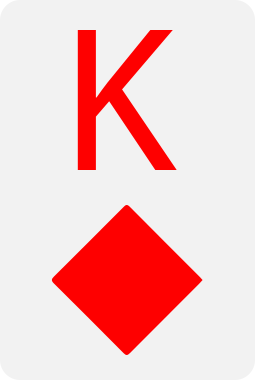
King-Two offsuit is the end of the road for the weak king family. There is nowhere lower to go with a king as the top card, and the two as a kicker represents the absolute floor of what can accompany it. In one sense, arriving at K2o after covering K6o through K3o is an exercise in confirming what was already clear several hands ago – that the kicker stopped mattering strategically long before reaching this point. In another sense, K2o has one small statistical curiosity that distinguishes it from the rest of the family, and it appears in the most unlikely column of the draw odds table.
What These Odds Show for K2o
The draw odds table for K2o is, as expected, almost indistinguishable from K3o, K4o, K5o, and K6o across most categories. High card on the flop at 53.88% – unchanged across the entire weak king series. Two pair at 22.79%, three of a kind at 4.45%, full house at 2.22% – identical. The pair by the river edges up again to 46.28%, continuing the gentle upward drift seen as the kicker decreases, a rounding and card removal artefact rather than a meaningful trend.
The straight rate reaches its lowest point in the series at 1.97% by the river. The two is the least connected card in the deck for straight-forming purposes, capable of contributing to straights only at the very bottom of the range – specifically the wheel (A-2-3-4-5) and the two-to-six straight (2-3-4-5-6). Two combinations, compared to the four or five available to the hands higher in this series. The 0.44% by the turn confirms that even reaching a straight draw requires a specific and narrow set of board cards.
The overcard table remains fixed at 22.55% on the flop, 29.14% by the turn, and 35.30% by the river – unchanged from every other king-high offsuit hand and unchanged from what it will be for K2 suited. The ace is still the only overcard that can appear, and its probability of doing so is independent of the kicker entirely.
The curiosity is in the flush column. K2o shows a flush rate by the river of 1.96%, while K3o through K6o all show either 1.96% or 1.95% depending on rounding. More interestingly, the straight rate of 1.97% and the flush rate of 1.96% are nearly equal – the only hand in this series where those two figures converge to the same approximate value. It is a statistical footnote rather than a strategic insight, but it illustrates just how marginal the two’s straight contribution has become: it is barely distinguishable from the board’s own flush completion rate, which has nothing to do with the hole cards at all.
Hand Strength Summary
- Hand type: Weakest offsuit king – the floor of the family
- Relative strength: Among the weakest viable starting hands in Texas Hold’em
- Best case: King-high board with no ace, heads-up, late position, fold-or-steal only
- Main vulnerability: Dominated by every other king without exception, near-zero straight potential, no flush equity, two has no independent strategic value
K2o is a king that happens to have a second hole card. The two does not raise the hand above what a king alone would represent in terms of made-hand potential, and it does not provide any drawing equity that could compensate for the kicker disadvantage. The hand’s entire playable value resides in a single card.
How King-Two Offsuit Wins
K2o wins through the same routes that have applied across the entire weak king sequence, now with the kicker’s contribution reduced to its absolute minimum:
- Pairing the king on a board with no ace, heads-up, against an opponent who has completely missed their hand
- Making two pair on the specific K-2-x board configuration – the rarest positive outcome given how infrequently a two appears on the board
- Winning uncontested pots preflop through a late-position steal where the king’s high-card credibility carries the raise
- King-high holding up in a fully passive, checked-down pot where no opponent has connected
The two contributes to winning outcomes only in the specific scenario where a K-2-x or 2-2-x board appears. In all other cases, the hand wins or loses based entirely on whether the king is sufficient.
Main Weaknesses
The weakness profile of K2o is the weak king family’s problems in their most concentrated form:
- Dominated by every single king in the deck – K3o through KA all have K2o outkicked when both players make top pair, covering the complete range of king-containing hands any opponent would voluntarily play
- The two is the lowest card available for straight-forming combinations, with only two possible straights (wheel and 2-3-4-5-6) available, producing the 1.97% completion rate that barely exceeds the board’s own flush rate
- No flush equity
- A pair of twos is the lowest possible pair and has no showdown value under any normal contested board conditions
- High card only on 53.88% of flops with no drawing path available in the vast majority of cases
- The complete absence of any kicker competition means K2o is not just dominated by good kings – it is dominated by every king, including the weak ones that are themselves considered poor starting hands
Best and Worst Flop Textures
Strong flops:
- King-high boards with no ace and completely disconnected low side cards – K-5-3 or K-4-2 rainbow textures where the hand has clear top-card status and opponents are unlikely to have connected significantly
- King-two boards producing immediate two pair – requiring both the rarest specific board configuration and an absence of threatening side cards
- Low boards in position where a single continuation bet ends the hand without requiring the holding to be legitimate
Dangerous flops:
- Any ace-high board – still occurring on 22.55% of flops and still reducing the hand to second-best high card regardless of which specific low card accompanies the king
- King-high boards with any substantial side card, where top pair with a two kicker is unplayable for multiple streets against any opponent willing to bet
- Any board at all in a multiway pot, where the certainty of being outkicked by at least one opponent’s king is effectively absolute
- Boards where the two has created a low pair – a pair of twos in any contested pot has no realistic path to the best hand
How It Plays by Position
Early position:
Never. K2o from early position is one of the clearest folds in all of Texas Hold’em. No table condition, stack size, or opponent dynamic changes this assessment under standard play.
Middle position:
A fold at any table with more than four players. In heads-up or three-handed play, the hand gains value through scarcity of alternatives, but that is a function of the game format rather than the hand’s intrinsic merit.
Late position:
The one position where K2o earns a place in a strategic discussion. From the button or cutoff in an unopened pot, a steal raise uses the king’s credibility without requiring the two to do any work. Opponents fold to the king’s implied strength, and if called, the plan is to continuation bet dry boards and release on resistance. The two is irrelevant to this entire process.
Blinds:
In the big blind with maximum pot odds against a single steal raise, K2o sits at the very outer limit of a defensible call. One street of investment, check-fold on most flops, continue only on a king-high board with no ace and a clear read that the opponent is stealing. From the small blind, folding is the standard play against any opponent with a reasonable range.
Common Mistakes with King-Two Offsuit
The mistakes with K2o include everything seen across the weak king series, arriving here at their starkest form:
- Any continuation after flopping top pair in a contested pot, where the two kicker loses to the complete range of king-containing hands an opponent would play
- Treating K2o as meaningfully different from K3o or K4o in strategic terms, when the practical difference is zero across all standard situations
- Entering pots from any position other than late position, where the hand’s sole source of value – the king’s positional credibility – is absent
- Calling 3-bets or facing significant preflop aggression without folding, where K2o has no equity justification for continuing
- Persisting with the hand postflop based on the low overcard rate alone, without accounting for the certainty of kicker domination whenever a king appears
Comparison to Similar Hands
- Stronger than: Nothing within the king-high offsuit family – K2o is the weakest king
- Weaker than: K3o, where the kicker has a fractionally higher straight rate and one more straight combination available; K2 suited, which transforms the hand with flush equity in exactly the same way suited versions improve every weak king
- Similar to: Q2o – the lowest queen, sharing an identical strategic profile with a different top card and correspondingly different overcard exposure
The completion of the weak king offsuit sequence from K6o to K2o confirms a principle that has been building across every hand in this series. Below a certain kicker threshold – roughly K7o – the offsuit king family collapses into a single strategic type. The kicker’s rank affects the straight rate marginally, edges the pair-by-river figure slightly, and changes which specific two pair combinations are possible. It does not change the overcard table, does not change the pair rate, does not change two pair or three of a kind rates in any meaningful way, and does not change the strategic framework. Fold early, fold middle, steal late, check-fold most flops. K2o applies this framework at its most unambiguous.
How King-Two Offsuit Performs in Multiway Pots
K2o in multiway pots has no scenario in which its intrinsic hand value generates profit. The argument has been made in full across K6o through K3o, and K2o adds one final point: the certainty of kicker domination is now absolute rather than near-absolute. Every king-containing hand in every opponent’s range has K2o outkicked. There are no exceptions.
In multiway pots this means top pair is unplayable for significant money regardless of board texture, a pair of twos has no value under any conditions, and the 1.97% straight rate offers no compensating equity to offset being behind. If K2o finds itself in a multiway pot, the correct approach is to check through when possible and fold to any meaningful aggression unless the board has produced a very specific and strong connection.
FAQ: King-Two Offsuit
Is K2o the worst king in Texas Hold’em?
Among offsuit kings, yes. K2o has the lowest straight potential of any king-high starting hand, is dominated by every other king without exception, and has no drawing equity to compensate. K2 suited is a genuinely different hand due to flush equity, but K2o is unambiguously the weakest member of the king family.
Does holding a two have any blocker value?
Marginally. Holding a two removes one of the four twos from the deck, slightly reducing the probability that opponents hold A2s or 23s type holdings in their range. This blocker effect is so small as to be irrelevant in any practical decision-making context.
Why does K2o have a higher flush rate than straight rate by the river?
The straight rate of 1.97% reflects the two’s extremely limited straight-forming combinations – only the wheel and 2-3-4-5-6. The flush rate of 1.96% reflects the board completing a flush through the community cards, which has nothing to do with K2o’s hole cards. The convergence of these two figures at essentially the same value is a statistical illustration of how little the two contributes to the hand’s drawing potential – its straight completion rate has become indistinguishable from a background board effect.
Should K2o ever be played for value?
No. The only profitable use of K2o is as a steal hand from late position where fold equity does the work. Any scenario requiring the hand to generate value through made-hand strength is outside K2o’s capabilities under standard conditions.
Related Hands