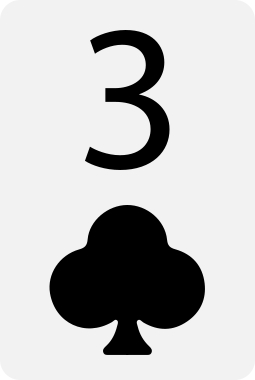
King-Three offsuit is where the weak king family reaches a point of near-total redundancy. The draw odds table for K3o could be mistaken for K4o, K5o, or K6o at a glance — the pair rates, two pair rates, three of a kind rates, full house rates, and overcard table are either identical or separated by fractions that carry no strategic meaning whatsoever. The straight rate continues its gradual decline, reaching 2.35% by the river, the lowest of any king-high hand covered so far. The hand is, for all practical purposes, a king with a placeholder attached to it, and the only honest strategic discussion is about what that king is worth on its own.
What These Odds Show for K3o
The draw odds table for K3o completes a pattern that has been building across the weak king sequence. High card on the flop at 53.88% — identical to every other king-high offsuit hand in this series. Pair by the river at 46.14%, a marginal uptick from K4o’s 46.00% that reflects rounding and card removal effects rather than any genuine improvement. Two pair at 22.79%, three of a kind at 4.45%, full house at 2.22% — all unchanged.
The straight rate tells the clearest story of the kicker’s declining contribution. K6o sat at 3.05%, K5o at 3.10%, K4o at 2.72%, and K3o arrives at 2.35% by the river. The three is far enough from the king that almost no standard board texture produces a straight draw for this hand, and the 0.00% on the flop confirms that no flop combination of three cards from the remaining deck produces an immediate straight with K3o as hole cards. The 0.55% by the turn reflects a narrow set of board configurations that create a backdoor straight draw, and 2.35% by the river is the cumulative result of those rare sequences completing.
The overcard table is, once again, 22.55% on the flop, 29.14% by the turn, and 35.30% by the river. This figure has not changed across a single king-high hand in this series and will not change for K2o either. It is a property of holding a king, not of the kicker.
Hand Strength Summary
- Hand type: Weak offsuit king — near the bottom of the family
- Relative strength: Among the weakest playable starting hands in Texas Hold’em
- Best case: King-high board with no ace, heads-up, late position, fold-or-steal dynamic
- Main vulnerability: Dominated by K4o and above, no straight potential, no flush equity, three has no independent board value
K3o has arrived at a point where describing the kicker in strategic terms requires acknowledging that it functions as a card occupying a slot rather than contributing to the hand’s character. The three is not a drawing card, not a pairing card with value, and not a blocker of anything meaningful. It is the second hole card, and its primary function is to be not an ace.
How King-Three Offsuit Wins
The winning routes for K3o are identical in structure to K4o and K5o, and they have not grown narrower — they were already as narrow as they can be while still justifying any discussion at all:
- Pairing the king on a board with no ace, heads-up, against an opponent who has completely missed
- Making two pair on the specific and unlikely K-3-x board texture
- Winning an uncontested pot preflop through a late-position steal where the king carries the credibility of the raise
- King-high holding up in a completely passive, checked-down pot
What K3o does not do is win meaningful pots through legitimate hand strength in any scenario that involves the three contributing to the outcome. The hand is a king, played alone, with a dead card in the other slot.
Main Weaknesses
By K3o the list of weaknesses has become a statement about the hand’s near-total dependence on a single card performing specific work under specific conditions:
- Dominated by K4o through KA — essentially the entire range of king-containing hands that opponents play voluntarily
- The three has no straight-forming value at any realistic stack depth, contributing to the lowest straight rate in the weak king series at 2.35%
- No flush equity
- A pair of threes on any standard board has no showdown value and no drawing value
- High card only on 53.88% of flops with no compensating draw available
- The hand cannot be continued for multiple streets after flopping top pair without an acute awareness that the kicker loses to nearly every other king in the deck
The accumulation of these weaknesses does not make K3o dramatically worse than K4o in practice — the hands are effectively equivalent — but it does confirm that the weak king family has fully exhausted its strategic variation by this point in the sequence.
Best and Worst Flop Textures
Strong flops:
- King-high boards with no ace and completely disconnected low side cards, where the hand holds the best high card and opponents are unlikely to have connected with their holdings
- King-three boards giving immediate two pair — the rarest positive outcome and the one requiring the most specific board configuration
- Boards in position where a single continuation bet ends the hand regardless of connection
Dangerous flops:
- Ace-high boards — 22.55% of flops contain an ace, and on every one of them K3o’s king is second-best high card with a three as backup
- King-high boards with any meaningful side card — K-Q, K-J, K-T type textures put top pair third kicker in an indefensible position against a player willing to put money in
- Any board where an opponent has shown genuine interest, since the range of hands that bet into or call on a king-high board almost universally contains a better king
- Boards of any kind in multiway pots, where the kicker problem is amplified by each additional opponent
How It Plays by Position
Early position:
Never. K3o from early position at any table format is a straightforward fold without exception.
Middle position:
A fold at a full ring table under all standard conditions. Even in short-handed play, the hand sits below the threshold where middle position opens are typically profitable.
Late position:
The only position where K3o carries any legitimate strategic value, and that value is narrow. From the button or cutoff in an unopened pot against opponents likely to fold, a single steal raise leverages the king’s high-card credibility and blocker value against premium king combinations. The hand should not be taken further without connecting strongly.
Blinds:
In the big blind facing a single steal raise with favourable pot odds, K3o sits at the absolute edge of defensible. One call is the maximum investment the pot odds might justify, and postflop the default line is check-fold on any board that does not produce two pair or better. From the small blind, folding is correct against any raise from an opponent with a standard range.
The positional framework for K3o is identical to K4o, K5o, and K6o. The king does the positional work. The kicker is irrelevant to that work. This has been true since K6o and remains true here.
Common Mistakes with King-Three Offsuit
The pattern of mistakes with K3o mirrors the rest of the weak king family, but one error intensifies at this end of the kicker range:
- Continuing after flopping top pair in any contested scenario, where the three kicker loses to every king in a reasonable opponent’s range without exception
- Treating the hand as more playable than K2o based on the marginal kicker difference, when the strategic implications of holding a three versus a two are essentially identical
- Limping into multiway pots to see cheap flops with the intention of making two pair — a plan that requires the specific K-3-x board to appear and does so rarely
- Overestimating the blocker value of the king as justification for entering pots from positions where the hand cannot profitably continue postflop
- Failing to apply the same discipline postflop that the hand’s statistics clearly demand — K3o is not a multi-street hand in contested pots under virtually any normal circumstances
Comparison to Similar Hands
- Stronger than: K2o, where the kicker is the lowest possible — though the practical difference between K3o and K2o is negligible in almost every scenario
- Weaker than: K4o, where the kicker has a fractionally higher straight rate and marginally more competitive value in the narrow range of kicker confrontations; K3 suited, which adds flush equity that completely transforms how the hand is played
- Similar to: Q2o — a strong top card paired with the lowest-tier kicker, positional steal value only, no drawing equity, no multi-street playability
The comparison between K3o and K3 suited is worth making one more time in this sequence, because it illustrates a general principle that applies across the entire weak king family. The suited version of every king-low hand is genuinely, meaningfully better — not marginally better. The flush equity introduced by the suited version gives the hand a path to a strong made hand that has nothing to do with the kicker, which is the specific problem the offsuit version cannot solve. K3s can flop a flush draw and continue with 9 clean outs. K3o cannot. That difference is categorical, not incremental.
How King-Three Offsuit Performs in Multiway Pots
K3o in multiway pots has no realistic profitable scenario that depends on the hand’s intrinsic value. The full argument has been made for K6o, K5o, and K4o, and nothing changes here:
- At least one opponent holding a better king is near-certain in any multiway pot involving players with reasonable ranges
- A pair of threes has no showdown value under any standard multi-opponent board conditions
- The 2.35% straight rate by the river means drawing equity is functionally absent
- The low overcard rate provides no practical advantage when the kicker problem makes top pair itself an unreliable holding
If K3o appears in a multiway pot, it is almost always because the player entered cheaply from the blinds or limped from late position into a passive field. The correct postflop approach in those circumstances is to check-fold unless the board produces an unusually strong connection, and to recognise that even two pair with K3o can be vulnerable to a higher two pair on boards with an ace or king and a three-high second pair.
FAQ: King-Three Offsuit
Is there any meaningful difference between K3o and K4o in practice?
Almost none. The straight rate drops from 2.72% to 2.35% by the river, and the pair rate edges up marginally due to card removal effects. At the table, the two hands are played identically in every standard situation. The player who makes different decisions with K3o versus K4o is manufacturing complexity that the statistics do not support.
At what point should the weak king family simply be treated as a single hand type?
From a strategic standpoint, K2o through K6o can be treated as a single category — fold early and middle, steal late, check-fold most flops — without meaningful loss of accuracy. K7o begins to introduce a kicker that competes in some confrontations. Below that, the differences are statistical footnotes.
Does K3o have any value as a bluff-catcher?
Very rarely and only in very specific low-stakes situations where an opponent is bluffing at a checked-down pot and king-high is sufficient to win at showdown. This is a passive, incidental form of value rather than a planned use of the hand.
How does K3o perform in tournaments versus cash games?
In tournaments with escalating blinds and shorter effective stack depths, K3o gains marginal value as a steal hand from late position because fold equity increases relative to postflop playability. In deep-stacked cash games, the hand’s postflop problems are more pronounced and its value decreases accordingly. Neither format makes it a hand to seek out.
Related Hands