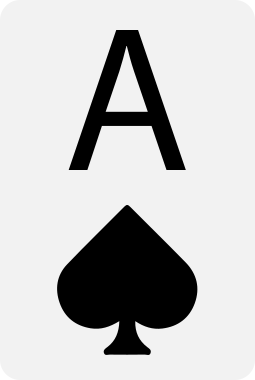
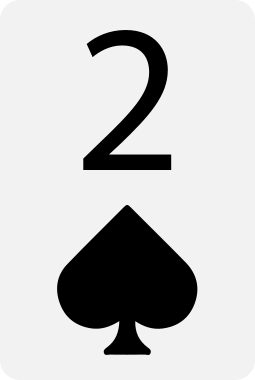
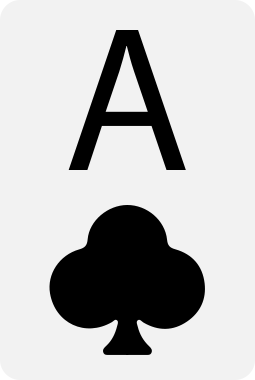
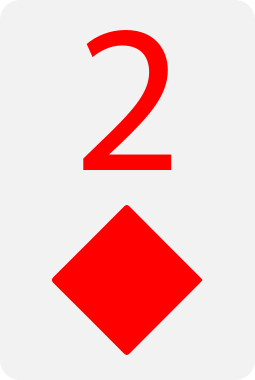
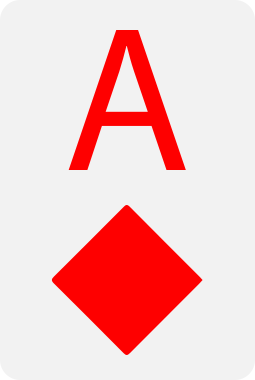
Ace Two Offsuit is the weakest hand in the ace-x family. It carries the most powerful rank in the deck alongside the lowest, creating a combination that is simultaneously difficult to dominate preflop and extremely difficult to play profitably after it. Among all the ace-x offsuit hands, A2o sits at the bottom of the kicker hierarchy with no room beneath it, and unlike A5o through A2s, it lacks even the suited flush draw that gives the suited version genuine speculative value.
What These Odds Show for A2o
The draw odds for A2o are nearly identical to A3o across most categories, with minor differences reflecting the two rather than the three as the secondary card. The 53.55% miss rate on the flop, 45.57% pair rate by the river, and 22.66% two pair rate all sit within the expected range for weak unpaired offsuit hands.
The straight column shows a 3.30% completion rate by the river, which is slightly lower than A3o’s 3.68%. This small difference reflects the two’s narrower straight connectivity. The two contributes primarily to the wheel straight – ace through five – where it sits as a natural connector between the ace played low and the three, four, five combination. A3o has both the wheel path and an additional combination through the three’s mid-range connectivity. A2o is almost entirely reliant on the wheel as its straight equity, requiring a three, four, and five on the board to complete it. Any other straight path requires the ace to anchor broadway combinations using ten through king, and those require four specific high cards, making the two essentially irrelevant.
The 0.33% flop straight rate confirms that A2o completes a straight on the flop in only the most specific of circumstances. A flop of three-four-five is the primary scenario, giving the hand an immediate wheel, and even that represents a tiny fraction of all possible flops.
As with all ace-x hands, there is no overcard table for A2o because the ace cannot be outranked by any community card. The kicker problem replaces the overcard problem entirely, and with a two as the secondary card, the kicker issue is as severe as it gets within the ace-x category.
Hand Strength Summary
- Hand type: Weakest ace-x offsuit hand
- Relative strength: Bottom of the ace-x offsuit category, above only the very worst non-ace hands in raw kicker hierarchy
- Dominates: Only A2 mirror hands in kicker battles, and virtually nothing preflop with actionable advantage
- Main vulnerability: Dominated by the entire ace-x hand range above it, no flush draw, minimal straight potential
A2o is a hand where the gap between perceived strength and actual strength is at its widest. The ace demands respect from opponents but the two provides almost nothing in return.
How A2o Wins
Pairing the ace in a heads-up or short-handed pot where no opponent holds an ace is the most straightforward path to winning. In late position steal situations this occurs frequently enough to make the hand profitable in those specific spots, because opponents will fold pre-flop or on the flop without connecting, and the ace provides enough board coverage to represent a range of strong hands credibly.
The wheel straight is A2o’s most distinctive winning mechanism and the one outcome that the two actually enables in a meaningful way. On a board of three-four-five, A2o makes the nut low straight – the best possible straight on that board – and it is an outcome opponents almost never see coming. A player who raised pre-flop with ace-king or continuation bet an overpair on that board has no reason to credit an ace-two until the chips are already in the middle. At 3.30% by the river, the wheel is infrequent but it is the hand’s sharpest weapon when it does arrive.
Two pair at 22.66% by the river is the third path, particularly on ace-two boards where both cards pair. This outcome is well disguised for the same reasons as the wheel, since opponents rarely account for the two’s relevance on the board.
Bluffing with the ace is perhaps the most consistent source of value with A2o in aggregate. On ace-high boards where opponents have missed or hold medium pairs, a continuation bet with ace in hand is a credible and often successful aggression line regardless of the kicker.
Main Weaknesses
The two kicker is the most extreme version of the kicker problem that runs through the entire weak ace-x offsuit family. Every other ace-x hand in the deck dominates A2o when an ace appears on the board. That is twelve combinations of ace-x starting from A3 through AK, plus their suited counterparts, all of which leave A2o drawing to two outs when the kicker determines the winner. In any raised pot or multiway scenario where opponents hold reasonable starting hands, the probability that a better ace is present is significant enough to make top pair two kicker an extremely unreliable holding.
The two contributes almost nothing to post-flop equity outside of the wheel. Unlike a three, four, or five, which each have multiple straight configurations available around them, the two can only contribute to straights by connecting upward through three-four-five, since there are no cards below it. This makes A2o the most straight-constrained hand in the ace-x offsuit family.
The absence of a flush draw – the key advantage of A2s over this hand – means there is no secondary equity path when the ace fails to pair and the wheel draw is not live. The hand must fold or bluff when it misses, and it misses on the flop over half the time.
Best and Worst Flop Textures
Strong flops
- Ace-high boards in heads-up or short-handed pots against wide ranges where opponents are unlikely to hold a better ace
- Three-four-five boards where the hand completes the wheel immediately, a rare but high-value outcome
- Boards containing two or three of the wheel cards, opening a draw to the nut low straight that provides genuine continuing equity
Dangerous flops
- Ace-high boards in multiway pots or against tight callers who are likely holding any other ace
- Middle-rank boards where neither card pairs and no draw exists
- Boards containing high cards that invite aggression the hand cannot compete with and has no draw to hide behind
How It Plays by Position
- Late position: The primary home for A2o. From the cutoff or button in an unopened pot, the hand has clear steal equity from the ace’s high-card authority, and even when called, it can navigate ace-high flops with continuation bet credibility and wheel draw boards with genuine equity.
- Early and middle position: A fold in most game types. The hand has the thinnest possible resilience against the ranges likely to be played from those positions, and out-of-position play with the worst kicker in the deck against any opponent who calls is a consistently losing proposition.
- Big blind: Can complete against a single very small raise but should approach every flop with strict fit-or-fold discipline. Against raises of any real size, the hand does not have enough post-flop potential to justify the investment in most spots.
Common Mistakes with A2o
- Treating top pair as a strong hand – ace-top pair with a two kicker is dominated by every other ace-x hand, and in any situation where an opponent has shown pre-flop interest and called a flop bet, the probability that they hold a better ace is substantial
- Overvaluing the wheel draw – on a three-four-x or four-five-x board with one card to come, the draw to complete the wheel is a gutshot with four outs and roughly 9% equity; treating this as a strong continuing hand without correct pot odds is a mistake
- Playing A2o as though it were a premium ace hand – the ace generates a psychological pull toward aggression and commitment that the two kicker does not support; the hand’s value is primarily as a steal and bluff vehicle, not as a value hand in contested pots
Comparison to Similar Hands
- Stronger than: Non-ace hands in raw high-card hierarchy, though virtually nothing in direct kicker confrontations
- Weaker than: Every other ace-x hand including A3o, and significantly weaker than A2s
The comparison to A3o is the most direct. A3o sits immediately above A2o in the kicker hierarchy and offers marginally better straight connectivity through the three’s additional mid-range combinations. In practical play the two hands are very similar, but A3o is the stronger hand in almost every measurable respect.
The comparison to A2s is the most consequential. The suited version of this hand is a meaningfully different proposition in many situations. A2s retains the wheel straight draw while adding flush draw equity that creates semi-bluff opportunities and multiway value that A2o cannot access. Many experienced players consider A2s through A5s to be speculative hands worth playing in a wider range of contexts precisely because of the flush draw, while A2o through A5o require strict positional and situational discipline to play profitably.
How A2o Performs in Multiway Pots
In multiway pots, A2o faces the most extreme version of the kicker problem in the entire ace-x family. With twelve ace-x combinations above it, the probability that at least one opponent holds a dominating ace in a three or four-way pot is high enough to make top pair almost unplayable for significant investment in most scenarios.
The wheel straight is the one multiway bright spot. Completing the wheel in a large multiway pot against opponents who have connected on different parts of the board is among the highest-value outcomes the hand can achieve. On a three-four-five board in a four-way pot, A2o makes the best possible straight on that board, and the implied odds from opponents holding two pair, sets, or weaker straights can be substantial.
Outside of this specific scenario, multiway pots should be approached with minimal investment and quick release on the flop when neither the ace nor the wheel draw is live.
FAQ: Ace Two Offsuit
Is A2o the worst ace hand?
Within the offsuit ace-x family, yes. It has the lowest kicker in the deck and the most constrained straight potential of any ace-x hand. A2s is a notably stronger hand due to the flush draw, making A2o the weakest ace hand across all suited and offsuit variants.
Can A2o make a straight other than the wheel?
The two contributes exclusively to the wheel in practice. The ace can anchor broadway straights through ten-jack-queen-king, but these require four specific high cards on the board and the two plays no role in them. For any realistic straight involving both hole cards, the wheel is the only option.
Why is A2o considered weaker than A5o despite the kicker being lower?
Because A5o has better straight connectivity. The five can contribute to both the wheel and several additional mid-range straight combinations, making it a slightly more versatile hand post-flop despite ranking below A6o through AKo in kicker hierarchy.
How does A2o compare to completely disconnected hands like 72o?
A2o is significantly stronger. The ace’s high-card authority gives it genuine steal equity and board coverage that 72o completely lacks. However, in contested pots where kicker strength matters, the two creates vulnerability that brings the hand closer to the bottom of the playable range than its ace might suggest.
Related Hands