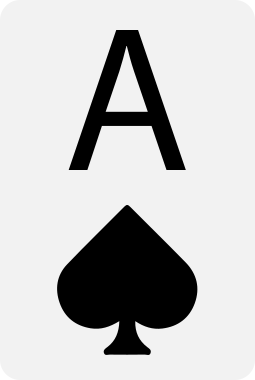
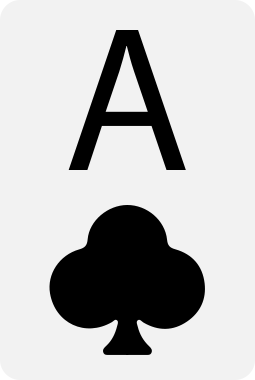
Ace-Five Offsuit is a hand of two distinct personalities. The ace provides genuine top-card strength and immediate high-card value that most marginal hands simply do not have, while the five is a weak kicker that contributes almost nothing in isolation. The result is a hand that can dominate weaker aces and steal pots with authority, but one that is in serious trouble when the ace pairs and faces a better kicker, or when the board develops in ways the five cannot engage with.
What These Odds Show for A5o
The 53.55% high card rate on the flop is in line with other weak offsuit holdings, but the context here is different from a hand like T8o or 98o. When A5o makes nothing on the flop, it still holds ace-high, which has genuine showdown value in some spots – particularly in heads-up pots or against passive opposition. High card means something different when that card is an ace.
The pair rate of 45.15% by the river is slightly higher than comparable offsuit hands, reflecting the ace’s ability to pick up top pair on a wide variety of boards. Pairing the ace is a meaningful event – ace-top pair is a strong holding, even with a five kicker – but it comes with the persistent risk of being outkicked by any opponent holding ace-six or better, which covers a large portion of reasonable opening ranges.
The straight draw numbers are modest. A 0.33% chance of flopping a straight rises to 4.43% by the river. The five does contribute to wheel straight combinations – A-2-3-4-5 – and A5o is one of the few ace-x offsuit hands that has any straight draw potential at all, since the wheel is the only straight the ace can anchor from the low end. On boards containing two, three, and four, the hand can pick up a gutshot or even an open-ended draw to the wheel, which is a genuine if infrequent source of equity. That 4.43% straight rate by the river reflects this narrow but real pathway.
Unlike the suited version, A5o produces no flush equity whatsoever. The 1.96% flush rate that appears in the table is a product of community card combinations, not hole card contribution – both cards need to be the same suit for a flush draw, and they are not.
There is no overcard table for A5o, because the ace has no overcard. This is one of the hand’s most underappreciated structural advantages – no board card will ever outrank the ace, meaning top pair with an ace is always top pair regardless of what lands on the community cards.
Hand Strength Summary
- Hand type: Weak ace, offsuit
- Relative strength: Marginal – stronger than it looks in some spots, weaker than it looks in others
- Potential: Top pair, wheel straight draws, preflop aggression
- Main vulnerability: Dominated by better aces, weak kicker in multiway pots
A5o is not a hand to build a pot with, but it is not a hand to simply discard either. Its value is highly situational, driven primarily by position, opponent tendencies, and board texture.
How A5o Can Win
Pairing the ace is the most common winning path, and when it happens against opponents without an ace it is often decisive. The hand also wins by using its preflop high-card strength to take down pots uncontested – ace-high is a credible bluff and semi-bluff anchor. On boards that develop a two, three, four combination, the wheel draw adds a surprise equity element that opponents may not account for. In late position against tight ranges, A5o can represent a wider range of strong holdings than its actual strength warrants.
Main Weaknesses
The five kicker is the hand’s defining weakness. Any opponent holding ace-six through ace-king has A5o dominated when both players pair the ace. This is a costly situation – two outs to improve – and it arises frequently because aces with better kickers make up a large portion of any reasonable opponent range. The hand also has no flush draw, and its straight potential is confined to the specific wheel combination, making it inflexible on most board textures. In multiway pots, both of these problems are amplified.
Best and Worst Flop Textures
Strong flops:
Ace-high boards with low, uncoordinated side cards (e.g. A♦ 7♣ 2♠) where top pair is likely best and no obvious draws are available. Low boards containing a two, three, and four that give A5o a wheel draw or completed wheel. Boards where the five pairs and the ace is available as an overcard bluff.
Dangerous flops:
Ace-high boards where opponents are likely to have better kickers – this is the most dangerous scenario for the hand, as it can create a large pot with a dominated holding. Boards with strong flush draws, particularly in a suit held by many opponent hands. Coordinated boards where neither card connects.
How It Plays by Position
- Early position: Generally a fold. The dominated ace problem is most severe from early position, where the range of hands still to act is wide and includes many better aces.
- Middle position: Marginal. In shorter-handed games it gains value, but from full-ring middle position the kicker vulnerability is a significant concern.
- Late position: The hand’s best home. Raising an unopened pot with A5o from the button or cutoff is standard in most games – the ace provides credibility and the five’s wheel potential adds a small equity bonus.
- Blinds: From the small blind, a complete or small raise is viable against a single limper. From the big blind, calling a single raise is reasonable given the pot odds and the ace’s postflop value.
Common Mistakes with Ace-Five Offsuit
The most damaging error is playing A5o as though the ace alone makes it a strong hand. Facing a raise and a call, or any sign of genuine strength from an opponent, the kicker becomes a serious liability on ace-high flops. Getting committed in large pots with one pair when opponents are representing better aces is a common and expensive mistake. Another error is failing to recognise the wheel straight potential on low boards – players sometimes give up on A5o entirely when the flop is 2♣ 3♦ 9♠, not realising that the four gives them an open-ended draw to the nuts.
Comparison to Similar Hands
- Stronger than: A4o, A3o, and A2o, which have even less straight potential and the same kicker problem. Also stronger than non-ace offsuit hands of comparable rank, since the ace’s high-card value and preflop fold equity is a genuine asset.
- Weaker than: Ace-Five Suited (A5s), which adds flush draw equity and the occasional nut flush draw to identical straight potential. Also weaker than A6o through ATo, which share the same structural profile but have better kickers.
Among the weak aces, A5o and A4o are often considered the most playable from the bottom of the range precisely because the five and four contribute to wheel draws that A6o through A9o cannot make.
How A5o Performs in Multiway Pots
In multiway pots, A5o’s kicker problem intensifies sharply. When an ace lands on the board in a four-way pot, the chances of at least one opponent holding a better kicker are high. The hand performs best multiway when it has connected with a draw – particularly the wheel draw – rather than when it is relying on top pair. Folding to significant multiway action on ace-high boards is often correct with this holding.
FAQ: Ace-Five Offsuit
Is A5o better than other weak aces?
Among the bottom tier of ace-x offsuit hands, A5o and A4o are generally considered slightly more playable than A6o-A9o because of the wheel straight potential. A5o can pick up draws to the nut low straight on boards that those other hands cannot use.
How often does the wheel draw actually come in?
Rarely – the straight rate is 4.43% by the river – but the value is not just in completing the straight. Picking up a gutshot or open-ended draw to the wheel on the flop adds equity even when it does not complete, and the nut straight draw (to the wheel) is a powerful semi-bluffing tool.
Should A5o be folded to a 3-bet?
Almost always. Against a 3-bet, the hand is frequently dominated by better aces, and the implied odds needed to justify continuing are rarely present.
Why is A5o considered better than A5o suited is obvious, but why is it still playable at all offsuit?
The ace does a lot of work. Preflop fold equity, top pair potential, and ace-high bluff credibility are all meaningful. The hand is not strong, but it is not without tools.
Related Hands