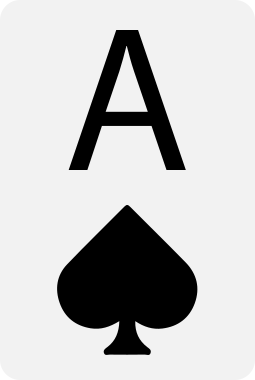
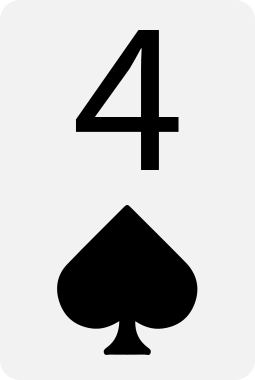
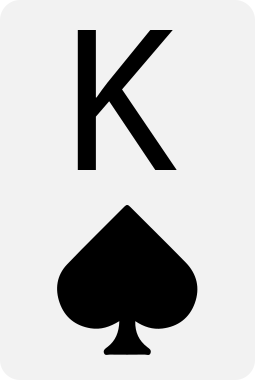
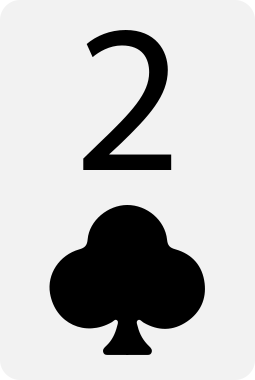
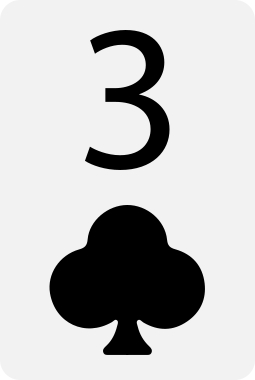
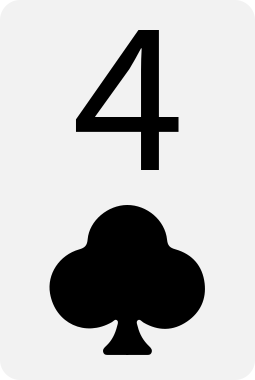
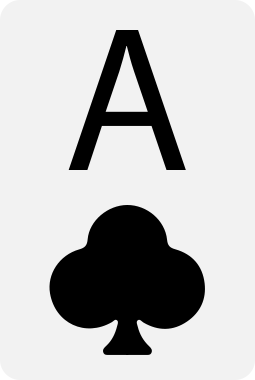
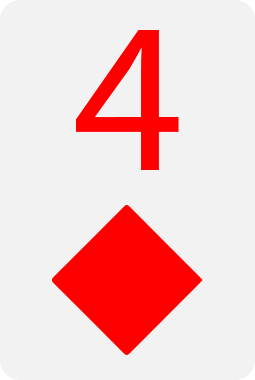
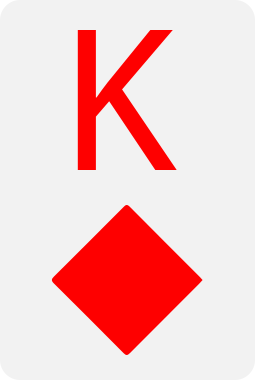
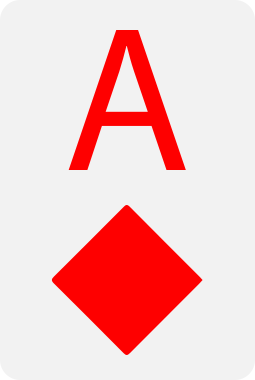
Ace Four Offsuit is a weak to marginal starting hand in Texas Hold’em. The ace gives it a high card anchor that no other rank can match, but the four is a poor kicker that creates serious problems whenever the ace pairs. It is not a hand that belongs in most opened ranges, and calling raises with it is almost always a mistake.
Understanding where it sits in the hand rankings and why helps clarify the situations in which it can be played without burning chips.
What These Odds Show for A4o
The draw odds for A4o have an unusual characteristic worth noting immediately: there is no overcard table for this hand. That is because the ace is the highest card in the deck and no board card can outrank it. This is one of the few genuine advantages A4o holds over the majority of starting hands – you will never face the pressure of an overcard on the board threatening your top pair.
That said, the draw odds table shows a familiar pattern for weak unpaired hands. On the flop, 53.55% of runouts produce nothing better than high card, and by the river that still accounts for 19.25% of outcomes. A pair is the most common result at showdown, sitting at 45.29% by the river, but pairing the ace with a four kicker puts you in a consistently difficult spot against any opponent also holding an ace.
The straight odds reach 4.05% by the river, which is respectable for an offsuit hand with a four in it. The wheel – A-2-3-4-5 – is a key straight draw for this hand, and the four plays a direct role in completing it. The flush odds are negligible at 1.96% by the river, which is expected for an offsuit holding. There is no realistic flush path for A4o and those numbers can be largely ignored when assessing its value.
Hand Strength Summary
- Hand type: Weak ace, offsuit
- Relative strength: Below average, bottom third of all starting hands
- Potential: Top pair with a weak kicker, wheel straight draw
- Main vulnerability: Dominated by any other ace with a better kicker
The ace is both the hand’s greatest asset and its greatest liability. It creates top pair frequently, but that top pair is often behind.
How A4o Wins
A4o wins most cleanly when it makes a straight, particularly the wheel, where the four kicker problem becomes irrelevant and the hand has full value regardless of what opponents hold. It can also win by pairing the ace against opponents who did not connect with the board at all, relying on ace-high or a lower pair to take the pot. In position, it can occasionally take down pots with well-timed aggression on boards where no one appears to have connected. Two pair with both hole cards is rare but does occur on low boards with a four, providing a well-disguised hand.
Main Weaknesses
The dominant weakness of A4o is kicker trouble. Any time the ace pairs and an opponent also holds an ace, the four is almost certainly the losing kicker. This is a situation that is both common and costly. Additional weaknesses include:
- No flush potential, removing one of the key ways suited aces generate value
- The four is too low to create straight draws without very specific board runouts
- Dominated by every other Ax hand from A5 upwards
- Difficult to continue past the flop without a clear, strong connection
- Weak showdown value in most single-pair scenarios
Best and Worst Flop Textures
Strong flops
- A-2-3 or 2-3-5 giving a wheel straight draw or completion
- Low boards pairing the four where it is likely to be the best pair
- Ace-high dry boards where it is reasonable to assume top pair is ahead
Dangerous flops
- Ace-high boards with strong kicker cards (e.g. A♠ K♦ 9♣), where any opponent with AK, AQ, AJ or even AT has A4o in serious trouble
- Boards that pair the four on a connected texture, creating a situation where bottom pair is drawing thin
- Wet boards where the hand has no draw and no strong pair
The biggest recurring danger is flopping top pair and walking into a dominating ace.
How It Plays by Position
- Early position: A fold in standard play. A4o does not have the raw equity or post-flop playability to open from UTG or early seats in most formats.
- Middle position: Still below the threshold for most opening ranges. Some players include it in wider middle position opens but it is at best marginal.
- Late position / Button: The most viable position for this hand. Stealing the blinds with an ace is a reasonable play, and the lack of an overcard threat makes it slightly easier to navigate post-flop than other weak hands.
- Blinds: In the big blind it can be defended against a single small raise, primarily because of the pot odds and the ace removing some overcard risk. In the small blind, the post-flop positional disadvantage limits its appeal.
Common Mistakes with A4o
- Over-valuing the ace and playing it from positions where it cannot realise its equity
- Continuing past the flop with a single pair of aces and a weak kicker against any significant resistance
- Failing to recognise when the wheel draw is live versus drawing dead
- Treating it as a strong hand simply because it contains an ace
- Calling 3-bets with it, which is almost always incorrect given the domination risk
The most expensive pattern with A4o is pairing the ace, betting for value, and losing to a better ace – a situation the hand invites regularly.
Comparison to Similar Hands
- Stronger than: A2o, A3o, K4o, Q4o
- Weaker than: A5o, A6o, any suited ace, any higher offsuit ace
- Similar to: A3o and A5o in terms of raw equity, though A5o has a marginally better straight draw profile
A5o is often considered slightly preferable to A4o because the five plays into more straight combinations. A4o’s primary straight draw is the wheel, which is a single specific target, whereas A5o has a touch more flexibility. The gap between A4o and A4s is significant – the suited version gains flush equity that transforms its playability in late position and multiway pots.
How A4o Performs in Multiway Pots
A4o is not well suited to multiway pots. The kicker problem intensifies with more players, as the chances of another ace being in play increase. Straight draws to the wheel become more valuable in multiway pots due to implied odds, but the hand rarely has the post-flop strength to navigate a large, multi-way pot without clarity on where it stands. In limped multiway pots it can occasionally see a cheap flop and connect in unexpected ways, but it should not be a hand regularly constructed around multiway scenarios.
FAQ: Ace Four Offsuit
Why is there no overcard table for A4o?
Because the ace is the highest ranked card in the deck, no board card can be higher. The overcard concern that affects most starting hands simply does not apply here.
Is A4o better than hands like K9o or QTs?
Despite containing an ace, A4o is not clearly better than many other hands. KTo and QTs, for example, have far better post-flop playability and less kicker domination risk.
When is A4o worth playing?
Primarily in late position as a steal, in the big blind at a reasonable price, or in tournament situations where stack depth and blind pressure change the calculation.
How often does A4o make the wheel straight?
The wheel is one component of the 4.05% straight completion rate by the river. It is not a frequent outcome, but it is the most valuable path to an unambiguous win for this hand.
Related Hands