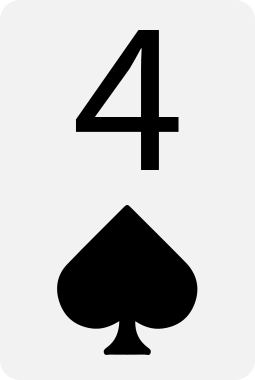
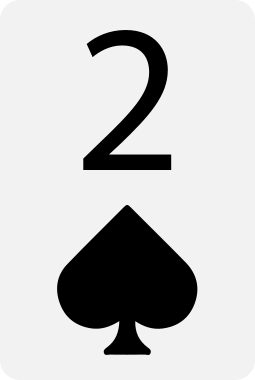
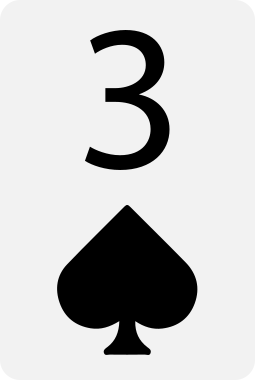
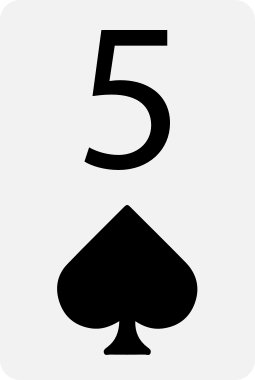
Ace-Four Suited is a hand that rewards clarity of purpose above almost anything else in the suited Ace-x family. It does not have the kicker strength of A9s or A8s, the wheel draw purity of A5s, or the established 3-bet bluff identity that A5s has earned in modern poker. What it has is the nut flush draw — the constant that runs through every suited Ace — and a genuine if modest straight draw through both the wheel and the Four’s direct participation in low straight combinations. Played with positional discipline and a clear understanding of what the hand is trying to accomplish on any given board, A4s is a consistently profitable speculative holding.
Before the flop, A4s is a late position open, a blind defence, and an occasional 3-bet bluff in the right spots. It is not a hand to commit significant chips with preflop without a specific plan for the flop, and it is not a hand to play from early position without acknowledging the kicker problems that will arise on Ace-high boards against almost any opponent willing to enter a raised pot.
What These Odds Show for A4s
The high card flop rate of 52.71% is consistent with K9s and A7s — a figure shared by all unpaired hands with similar pair probability structures. The pair rate of 40.41% on the flop and the two pair, three of a kind, full house, and four of a kind rates are all consistent with the broader suited Ace-x family, driven by deck mechanics that are rank-independent for unpaired hands.
The straight odds of 0.32% on the flop, 1.45% by the turn, and 3.79% by the river sit between A5s (4.14%) and A8s (2.84%), and the position of A4s between those two reference points is structurally meaningful. A5s produces the highest straight rate in the suited Ace family because both hole cards contribute directly to the wheel — the Ace as the low card, the Five as the high card — requiring only a 2-3-4 board to complete it. A4s produces the second-highest straight rate in the low suited Ace range for a related but distinct reason: the Four contributes to the wheel as the fourth-highest card (A-2-3-4-5 with the Four one step below the Five), and a board of 2-3-5 completes the wheel for A4s with the Four filling the internal gap. Additionally, the Four participates in low-range straights including 2-3-4-5-6, 3-4-5-6-7, and 4-5-6-7-8, giving A4s a broader low-end straight draw profile than A3s (which requires more specific board configurations) while remaining below A5s (which has the cleanest wheel draw in the family).
The flush odds of 0.84% on the flop, 2.92% by the turn, and 6.52% by the river are consistent with the suited Ace family. The Four plays no role in the flush — the Ace is always the highest card of the five suited cards — and the nut flush produced is identical in strength to every other suited Ace. The 6.52% figure matches K9s and A7s within rounding, confirming that the nut flush probability is essentially constant across the family.
The straight flush odds of 0.01% on the flop, 0.02% by the turn, and 0.06% by the river match A5s and K9s, reflecting the low-end straight flush combinations that run through the Four in its suit — specifically the A-2-3-4-5 suited combination and the low straight flushes running upward through the Four. Both hole cards can contribute to these combinations, and while the outcomes are rare, they are structurally available to A4s in a way that offsuit hands and suited hands with higher secondary cards cannot replicate at the low end.
A4s and the Wheel: A Comparison with A5s
The most instructive way to understand A4s is to compare it directly to A5s, which is the reference point for the entire low suited Ace family’s straight draw potential.
A5s makes the wheel with a 2-3-4 board — both hole cards are direct participants, the board provides three specific ranks, and the result is the nut straight with the Five as the high card. The draw is maximally clean because no other card from the hand is needed once the board shows 2-3-4.
A4s makes the wheel with a 2-3-5 board — the Ace plays as the low card, the Four fills the gap between Three and Five, and the Five must appear on the board rather than being held in the hand. The draw is slightly less clean because it requires a specific internal card (the Five) rather than a sequential completion from outside. A4s can also make the wheel with a 2-5-x board if the remaining cards include a Three, or a 3-5-x board if the remaining cards include a Two — partial draws exist but are less direct than A5s’s 2-3-4 requirement.
The practical result is that A4s has genuine wheel draw potential but requires one more specific card from the board than A5s does to complete it cleanly. This is reflected in the 3.79% versus 4.14% straight rate difference — A4s is 0.35 percentage points behind A5s by the river, a modest but real gap that compounds over volume.
The strategic implication is that A4s can be played with some of the same wheel draw awareness that A5s warrants — particularly on boards containing 2-3, 2-5, or 3-5 where the draw is partially live — but it should not be treated as having the same quality of straight draw that makes A5s distinctive. A4s is a nut flush hand with a secondary straight draw, where A5s is a hand with two roughly co-equal primary equity sources.
A4s as a 3-Bet Hand
A5s’s established role as a light 3-bet bluff raises the natural question of whether A4s occupies the same role. The answer is yes, but with qualifications.
A4s shares the core properties that make suited low Aces attractive as 3-bet bluffs. It is unlikely to be dominated in a way that eliminates equity — an opponent holding A4 is exceedingly rare. When called, it has the nut flush draw and a partial wheel draw as live equity sources. It is not a hand that benefits from flat calling and building a bloated preflop pot out of position.
What A4s lacks compared to A5s is the same wheel draw clarity. A5s has a clean two-card wheel draw that completes on a single board texture (2-3-4). A4s’s wheel draw is one step more indirect, requiring a specific internal card from the board rather than three sequential cards below the secondary hole card. This makes A4s a slightly less reliable equity source when called in a 3-bet pot, since the post-flop scenarios where it has strong equity are marginally less frequent.
In practice, A4s is used in the same 3-bet bluffing role as A5s at many tables, and the difference in wheel draw quality is small enough that it does not fundamentally change the strategic calculus. Both hands have the nut flush draw as the primary equity source when called, and that draw justifies the 3-bet in the majority of situations where it is used. A4s is a secondary option in that role after A5s — equally valid in principle, marginally less powerful in practice.
Hand Strength Summary
- Hand type: Suited Ace-x, low secondary card with wheel draw access
- Relative strength: Top 20–25% of all starting hands
- Dominates: A3s, A2s in kicker strength and straight potential; A4o by virtue of the nut flush draw
- Dominated by: AK, AQ, AJ, AT, A9, A8, A7, A6, A5 — every higher Ace-x hand beats the Four kicker; pocket pairs of Five or higher
A4s sits at the lower end of the suited Ace family, with a kicker that loses to almost every Ace-x holding an opponent might play, and a straight draw that is genuine but slightly less clean than A5s. Its profitability comes almost entirely from the nut flush draw and the positional discipline to fold when neither the flush draw nor a made hand is present.
How A4s Wins
A4s wins through a focused set of routes:
- Making the nut flush — the primary equity source, identical in strength to every suited Ace
- Completing the wheel or a low straight involving the Four — 3.79% by the river, a genuine and disguised path to a strong hand
- Flopping top pair (Ace) and holding against opponents who have missed entirely or hold A3 or A2
- Making two pair with both the Ace and Four on boards containing both ranks — unusual but valuable on low boards
- Semi-bluffing with the nut flush draw and winning through fold equity before completion
- Making a straight flush through the low suited combinations involving the Four — rare but structurally available
The nut flush semi-bluff is the primary active equity tool. Nine clean outs to the best possible flush, combined with the Ace as a potential pair out, frequently gives A4s ten or more working outs on the flop. That is a strong enough equity position to justify aggression in position rather than passive calling.
Main Weaknesses
A4s has the most acute kicker weakness of any hand in this series:
- The Four loses the kicker battle to every Ace-x hand that willingly enters a raised pot — AT through A5 all have the kicker covered, and that is the range of hands most commonly found at raised pots
- Top pair Four kicker has essentially no showdown value against any opponent willing to continue on an Ace-high board
- High card on the flop 52.71% of the time with a Four that is below the vast majority of all possible board textures
- The wheel draw is one step less direct than A5s, requiring a specific internal card from the board
- In 3-bet pots, the kicker problem is at its most acute — the hands that 3-bet frequently are concentrated at the top of the Ace-x range
The kicker weakness for A4s is more severe than for any other hand covered in this series. The Four beats only A3 and A2 in kicker battles, and neither of those hands appears with meaningful frequency in opponents’ raising ranges. For practical purposes, top pair on an Ace-high board with A4s is a hand that loses to every reasonable Ace-x holding at the table.
Best and Worst Flop Textures
Strong flops
- Ace-high boards with two cards of your suit — top pair and the nut flush draw simultaneously; despite the weak kicker, the flush draw elevates this to a strong continuing hand
- Three cards of your suit — immediate nut flush, regardless of the Four’s contribution to the board
- 2-3-5 or 2-3-x boards — wheel draw is live with one card to come; on 2-3-5 the wheel is already made
- Low boards (e.g. 4♣ 2♦ 8♠) where the Four gives top pair or second pair on a board opponents are unlikely to connect with
- 3-4-5 or 4-5-6 boards — straight draw through the Four with multiple combinations live
Dangerous flops
- Ace-high boards without the flush draw in any significant pot — top pair Four kicker loses to every Ace-x hand an opponent is realistically holding
- Ace-high boards in multiway pots — the probability of facing a better Ace is near-certain with three or more players
- Mid-range boards (7-8-9 or 8-9-T) — both hole cards are irrelevant to the board texture and no draw is available
- High boards (K-Q-J or Q-J-T) — the Four provides no equity and the Ace is an overcard that does no work against broadway-connected opponents
How It Plays by Position
- Early position: A fold in virtually all formats — the kicker weakness is at its most damaging without positional control, and the hand cannot navigate multi-street decisions against tight ranges without paying a heavy price
- Middle position: A marginal open at best; better treated as a fold or 3-bet bluff than a flat call behind an early position opener
- Late position (CO/BTN): The appropriate home for A4s — open wide, see flops cheaply, fold cleanly when you miss without a draw, and apply pressure with the nut flush draw in position
- Blinds: A solid defend against late position steals at the right price; in 3-bet pots out of position the kicker weakness is most costly and discipline across multiple streets is essential
Position is even more important for A4s than for A7s or A8s, because the kicker weakness is more severe and the hand has fewer fallback equity sources when the flush draw is not live. Without position to control pot size and fold without cost, A4s generates very little profit outside of flush-completing runouts.
Common Mistakes with A4s
- Continuing with top pair Four kicker in any pot with significant action — this is the most expensive mistake and the most common; the Four kicker is essentially the worst possible kicker on an Ace-high board
- Not folding to 3-bets out of position — A4s is dominated by the large majority of 3-betting ranges and cannot profitably navigate multi-street decisions from out of position without the flush draw
- Treating A4s identically to A5s — the wheel draw quality difference is real, and A4s should be played with slightly less straight draw confidence on low boards
- Under-valuing the partial wheel draw — 2-3-x and 2-5-x boards give A4s genuine equity that is easy to overlook when focusing on the pair miss
- Passive play with the nut flush draw — nine clean outs to the best possible flush warrants aggression, not check-calling
Comparison to Similar Hands
- Stronger than: A3s and A2s in kicker strength and straight draw potential; A4o by virtue of the nut flush draw and straight flush possibilities
- Slightly weaker than: A5s — the wheel draw is one step less direct, the kicker is marginally weaker in the specific scenarios where it matters, and A5s has a more established strategic identity as a 3-bet bluff hand
- Comparable to: A3s in playing style and reliance on the flush draw; A5s in 3-bet bluff utility though slightly less effective in that role
Examples:
- Against A9o: A4s is dominated through the kicker — the Nine wins decisively — but the nut flush draw closes the equity gap meaningfully and the hands are closer than the rank difference implies
- Against KK: A4s is approximately a 30% underdog preflop — live Ace out, nut flush draw, and low straight draw give it more equity than its rank alone suggests
- Against A4o: A4s is a clear favourite — identical ranks, but the nut flush draw and straight flush potential provide a significant structural equity advantage
- Against 56s: A4s is a modest underdog in straight connectivity — 56s has better direct straight draw access through the mid-range — but the Ace’s dominance and the nut flush outranking the Five-high flush compensates significantly
How A4s Performs in Multiway Pots
A4s in multiway pots follows the same framework established for A5s through A7s, with the kicker weakness more acute:
- The nut flush draw retains its full value regardless of the number of opponents — the Ace of the suit is in your hand, no opponent can hold a better flush, and the draw is worth continuing with against any number of players
- The kicker weakness is near-total multiway — with three or more opponents, the probability that at least one holds a better Ace approaches certainty, making top pair Four kicker essentially unplayable in a contested pot
- The wheel draw has strong implied odds multiway on the rare boards where it is live — opponents holding mid-pairs or top pair on a 2-3-5 board will rarely put you on the wheel and will commit chips accordingly
- Fold equity on semi-bluffs decreases multiway but the underlying equity of the nut flush draw remains intact
Multiway, A4s is the purest draw-or-fold hand in the suited Ace family. The flush draw is the only reliable reason to continue in a multiway pot with A4s. Everything else — top pair, partial straight draws, backdoor possibilities — should be evaluated conservatively, and the default without the flush draw is to fold to any significant action.
FAQ: Ace-Four Suited
How does A4s compare to A5s?
A5s is the stronger hand primarily because of the wheel draw quality. A5s makes the wheel with a 2-3-4 board — both hole cards contribute directly and the board only needs three sequential cards below the Five. A4s makes the wheel with a 2-3-5 board — requiring a specific internal card from the board — which is one step less clean. Both hands have the nut flush draw as their primary equity source, and in flush draw situations they are essentially identical. The straight rate difference (4.14% for A5s versus 3.79% for A4s) reflects that single structural distinction, and it accumulates into a meaningful gap over a large sample. A5s also has a slightly more established 3-bet bluff identity in modern poker, though A4s is a valid secondary option in that role.
Is the Four kicker ever an asset?
Rarely, but occasionally. Against recreational opponents at loose tables who play A3, A2, or random wheel card combinations, the Four wins kicker battles it would lose against tighter ranges. On very low boards where a Four is relevant to the texture — 4-2-x or 4-3-x — the Four contributes to two pair or trips in scenarios where opponents are unlikely to connect. In those specific spots the Four has genuine value. In most raised pot situations at competent tables, the Four is simply a weak kicker that loses to every realistic Ace-x holding.
Should A4s ever be used as a 3-bet bluff?
Yes, particularly in position against wide late-position openers. It shares the core 3-bet bluff properties of A5s — unlikely to be dominated, nut flush draw equity when called, not a hand that benefits from flat calling — and is a valid choice in that role. A5s is preferred when both are available because of the cleaner wheel draw, but at tables where A5s is already committed to the value or bluffing range at a given frequency, A4s is a natural extension of the same strategy.
Where does A4s fit in the suited Ace family overall?
Near the bottom, but above A3s and A2s. A common framework for the family places ATs and above in the strong tier, A8s and A9s in the mid-range speculative tier, A5s through A7s in the low suited Ace tier with distinctive characteristics, and A4s through A2s as the pure flush draw range where straight draws are secondary and kicker value is minimal. A4s sits at the top of that bottom tier, with better straight draw access than A3s and A2s while still relying primarily on the nut flush for its post-flop equity.
Related Hands