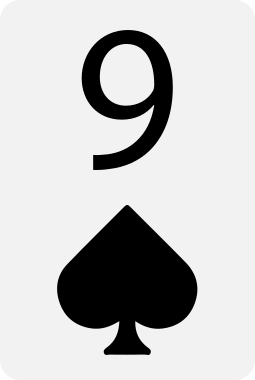
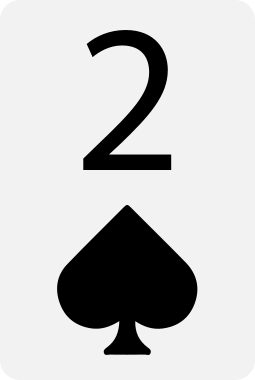
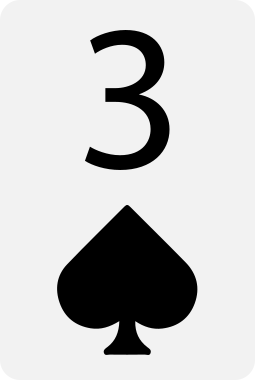
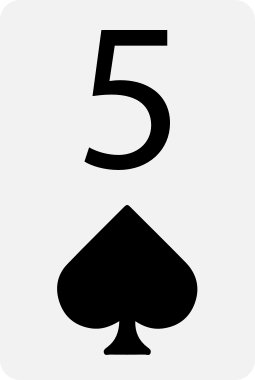
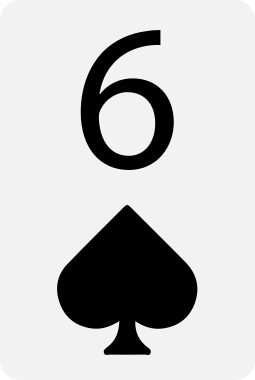
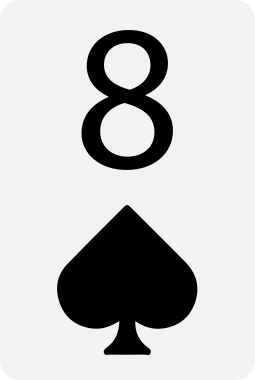
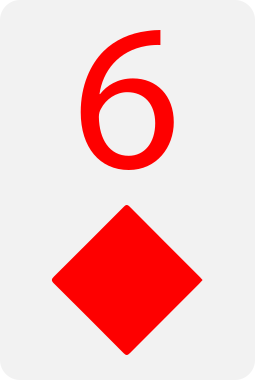
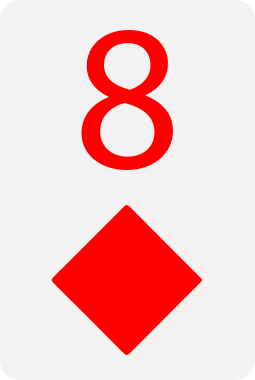
Ace-Nine Suited is a hand that sits in an interesting middle ground – strong enough to play in most situations, but not so powerful that it can be played recklessly. It combines the high-card strength of an Ace with a connected nine and, crucially, the flush potential that comes from both cards sharing a suit. That last point is what separates A9s from its offsuit equivalent and gives it a meaningful edge in the right spots.
Before the flop, A9s is a comfortable open from most positions and a reasonable 3-bet candidate in the right circumstances. Its strength lies not in dominating the field the way AK or a premium pair does, but in its ability to make strong, hard-to-read hands – particularly flushes and two pair – while also holding a live Ace.
What These Odds Show for A9s
Like all unpaired hands, A9s arrives at the flop as a high card the majority of the time. The 53.04% high card rate on the flop is the baseline reality of playing broadway and semi-broadway hands – you will frequently miss, and your post-flop decisions will matter.
The pair rate of 40.41% on the flop is consistent with other Ace-x hands, and those pairs carry real value. When you pair your Ace, you typically have top pair with a decent kicker. When you pair your nine, you have middle or bottom pair depending on the board, which requires more caution.
The flush numbers are where A9s genuinely distinguishes itself. A 0.84% chance of making a flush on the flop rises to 2.93% by the turn and 6.57% by the river. That river figure is substantially higher than an offsuit holding, and the flush you make is always the nut flush – the best possible flush – because you hold the Ace of that suit. That matters enormously. It means that when you do hit, you rarely have to worry about being beaten by a higher flush, which is one of the most expensive spots in Hold’em.
Two pair develops at 4.04% on the flop, climbing to 22.26% by the river. This is a meaningful secondary equity source, particularly on boards where both an Ace and a nine land, giving you top and bottom two pair.
The straight odds are notably lower for A9s than for AQo. With 0.00% on the flop, 0.63% by the turn and 2.49% by the river, the nine doesn’t connect to broadway the way the Queen does, and the gaps in between (A-9 skips a lot of connectors) limit straight possibilities. When straights do come in, they typically involve a wheel (A-2-3-4-5) or a mid-range run including the nine, but these are less frequently flopped cleanly.
Hand Strength Summary
- Hand type: Suited Ace-x, semi-connected
- Relative strength: Top 10–15% of all starting hands
- Dominates: Ace-x with kickers below nine, weaker suited hands in the same suit
- Dominated by: AK, AQ, AJ, AT, and pocket pairs of Ten or higher
A9s is a hand that plays better than its raw ranking suggests when position and implied odds are factored in. The nut flush draw is its defining asset.
How A9s Wins
A9s has more routes to winning than a typical offsuit hand of similar rank:
- Flopping top pair (Ace) and holding up
- Hitting the nut flush – the single most valuable draw available to this hand
- Making two pair with both the Ace and nine
- Flopping a flush draw and either completing it or winning with fold equity
- Occasionally making a straight, particularly the wheel (A-2-3-4-5)
- Set-like disguised hands (two pair, trips on paired boards) that opponents don’t see coming
The nut flush path deserves emphasis. When you flop the nut flush draw – which happens a meaningful portion of the time with a suited Ace – you have approximately 9 outs to the best possible flush. That draw, combined with any pair outs, can make A9s a significant favourite even when behind on the flop.
Main Weaknesses
A9s has genuine vulnerabilities that require careful management:
- The nine is a weak kicker – when an Ace pairs and an opponent holds AT, AJ, AQ, or AK, you lose the kicker battle
- High card on the flop 53.04% of the time means frequent tough decisions with no made hand
- Straight potential is limited compared to more connected holdings
- In 3-bet pots, you may find yourself with top pair weak kicker in a large pot – a notoriously uncomfortable spot
- Dominated by all higher Ace-x hands, which are common in opponents’ ranges
The kicker vulnerability is the most important factor. A9s is not a hand to be over-committed with on an Ace-high board without significant additional equity – a flush draw, two pair, or a read that your opponent doesn’t hold an Ace.
Best and Worst Flop Textures
Strong flops
- Ace-high boards with two cards of your suit – top pair and the nut flush draw simultaneously
- Nine-high boards that miss most of your opponents’ ranges – middle pair or better with disguise
- Monotone boards in your suit – immediate flush or strong draw
- Low boards (e.g. 9♦ 4♠ 2♣) where your nine is an overpair to the board
Dangerous flops
- Ace-high boards in multiway pots – kicker problems loom large
- Dry Ace-high boards where you have top pair but no flush draw – vulnerable to better kickers
- Coordinated boards in a different suit – you’ve missed and have limited outs
- Boards with Ten, Jack, Queen, or King alongside an Ace – your nine does no work and opponents connect heavily
How It Plays by Position
- Early position: Playable but best treated as a call or open-raise hand rather than a 3-bet squeeze; you’ll be out of position postflop often
- Middle position: A standard open; the suited nature gives you enough postflop equity to play profitably
- Late position (CO/BTN): Where A9s really shines. You can see cheap flops, realise your flush draw equity, and put pressure on missed boards in position
- Blinds: The nut flush potential plays well from the big blind when defending against a steal; out of position in 3-bet pots, proceed with caution
Position dramatically affects how well A9s can realise its equity. The flush draw is most valuable when you can control the price you pay to see cards.
Common Mistakes with A9s
- Over-valuing top pair on an Ace-high board and committing too many chips without the flush draw
- Not recognising when the flush draw alone gives you enough equity to continue
- Under-betting the nut flush draw – it deserves aggressive action as semi-bluff equity
- Calling 3-bets out of position too liberally – A9s is better suited to being the aggressor in position
- Forgetting the wheel straight possibility on boards like 2-3-4 or 2-3-5
Comparison to Similar Hands
- Stronger than: A8s, A7s, A6s and all weaker suited Ace-x; A9o (due to flush equity)
- Slightly weaker than: AT, AJ, AQ in terms of kicker strength and straight potential
- Competitive against: Suited connectors in a different suit – A9s has comparable or better equity due to the nut flush draw
Examples:
- Against ATs: A9s is a slight underdog – dominated by the Ten kicker but partially compensated by flush equity
- Against KK: A9s is roughly a 30% underdog, similar to other unpaired hands against premium pairs
- Against 87s: A9s has a modest equity edge – the suited Ace brings more raw high-card strength than the connected middle cards
- Against A9o: A9s is a clear favourite – identical rank cards, but the flush potential gives A9s a substantial equity boost
How A9s Performs in Multiway Pots
A9s is actually somewhat better suited to multiway pots than most dominated Ace-x hands, and the reason is the nut flush draw. When you have the nut flush draw in a multiway pot, you have:
- Roughly 9 outs clean – no opponent can have a better flush draw
- Implied odds that increase with more players
- The ability to continuation bet or check-raise as a semi-bluff with significant equity behind
That said, the kicker vulnerability remains. In a multiway pot where an Ace flops, multiple opponents may have paired it with a better kicker, leaving you in a dominated spot without the flush draw to bail you out. Discipline in reading the board texture is important.
FAQ: Ace-Nine Suited
Is A9s a premium hand?
Not quite, but it is a strong speculative hand. It sits just outside the premium tier but outperforms its rank because of the nut flush draw potential.
Should you 3-bet A9s?
Occasionally, as a light 3-bet in position against wide openers. It has enough equity and playability to justify it, but it is not a standard 3-bet hand from early position or out of position.
Why is the suited version so much better than A9o?
The flush draw probability by the river (6.57%) may seem modest in isolation, but the nut flush – when it arrives – is essentially an unbeatable hand. The ability to make the best possible flush without fear of a higher flush is a significant structural advantage over the entire course of play.
What is the wheel and why does it matter for A9s?
The wheel is the straight A-2-3-4-5. The Ace plays as the low card in this straight, meaning A9s can make it on the right board (e.g. 2♣ 3♦ 4♠). It’s a rare but disguised hand – opponents holding nothing but overcards won’t see it coming.
Related Hands