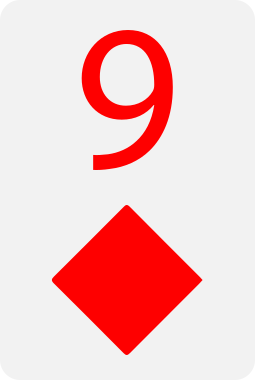
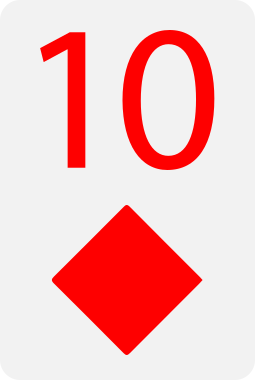
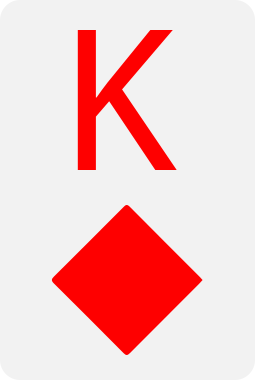
King-Nine Suited is a hand that rewards positional awareness more than almost any other in the suited one-gapper category. It combines the raw high-card strength of a King with the flush potential that comes from being suited, and adds a meaningful – if sometimes overlooked – straight draw capability through both the broadway end and the nine-high end of the board. It is not a hand to play from every position, but in the right spots it is a genuinely dangerous holding.
Before the flop, K9s sits in the upper portion of the speculative hand range. It is not a premium hand and should not be treated as one, but it has enough equity and post-flop flexibility to be profitable when played with position and discipline. The suited King is the key asset – it gives you the second-highest possible flush draw, behind only the Ace of that suit.
What These Odds Show for K9s
The high card flop rate of 52.71% is the lowest of any hand covered in this series so far for a non-pair holding, and the reason is the combined effect of two meaningful draw types – flush and straight – working alongside the standard pair probability. You still miss the board more often than not, but K9s has slightly more ways to connect than purely high-card hands like KQo.
The pair rate of 40.41% on the flop is consistent across all unpaired hands and is the baseline improvement you can expect. When you pair the King you have top pair on almost every board, and the nine kicker, while not strong, is disguised – opponents rarely put you on K9 and may pay off your top pair more readily than they would a more obvious holding.
The straight odds of 0.32% on the flop, 1.45% by the turn, and 3.75% by the river place K9s slightly above AQo (3.68%) and well above A9s (2.49%) despite the gap between King and Nine being larger than those hand combinations. The reason is that K9s has straight possibilities running in two directions. The King connects with broadway cards – a flop of Q-J-T gives an open-ended straight draw to the nut broadway straight – and the nine connects with middle-range cards like 8-7, 8-T, and 7-8 to form the lower end of straights. Neither direction is as clean as the connected broadway hands, but the two-directional nature gives K9s more raw straight combinations than its gapped structure might suggest.
The flush numbers are a defining feature. At 0.84% on the flop, 2.92% by the turn, and 6.52% by the river, K9s produces the second-nut flush. The distinction from A9s is important here – where A9s makes the nut flush (unbeatable by any other flush), K9s makes the King-high flush, which is the best flush possible when no Ace of that suit is on the board or in an opponent’s hand. In practice this is a very strong hand, but there is always the risk of running into the Ace-high flush when the board shows three or more cards of your suit. This is a consideration that does not exist with suited Aces.
The straight flush odds deserve a mention – 0.01% on the flop, 0.02% by the turn, and 0.06% by the river. These are small numbers, but they are slightly higher than the offsuit hands in this series because the suited nature of K9s creates rare but real straight flush possibilities, particularly around the nine-high end of the board.
The overcard odds of 22.55% on the flop, rising to 35.30% by the river, are identical to Pocket Kings and KQo, and for the same reason: the King is your highest card, and only the four Aces in the deck constitute overcards. This is one of the genuine structural advantages of holding a King – your overcard exposure is limited to a single rank. Any Ace on the board is a potential problem, but everything from Queen downward leaves your King uncontested at the top of the board.
Hand Strength Summary
- Hand type: Suited one-gap broadway connector
- Relative strength: Top 15–20% of all starting hands
- Dominates: K8s and below, weaker King-x suited and offsuit hands, nine-x hands with worse kickers
- Vulnerable to: AK (shares King, weaker kicker), KQ and KJ (shares King, weaker kicker), pocket pairs of Ten or higher, Ace-high flushes in your suit
K9s is a hand that relies on its suited nature and positional advantage to generate profit. Its raw high-card strength is moderate – the nine is a weak second card – but the flush draw and the King’s board coverage give it more playability than its rank gap suggests.
How K9s Wins
K9s has a broader range of winning routes than most hands at its strength level:
- Flopping top pair (King) with a board where opponents can’t easily have a better kicker
- Making the King-high flush – a strong and well-disguised hand
- Completing a straight, either through the broadway end (with Q, J, T) or the nine-high end (with 8, 7)
- Flopping a flush draw and applying pressure as a semi-bluff
- Two pair on boards containing both a King and a nine
- Occasionally making a straight flush around the nine-high combinations
The flush draw is the primary weapon in spots where you miss the board. A flopped King-high flush draw has nine outs to a very strong hand, and combined with any pair or straight draw outs, K9s can have substantial equity even when behind on the flop.
Main Weaknesses
K9s has clear vulnerabilities that shape how it should be played:
- The nine is a weak kicker – on King-high boards, KQ, KJ, and KT all have you dominated through the kicker
- The King-high flush can be beaten by the Ace-high flush – unlike A9s, you cannot be certain your flush is the best flush
- Kicker problems compound in 3-bet pots, where opponents hold stronger King-x combinations more frequently
- The 52.71% high card flop rate means you miss the board more than half the time, often with no draw
- Straight draws through the nine require fairly specific board textures to materialise
The kicker problem on King-high boards is the most expensive leak associated with K9s. It is tempting to continue strongly when you flop top pair, but K9s is often dominated in that spot and requires caution without the flush draw or additional equity.
Best and Worst Flop Textures
Strong flops
- King-high boards with two cards of your suit – top pair and the King-high flush draw simultaneously
- Low or mid boards (e.g. 9♦ 5♠ 2♣) – you have top pair or an overpair with the nine, and opponents are unlikely to connect strongly
- Three cards of your suit on the flop – immediate King-high flush
- Q-J-T boards – open-ended broadway straight draw, plus your King is already the nut straight card
- Nine-high coordinated boards including 8, 7, or T – straight draw potential through the nine
Dangerous flops
- King-high boards in raised or 3-bet pots – KQ, KJ, and KT will frequently have your kicker dominated
- Ace-high boards with three or more of your suit – you may make a flush but it loses to the Ace-high flush
- Dry boards with neither a King, a nine, nor flush draw cards of your suit – you have nothing and limited outs
- Multiway Ace-high boards – Ace-x holdings are common and your King does reduced work
How It Plays by Position
- Early position: Generally a fold or marginal open; the kicker weakness and suit vulnerability are harder to manage out of position
- Middle position: Playable as an open raise; fold to significant 3-bet pressure from tight ranges where you will frequently be dominated through the kicker
- Late position (CO/BTN): Where K9s is genuinely strong. You can steal from wide ranges, fold when you miss in position, and extract maximum value from your flush and straight draws with positional control
- Blinds: A reasonable defend against late position steals when the price is right; 3-bet pots out of position with K9s are difficult given the kicker and flush vulnerability
K9s is a hand that requires position to realise its equity. Without it, the kicker problems and missed board decisions become much more costly.
Common Mistakes with K9s
- Treating top pair as a strong hand in 3-bet pots – KQ, KJ, and KT dominate the kicker in exactly those spots
- Continuing on Ace-high boards with three or more of your suit without considering the Ace-high flush risk
- Not semi-bluffing aggressively enough with the King-high flush draw in position – it is a strong equity holding
- Open-raising from early position too often – K9s benefits significantly from positional advantage and suffers without it
- Over-folding the straight draw potential – a flopped open-ended draw with K9s is a meaningful equity holding that warrants continuation
Comparison to Similar Hands
- Stronger than: K8s, K7s, K6s and all weaker King-x suited hands; K9o by virtue of the flush equity
- Slightly weaker than: KTs, KJs, KQs – each of those holds a stronger kicker and better straight connectivity
- Competitive against: Suited connectors like 87s and 98s – K9s gives up some straight connectivity but gains the King’s board dominance and a stronger flush rank
Examples:
- Against KQo: K9s is a significant underdog – sharing the King means the Queen kicker dominates, though flush draw equity closes the gap somewhat
- Against AKo: K9s is dominated through the kicker; both pair a King equally but AK wins the kicker battle decisively
- Against 98s: K9s is a modest favourite – the King provides stronger high-card equity, though 98s has better straight connectivity
- Against K9o: K9s is a clear favourite – identical rank combination but the flush potential gives K9s a meaningful equity edge
How K9s Performs in Multiway Pots
K9s in multiway pots has a specific risk profile shaped by both its strengths and weaknesses:
- The King-high flush becomes slightly riskier in multiway pots – more opponents increases the chance someone holds the Ace of your suit
- Straight draw implied odds improve with more players – completing a straight in a multiway pot yields a larger pot
- Top pair with the nine kicker is even weaker multiway – more opponents means more chances someone holds a better King
- The flush draw semi-bluff becomes less effective as a bluffing tool but retains its equity value
The practical approach is to be selective: in multiway pots, heavily favour continuing with the flush draw or a completed strong hand, and be willing to fold one pair without significant additional equity. The strength of K9s in multiway situations is its drawing potential, not its pair value.
FAQ: King-Nine Suited
Is K9s worth playing?
Yes, particularly in position. It has a meaningful flush draw, two-directional straight potential, and top pair value on King-high boards. The key is avoiding spots where the kicker weakness is exposed, primarily in 3-bet pots out of position.
How dangerous is the King-high flush with K9s?
Very strong in most situations, but not invincible. The Ace-high flush beats it, so on boards showing three or more cards of your suit, you should be aware of opponents who may hold the Ace of that suit. Against a single opponent in position, the King-high flush wins the large majority of the time. In multiway pots, caution is warranted.
Why does K9s have slightly higher straight flush odds than the offsuit hands covered previously?
Because the suited nature of K9s means that when straight combinations involving both the King and Nine land in the same suit, a straight flush is possible. These are rare runouts, but they add a small but real probability that offsuit hands completely lack.
How does K9s differ from K9o strategically?
The flush draw changes the hand substantially. K9o is primarily a top-pair or fold hand. K9s has an additional equity source that allows it to continue profitably on many boards where K9o should fold, particularly when flopping a flush draw with or without pairing.
Related Hands