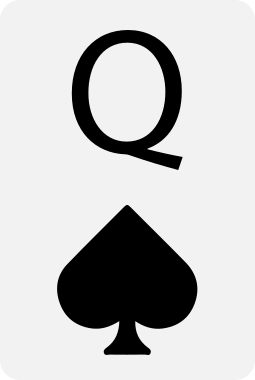
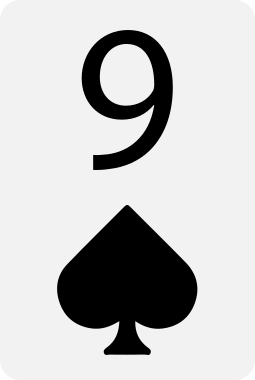
Queen-Nine Suited is a hand that sits at an interesting crossroads in the suited one-gapper category. It shares structural similarities with both K9s – a high card paired with a mid-range second card in the same suit – and the suited connector family represented by T9s, drawing elements from both without quite reaching the heights of either. What it offers is a genuine blend: meaningful flush draw equity through the Queen-high flush, stronger straight potential than K9s, a more manageable overcard problem than T9s, and enough board coverage to play profitably across a wide range of textures when handled with positional awareness.
Before the flop, Q9s is a speculative hand rather than a premium one. It is not looking to be the best hand preflop – it is looking to see a flop cheaply and build equity from there. In the right position and at the right price, it is a consistently profitable holding.
What These Odds Show for Q9s
The high card flop rate of 52.39% is the second lowest of any non-pair hand in this series, behind only T9s at 51.75%. The reason mirrors T9s: connected cards in the middle of the deck touch more board textures than gapped or high-card hands, and the suited nature adds a further layer of potential connectivity. Q9s misses the board more often than not, but it misses less often than purely high-card hands like AQo or K9s.
The pair rate of 40.41% on the flop is consistent across all unpaired hands. When Q9s pairs the Queen it typically has top pair on most boards, given the Queen’s high rank. When it pairs the Nine it usually has middle pair, which is a more nuanced holding – strong on low boards, vulnerable when opponents hold overcards and connect with them.
The straight odds are the first number that clearly separates Q9s from K9s. At 0.64% on the flop, 2.36% by the turn, and 5.36% by the river, Q9s significantly outpaces K9s (3.75% by the river) and approaches KQo (5.01%) despite holding a weaker second card. The structural reason is familiar: the Queen and Nine sit closer together in the middle of the deck than King and Nine, meaning more overlapping straight combinations run through both cards simultaneously. Q9s can connect with K-J-T for a Queen-high straight, J-T-8 for an open-ended draw through the nine and queen, T-8-7 running through the nine, and several other combinations. The Queen contributes to broadway straight draws while the Nine reaches into mid-range territory, giving Q9s a two-directional straight capability that K9s cannot fully replicate.
The flush odds of 0.83% on the flop, 2.90% by the turn, and 6.48% by the river place Q9s in familiar suited hand territory. The Queen-high flush is the third-highest possible flush, behind only Ace and King-high. This means two holdings in the same suit can beat it – the Ace-high and King-high flush – and this exposure is slightly greater than K9s (one higher flush possible) but meaningfully less than T9s (three higher flushes possible). In practice, the Queen-high flush is a very strong hand in most situations, but it requires a degree of awareness on flush-heavy boards that suited Ace hands do not.
The straight flush odds of 0.01% on the flop, 0.04% by the turn, and 0.11% by the river are higher than K9s (0.06% by the river) and reflect Q9s’s better straight connectivity. More overlapping straight combinations in its suit means more rare but real straight flush possibilities.
The overcard table is where Q9s occupies genuinely new ground compared to the King-high hands covered previously. With a Queen as the highest card, any King or Ace on the board constitutes an overcard. The 41.43% flop rate, 51.40% by the turn, and 59.85% by the river sit between the K9s figures (22.55% / 29.14% / 35.30%) and the T9s figures (69.47% / 79.86% / 86.87%). This middle position reflects the Queen’s rank precisely – eight ranks above the Two, four ranks below the Ace – and it is a meaningful distinction. More than half of all rivers will contain at least one overcard to the Queen, but nearly 40% will not. There is a real slice of board textures where the Queen stands uncontested at the top of the board, and that gives Q9s genuine top pair value that T9s struggles to access as reliably.
Hand Strength Summary
- Hand type: Suited one-gap connector, upper mid-range
- Relative strength: Top 15–20% of all starting hands
- Dominates: Q8s and below, weaker Queen-x suited and offsuit hands, nine-x hands with a weaker kicker
- Vulnerable to: AQ and KQ (share the Queen, hold a better kicker), higher pocket pairs, Ace-high and King-high flushes in its suit
Q9s is best understood as a hand with three genuine equity sources – top pair on Queen-high boards, a meaningful straight draw, and a Queen-high flush draw – and the ability to combine two or more of those sources on the right flop.
How Q9s Wins
Q9s has a broader set of winning routes than its rank might suggest:
- Flopping top pair with the Queen on boards where opponents have not connected
- Completing a straight, particularly through the Queen-high or mid-range combinations
- Making a Queen-high flush – a strong and well-disguised result
- Making two pair with both the Queen and Nine on the right boards
- Semi-bluffing with an open-ended straight draw, flush draw, or both simultaneously
- Making a straight flush on rare but real combinations running through both cards in suit
The combination flop is the most valuable scenario. When Q9s flops both a flush draw and an open-ended straight draw – for example on a board of J♠ 8♠ 3♦ when holding Q♠ 9♠ – it has fifteen or more combined outs to a very strong hand. That is a scenario where Q9s is a favourite over most made hands, and it should be played with corresponding aggression.
Main Weaknesses
Q9s has clear vulnerabilities that shape how it must be played:
- The Nine is a weak kicker – on Queen-high boards, KQ, AQ, and JQ all have the kicker covered
- The Queen-high flush can be beaten by Ace and King-high flushes – two possible better holdings in the same suit
- The 52.39% high card flop rate means frequent decisions with nothing made
- In 3-bet pots the kicker weakness is exposed most acutely – opponents 3-betting hold stronger Queen-x combinations at higher frequency
- Straight draws require specific board textures and are not always clean – gutshots and partial draws are easier to misread as stronger than they are
The kicker problem on Queen-high boards is the most consistently expensive leak with Q9s. Top pair with a Nine kicker is a hand that can cost a great deal against opponents holding KQ or AQ, particularly in raised pots where those hands feature prominently.
Best and Worst Flop Textures
Strong flops
- Queen-high boards with two cards of your suit – top pair and the Queen-high flush draw simultaneously
- J-T-x or J-8-x boards – open-ended straight draw through the Queen and Nine, often with multiple nut combinations
- Low or mid boards (e.g. 9♦ 5♠ 2♣) – the Nine gives top pair on boards opponents are unlikely to connect with
- Three cards of your suit – immediate Queen-high flush
- Boards that give both a straight draw and flush draw in your suit – the combination is a monster semi-bluffing hand
Dangerous flops
- Queen-high boards in raised or 3-bet pots – KQ and AQ are likely in opponents’ ranges and dominate through the kicker
- Ace or King-high boards with three or more of your suit – flush draw is live but can be beaten by higher flushes
- Dry boards with no Queen, no Nine, and no draw – you have nothing and limited paths to improvement
- Multiway pots with a Queen on an otherwise connected board – more opponents means more chances someone holds a better Queen or a straight draw through the same cards you need
How It Plays by Position
- Early position: Generally a fold; the kicker weakness and flush vulnerability are hardest to manage without positional control over multiple streets
- Middle position: A marginal open; playable at looser tables but best avoided against tight ranges where Queen-x domination is more likely
- Late position (CO/BTN): The natural home of Q9s – steal wide, fold when you miss without a draw, and attack hard when a straight draw or flush draw is live
- Blinds: A reasonable defend against late position steals given the pot odds and board coverage; in 3-bet pots out of position the hand becomes difficult across multiple streets
Position allows Q9s to realise its drawing equity at the right price and fold without cost when nothing develops. Without it, the kicker weakness and flush vulnerability compound over multiple streets.
Common Mistakes with Q9s
- Continuing with top pair Nine kicker in large pots without additional equity – this is a trap hand on Queen-high boards in raised pots
- Not semi-bluffing aggressively enough with combination draws – a flopped flush draw and straight draw together is a powerful equity holding that warrants significant pressure
- Overestimating the Queen-high flush – on boards with heavy action from multiple opponents, Ace and King-high flushes are realistic holdings to consider
- Playing from early position too often – Q9s depends on position to navigate its vulnerabilities profitably
- Treating gutshot straight draws as equivalent to open-ended draws – Q9s sometimes picks up partial straight draws that are significantly weaker than the open-ended combinations
Comparison to Similar Hands
- Stronger than: Q8s, Q7s and all lower Queen-x suited hands; Q9o by virtue of flush and straight flush equity; J9s in raw high-card value
- Slightly weaker than: KQs and QJs – KQs holds a stronger second card and better broadway connectivity; QJs has better straight connectivity and a stronger kicker
- Most comparable to: K9s in structure, T9s in playing style – Q9s borrows from both, sitting between them in almost every measurable dimension
Examples:
- Against KQo: Q9s is a significant underdog – sharing the Queen means the King kicker dominates, though flush draw equity narrows the gap
- Against JJ: Q9s is approximately a 35% underdog preflop – a pair versus a one-gapper with draws; the straight and flush potential give Q9s more equity than raw rank suggests
- Against T9s: Q9s is a modest favourite – the Queen provides better board coverage and a stronger flush rank, though T9s has better straight connectivity
- Against Q9o: Q9s is a clear favourite – identical ranks but flush and straight flush potential give Q9s a meaningful equity edge
How Q9s Performs in Multiway Pots
Q9s has a specific multiway profile shaped by the interaction of its three equity sources:
- Straight draw implied odds improve with more players – the 5.36% river straight rate builds a larger pot when multiple opponents contribute
- The Queen-high flush becomes slightly riskier multiway – more opponents increases the chance someone holds the Ace or King of the suit
- Top pair Nine kicker is weak multiway – more opponents means more chances someone holds a better Queen
- Combination draws – flush draw plus straight draw simultaneously – retain strong equity in multiway pots regardless of fold equity
The practical approach is consistent with other suited one-gapper hands: in multiway pots, continue with full draws, exercise caution with one pair, and never try to fight for a large multiway pot with top pair weak kicker on a board where opponents are connecting. Q9s’s multiway value lies in its drawing potential and the implied odds when those draws complete.
FAQ: Queen-Nine Suited
How does Q9s compare to K9s?
Q9s has meaningfully better straight potential – 5.36% by the river versus 3.75% for K9s – because the Queen and Nine sit closer together in the deck and create more overlapping straight combinations. K9s compensates with a stronger second-nut flush (one higher flush possible versus two for Q9s) and a lower overcard rate. Both hands play similarly in most situations, but Q9s is the more draw-oriented of the two while K9s relies slightly more on its King for board dominance.
Is the Queen-high flush strong enough to commit chips with?
In most situations, yes – a Queen-high flush is a very strong made hand. The caveat is board texture and opponent count. Against a single opponent on a three-flush board with little action, it is likely the best hand. In a multiway pot with significant action on a four-flush board, Ace and King-high flushes become realistic holdings and caution is warranted. Reading the specific situation matters more than the hand rank alone.
Should Q9s ever be used as a 3-bet hand?
Occasionally, as a light 3-bet in position against wide late-position openers. It has enough equity through its straight and flush draw potential to function as a semi-bluff 3-bet and plays well in position with initiative. It is not a standard 3-bet hand, and out of position against tight ranges it should generally be folded or flatted.
Why does Q9s have higher straight odds than KQo despite holding a weaker second card?
Because the gap between Queen and Nine (four ranks) is smaller than the gap between King and Queen in terms of straight combinations – KQo actually has strong straight potential too, but Q9s benefits from the Nine reaching into mid-range territory where KQo cannot. More importantly, both the Queen and Nine contribute to multiple overlapping straight combinations from different directions, giving Q9s a broader range of straight-completing boards than a pure broadway hand like KQo achieves.
Related Hands