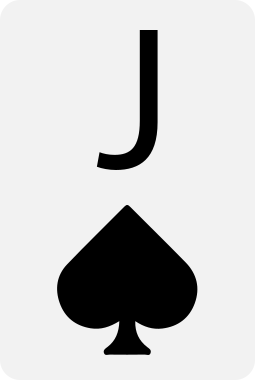
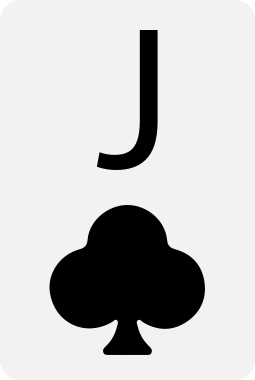
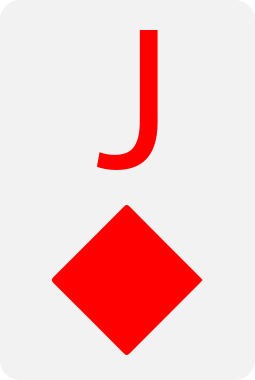
Pocket Jacks has a reputation unlike any other hand in Texas Hold’em. It is universally acknowledged as a premium starting hand – strong enough to raise and 3-bet without hesitation – yet it generates more frustration, debate, and second-guessing than perhaps any hand in the game. There is even a well-worn joke among poker players that there are only three ways to play Jacks, and all three are wrong.
The numbers on this page go a long way to explaining why.
What These Odds Show for JJ
The draw odds for Jacks look familiar on the surface – one pair on the flop at 71.84%, improving to two pair (39.52%), three of a kind (11.73%), or a full house (8.55%) by the river. These figures are virtually identical to AA, KK, and QQ, because all pocket pairs share the same structure of improvement paths.
The overcard table, however, is where Jacks reveals its true character – and where it diverges dramatically from the hands above it.
There is a 56.96% chance that an overcard – an Ace, King, or Queen – appears on the flop. That is a majority of flops. By the turn, that figure rises to 67.95%, and by the river it reaches 76.31%. In other words, in more than three quarters of all hands played with Pocket Jacks, the board will contain at least one card that beats a Jack before showdown.
Compare that to QQ at 41.43% on the flop, KK at 22.55%, and AA at 0%. The jump from Queens to Jacks – adding one additional overcard rank – produces a 15-point increase in overcard exposure on the flop alone. This is the root cause of almost every difficulty associated with playing Jacks well.
The higher pocket pair table compounds this further. With three ranks above it (AA, KK, QQ), Jacks faces a 1.47% chance per opponent of being dominated by a higher pocket pair before the flop. At a full nine-player table, that rises to 12.59% – meaning roughly 1 in 8 full-table hands will see Jacks face a superior pair from the start.
Hand Strength Summary
- Hand type: Premium pocket pair
- Relative strength: Top 5 starting hands; fifth strongest overall
- Dominates: TT and below, most non-premium broadway hands
- Main vulnerabilities: AA, KK, QQ preflop; Ace, King, and Queen-high boards postflop
Jacks is powerful enough to warrant aggressive play in virtually every preflop situation, but it demands more postflop discipline and board-reading skill than any of the hands above it.
How Pocket Jacks Wins
Despite its reputation, Jacks wins in several well-defined ways:
- Holds as the best hand against lower pairs on low boards
- Improves to a set – the most valuable outcome with this hand
- Applies preflop pressure to force out hands with overcards before they can realise equity
- Dominates mid-range hands such as TT, 99, AT, and KJ
- Wins uncontested through continuation betting on low, dry boards
The 10.78% chance of flopping a set of Jacks is especially significant here. A Jack on a board of A♠ K♦ J♣ is far better concealed than top set would be for AA or KK, because opponents naturally focus on the two overcards rather than the apparent danger of the bottom card.
Main Weaknesses
The list of threats facing Jacks is longer than for any other hand in the top five:
- Dominated preflop by AA, KK, and QQ
- An overcard appears on the majority of all flops (56.96%)
- Opponents holding AK, AQ, KQ, or QJ all have live cards against a Jack-high board
- Difficult to play confidently in multiway pots where any overcard is likely to have connected
- One pair of Jacks is vulnerable to the wide range of two pair or better hands that develop by the river
Jacks requires a level of postflop awareness that is not needed with AA or KK, and even goes beyond what QQ demands given the additional overcard rank in play.
Best and Worst Flop Textures
Strong flops
- Low boards with no Ace, King, or Queen (e.g. 9♣ 6♦ 2♠) – Jacks is an overpair and can play aggressively
- Jack-high boards – top set, often in a disguised spot
- Paired low boards where opponent ranges are unlikely to have connected
Dangerous flops
- Any board containing an Ace, King, or Queen – the majority of all flops
- Coordinated boards where straight and flush draws are live alongside overcards
- Multiway pots on high boards where multiple opponents may have connected
A clean, low flop with Pocket Jacks is a relief – and statistically, it arrives less than half the time.
How It Plays by Position
- Early position: Raise strongly. Jacks is too good to limp, and a preflop raise narrows the field before the overcard-heavy flop arrives.
- Middle position: Standard raise or 3-bet. Consider the likely calling range of players still to act.
- Late position: Excellent for isolating and building a pot. Position is especially valuable with Jacks given the frequent need to make reads postflop.
- Blinds: Play firmly preflop but be prepared to check-call rather than lead on overcard-heavy boards, particularly in multiway pots.
Position matters more with Jacks than with AA or KK precisely because so many flops require a decision about whether your hand is still the best one.
The Right Way to Think About Jacks
The difficulty players have with Jacks usually comes from one of two errors: either they overvalue it by treating it like AA, continuing aggressively on every overcard board, or they undervalue it by becoming passive preflop out of fear of the overcards to come.
The correct approach sits between the two. Jacks is a strong hand preflop that should always be played aggressively to reduce the field and deny opponents their equity. Postflop, it requires an honest assessment of the board. On low boards, play it hard. On overcard boards, consider the range of hands your opponent would call a 3-bet with – many of those hands contain the very cards now on the board.
The 56.96% flop overcard rate is not a reason to shy away from Jacks. It is a reason to understand the hand deeply.
Common Mistakes with Pocket Jacks
- Limping or under-raising preflop to avoid difficult postflop spots
- Automatically folding to aggression on overcard boards without considering the opponent’s full range
- Committing too many chips on multi-street action against passive players who show strength on overcard boards
- Failing to check back or pot control when the board is dangerous and stack-to-pot ratio is high
- Playing Jacks the same way regardless of position, opponent tendencies, and board texture
Comparison to Similar Hands
- Stronger than: TT, 99, AQs, KQs
- Beaten preflop by: AA, KK, QQ
- The draw odds mirror those of higher pocket pairs, but the overcard exposure is dramatically higher
Examples:
- Against TT: Jacks is a dominant favourite – approximately 80% preflop
- Against AKs: Jacks is a slight favourite preflop, but AKs has significant drawing equity
- Against QQ: Jacks is a significant underdog, roughly 18% to win
How Pocket Jacks Performs in Multiway Pots
Jacks suffers considerably in multiway pots. The 56.96% overcard flop rate means it is the statistical norm for at least one opponent in a multiway hand to have connected with an Ace, King, or Queen. Fold equity is essential with Jacks – the hand performs best when it has reduced the field to one or two opponents before the flop.
This makes preflop aggression with Jacks not a stylistic preference, but a mathematical necessity.
FAQ: Pocket Jacks
Why is JJ considered so difficult to play?
Because it sits at the precise point where overcard boards shift from uncommon to routine. With QQ, an overcard flop is a meaningful concern. With JJ, it is the expected outcome. That reality requires a level of postflop discipline that trips up even experienced players.
Should you always 3-bet with Jacks?
In most situations, yes. The goal is to narrow the field and deny equity to hands like AQ and KQ that are currently behind but would pick up outs against almost any flop.
How do you play Jacks on an Ace-high flop?
Against a single opponent who called a preflop raise from a wide range, a continuation bet can still be correct – many of those ranges miss the Ace. Against a tight, passive player who suddenly shows interest, checking back and re-evaluating is often the safer line.
Is it ever correct to fold Jacks preflop?
Very rarely, and only in specific tournament spots against extremely narrow 4-bet or all-in ranges from tight players. In the vast majority of cash game and tournament situations, Jacks should be played preflop without hesitation.
Related Hands