Pocket Queens Draw Odds

back of playing card back of playing card back of playing card back of playing card back of playing card
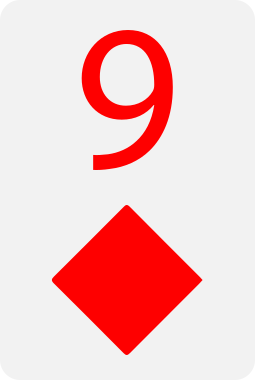
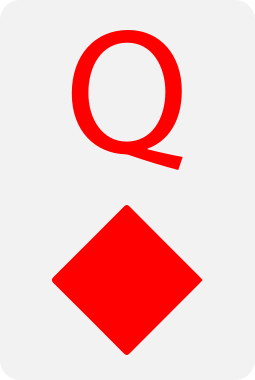
Queen of Spades Queen of Hearts
Two of Spades
Three of Spades
Four of Spades
Five of Spades
Six of Spades
Seven of Spades
Eight of Spades
Nine of Spades
Ten of Spades
Jack of Spades
Queen of Spades
King of Spades
Ace of Spades
Two of Hearts
Three of Hearts
Four of Hearts
Five of Hearts
Six of Hearts
Seven of Hearts
Eight of Hearts
Nine of Hearts
Ten of Hearts
Jack of Hearts
Queen of Hearts
King of Hearts
Ace of Hearts
Two of Clubs
Three of Clubs
Four of Clubs
Five of Clubs
Six of Clubs
Seven of Clubs
Eight of Clubs
Nine of Clubs
Ten of Clubs
Jack of Clubs
Queen of Clubs
King of Clubs
Ace of Clubs
Two of Diamonds
Three of Diamonds
Four of Diamonds
Five of Diamonds
Six of Diamonds
Seven of Diamonds
Eight of Diamonds
Nine of Diamonds
Ten of Diamonds
Jack of Diamonds
Queen of Diamonds
King of Diamonds
Ace of Diamonds

Draw Odds

Hand On The Flop By The Turn By The River
High Card 0.00 % 0.00 % 0.00 %
Pair 71.84 % 54.26 % 35.70 %
Two Pair 16.16 % 28.54 % 39.60 %
Three Of A Kind 10.78 % 12.23 % 11.75 %
Straight 0.00 % 0.33 % 1.59 %
Flush 0.00 % 0.43 % 1.96 %
Full House 0.98 % 3.71 % 8.55 %
Four Of A Kind 0.24 % 0.49 % 0.84 %
Straight Flush 0.00 % 0.00 % 0.01 %

Odds Of An Overcard On The Board

On The Flop By The Turn By The River
41.43 % 51.40 % 59.85 %

Odds Of An Opponent Having a Higher Pocket Pair

Number Of Opponents Odds
1 0.98%
2 1.95%
3 2.92%
4 3.88%
5 4.84%
6 5.79%
7 6.73%
8 7.66%
9 8.59%

Pocket Queens (QQ) – Odds Breakdown and Analysis

Pocket Queens is the third strongest starting hand in Texas Hold’em, behind only Pocket Aces and Pocket Kings. It is a genuine premium hand – one that warrants aggressive play before the flop – but it comes with a postflop complexity that the top two hands do not share: overcards are the norm, not the exception.

Understanding that distinction is key to playing Queens well.


What These Odds Show for QQ

The draw odds for Queens look familiar at a headline level. The most common made hand on the flop is one pair at 71.84%, dropping to 35.70% by the river as the hand frequently improves into two pair (39.60%), three of a kind (11.75%), or a full house (8.55%).

But the overcard table is where Queens diverges sharply from AA and KK. With Queens, there is a 41.43% chance that an overcard – an Ace or a King – appears on the flop. By the river, that figure rises to 59.85%. In other words, on the majority of runouts, the board will contain at least one card that beats a Queen.

This does not mean Queens is a weak hand. It means that navigating boards correctly, rather than playing Queens mechanically, is what separates players who profit from the hand from those who do not.

The higher pocket pair table also reflects Queens’ wider vulnerability. Against a single opponent, there is a 0.98% chance they hold either AA or KK – double the same figure for Kings. At a full nine-player table, that rises to 8.59%, meaning roughly one in twelve full-table hands will see Queens face a higher pocket pair before the flop.


Hand Strength Summary

  • Hand type: Premium pocket pair
  • Relative strength: Top 3 starting hands
  • Dominates: JJ and below, most broadway hands, suited connectors
  • Main vulnerabilities: AA, KK, and overcard-heavy boards

Queens enters the flop as a strong favourite in most scenarios, but with the awareness that more than 4 in 10 flops will introduce at least one card that outranks it.


How Pocket Queens Wins

Pocket Queens wins in several distinct ways:

  • Holds as the best one pair hand at showdown on low boards
  • Improves to a set, two pair, or full house
  • Applies preflop pressure that forces folds from weaker holdings
  • Dominates hands like JJ, TT, AJ, and KQ

The 10.78% chance of flopping a set is particularly valuable with Queens, because a set of Queens on an overcard board is far more disguised than top pair. Opponents holding AK or KQ on an Ace-King high board are unlikely to put you on a set.


Main Weaknesses

Queens faces a broader set of threats than AA or KK:

  • Dominated preflop by both AA and KK
  • An overcard appears on the flop in nearly 4 out of 10 hands
  • By the river, the majority of boards will contain an Ace or a King
  • Difficult to continue confidently in multiway pots on high boards

This is why many experienced players describe Queens as the trickiest of the premium pairs to play well. It is strong enough to always play aggressively preflop, but nuanced enough postflop to require genuine read of the situation.


Best and Worst Flop Textures

Strong flops

  • Low boards with no Ace or King (e.g. 9♦ 6♣ 2♠)
  • Queen-high boards – top set with strong concealment
  • Dry, unconnected boards that give opponents little to work with

Dangerous flops

  • Ace-high or King-high boards, particularly in multiway pots
  • Coordinated boards with flush and straight draw potential (e.g. J♠ T♠ 9♦)
  • Boards where an opponent’s calling range connects well (e.g. A♣ K♦ Q♠ – top set, but an opponent with AK has two pair)

The good news is that a Queen-high flop – giving you top set – is one of the more profitable spots in poker. The bad news is that the majority of flops will not be Queen-high.


How It Plays by Position

  • Early position: Raise strongly. Queens is too good to limp, and you want to build the pot and narrow the field.
  • Middle position: Standard raise. Consider the likelihood of a 3-bet from players still to act.
  • Late position: Excellent spot to 3-bet or isolate. Queens plays well in position postflop.
  • Blinds: Still a premium hand, but play carefully facing aggression from tight early position ranges.

Queens is one of the few hands where facing a 4-bet preflop genuinely warrants consideration. Against a tight, aggressive player, a 4-bet range is heavily weighted towards AA and KK – both of which have Queens crushed.


Common Mistakes with Pocket Queens

  • Folding preflop to 3-bets too often (Queens is still premium against most 3-bet ranges)
  • Calling 4-bets too loosely against tight players
  • Continuation betting automatically on Ace-high or King-high flops without considering opponent range
  • Giving up too easily when overcards appear – a set of Queens on a high board is strong, not scary
  • Stacking off postflop against passive players who suddenly show aggression on overcard boards

Comparison to Similar Hands

  • Stronger than: JJ, TT, AKs, and all other non-premium pairs
  • Beaten preflop by: AA and KK only
  • Draw odds are nearly identical to AA and KK, but postflop texture matters far more

Examples:

  • Against JJ: Queens is a dominant favourite
  • Against AKo: Queens is ahead preflop, but AK has significant equity
  • Against KK: Queens is a significant underdog, roughly 18% to win

How Pocket Queens Performs in Multiway Pots

Queens suffers more in multiway pots than either AA or KK. The 41.43% overcard flop rate means that in a multiway pot, it is very likely at least one opponent connects meaningfully with a high flop. This makes aggressive preflop play with Queens not just about value, but about creating a heads-up dynamic where overcard boards are easier to navigate and fold equity is retained.


FAQ: Pocket Queens

Should you always raise preflop with Queens?

Yes, without exception. Queens is a premium hand and should be raised or 3-bet preflop in every situation.

Should you fold Queens to a 4-bet?

It depends on the player and the situation. Against a tight, straightforward opponent who very rarely 4-bets, folding Queens can be correct. Against an aggressive player with a wide 4-bet range, calling or re-shoving is often right.

How do you play Queens on an Ace-high flop?

Carefully. Check-call or check-fold rather than leading out is often the correct approach, particularly in multiway pots or against players who would not continue without an Ace.

Why does QQ feel harder to play than AA or KK?

Because it is. The 41.43% overcard flop rate means Queens frequently faces ambiguous postflop situations that AA and KK simply do not encounter at the same frequency.


Related Hands

Poker Odds Calculator Explained
Use Bet Shrew Poker Odds Calculator to calculate the odds of making a hand while playing Texas Hold‘em poker.

Poker is a game of incomplete information as you do not have access to your opponent's hole cards while making your betting decisions. Unlike other online Poker Odds Calculators, the Bet Shrew Poker Odds Calculator reflects this and calculates your odds based only on the cards that you can see.

The Bet Shrew Poker Odds Calculator is perfect for beginners and intermediate players wanting to calculate their draw odds and outs quickly and accurately without any complicated maths.

The various odds tables that you may encounter while using the Bet Shrew odds calculator are explained below.

Starting Hand Odds

Before you have even been dealt your hand, the calculator will show you the odds of being dealt different possible starting hands. For example, it will show you the odds of being dealt pocket aces (note: this can be applied to any specific pair).

These odds can be particularly useful when you are short stacked, waiting for that all-in opportunity.

Draw Odds

When you specify your hole cards, the calculator will consider every possible combination of cards that can still be drawn from the deck, evaluate what hand you would make for each possible combination and calculate the odds of you making each hand.

The draw odds table will breakdown your odds of making a hand on the flop, by the turn and by the river.

Odds of a Higher Poker Pair

When you have a pocket pair, the Poker Odds Calculator will show you the odds of an opponent holding a higher pocket pair.

The odds of an opponent holding a higher pocket pair is dependent on how high your pocket pair is and the number of players at you table. The odds presented will automatically consider the cards you are holding and then show you a breakdown of the odds based on the number of players.

Please note that these odds are based on the number of players at your table, not the number of players in the hand. This is important to note because a player at your table could be dealt a higher pocket pair but fold.

Odds of an Over Card

The odds of an over card table shows the odds that a card with a higher value than your highest denomination card will be drawn on the board.

Knowing the odds of an over card being drawn allows you to bet an appropriate amount to price out players fishing for a higher pair.

To set your hole cards or any community cards, simply click on the card you wish to set from the deck. As you click on cards from the deck, first your hole cards will be set, followed by the flop, the turn and then the river. As you set the cards in the hand, draws odds will automatically be calculated and displayed.

To unset a card, simply click on it to return it to the deck. Clicking the new hand button will reset the whole table and allow you to calculate the odds for a new hand.

How are draw odds calculated?

To calculate your draw odds, the calculator generates every possible combination of cards that could be drawn from the deck. For each combination, it evaluates the best 5 card hand that can be made and tallies up how often that a hand is made. This yields the precise probability of making each hand type.

This is a computationally expensive process. For speed and performance benefits, draws odds have been pre-computed and stored. This means that rather than recalculating draw odds every time, the calculator only needs to lookup the correct values from a table; albeit a very large table.

For a guide on how to calculate draw odds manually yourself, see our guide to calculating draw odds and outs.

Why are the draw odds different to what I expected?

Calculating draw odds is tricky. To understand how and why the odds above may not be quite what you expected it is best to use an example.

Let's say that you have AS and KS in your hand and you want to know the odds of making a pair on the flop. There are 6 cards that can make you a pair (3 Aces and 3 Kings).

To calculate your odds you may intuitively say that the odds of drawing an Ace or a King as the first card of the flop is 6 divided by the 50 remaining cards in the deck and you would be correct.

For the second card of the flop you might be inclined to say that it would be 6 divided by the 49 cards remaining in the deck. However, you must also consider what impact the first flop card made on your odds. This is where the math can get tricky.

Let’s say the first flop card is a 7D. If the second flop card is any other 7, even though you have not paired your hole cards, the hand you have made is still a pair; a pair of sevens.

Using the same example of AS, KS, another consideration is what if you make a better hand like 2 pair or 3 of a kind?

If the first of the flop cards is an Ace, great you've made top pair! However, if another Ace or a King comes you have no longer made a pair you have made a better hand.

The Bet Shrew odds calculator factors these consideration in as it determines every possible combinations of cards that could be drawn, evaluates the best 5 card hand that can be made and aggregates the results to determine their probabilities.

For draw odds based on outs, check out our drawing odds and outs table.