Pocket Kings Draw Odds

back of playing card back of playing card back of playing card back of playing card back of playing card
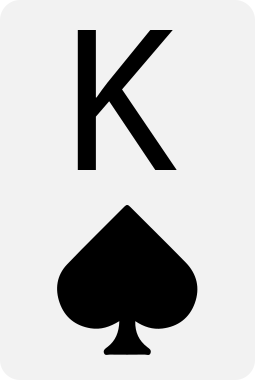
King of Spades King of Hearts
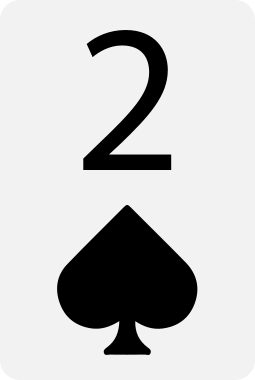
Two of Spades
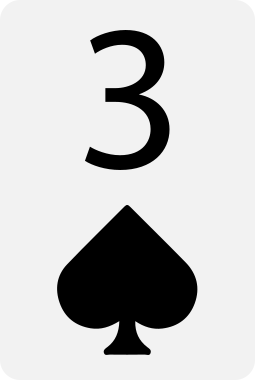
Three of Spades
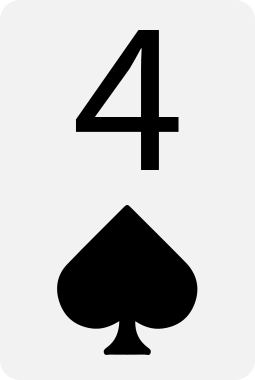
Four of Spades
Five of Spades
Six of Spades
Seven of Spades
Eight of Spades
Nine of Spades
Ten of Spades
Jack of Spades
Queen of Spades
King of Spades
Ace of Spades
Two of Hearts
Three of Hearts
Four of Hearts
Five of Hearts
Six of Hearts
Seven of Hearts
Eight of Hearts
Nine of Hearts
Ten of Hearts
Jack of Hearts
Queen of Hearts
King of Hearts
Ace of Hearts
Two of Clubs
Three of Clubs
Four of Clubs
Five of Clubs
Six of Clubs
Seven of Clubs
Eight of Clubs
Nine of Clubs
Ten of Clubs
Jack of Clubs
Queen of Clubs
King of Clubs
Ace of Clubs
Two of Diamonds
Three of Diamonds
Four of Diamonds
Five of Diamonds
Six of Diamonds
Seven of Diamonds
Eight of Diamonds
Nine of Diamonds
Ten of Diamonds
Jack of Diamonds
Queen of Diamonds
King of Diamonds
Ace of Diamonds

Draw Odds

Hand On The Flop By The Turn By The River
High Card 0.00 % 0.00 % 0.00 %
Pair 71.84 % 54.37 % 35.98 %
Two Pair 16.16 % 28.54 % 39.67 %
Three Of A Kind 10.78 % 12.23 % 11.77 %
Straight 0.00 % 0.22 % 1.22 %
Flush 0.00 % 0.43 % 1.96 %
Full House 0.98 % 3.71 % 8.55 %
Four Of A Kind 0.24 % 0.49 % 0.84 %
Straight Flush 0.00 % 0.00 % 0.01 %

Odds Of An Overcard On The Board

On The Flop By The Turn By The River
22.55 % 29.14 % 35.30 %

Odds Of An Opponent Having a Higher Pocket Pair

Number Of Opponents Odds
1 0.49%
2 0.98%
3 1.47%
4 1.96%
5 2.44%
6 2.93%
7 3.42%
8 3.91%
9 4.39%

Pocket Kings (KK) – Odds Breakdown and Analysis

Pocket Kings is the second strongest starting hand in Texas Hold’em, beaten only by pocket aces. It is a premium pair with extremely high raw equity and strong performance across almost all game formats.

Before the flop, KK is typically ahead of every other hand except AA, making it a dominant favourite in most scenarios.


What These Odds Show for KK

With Pocket Kings, the most common made hand on the flop is still one pair, at 71.84%. By the river, that drops to 35.98%, not because the hand gets worse, but because many runouts improve it into stronger categories like two pair (39.67%), three of a kind (11.77%), or full house (8.55%).

One of the most interesting numbers on this page is the 22.55% chance of an overcard appearing on the flop. Since Kings only fears Aces as a higher rank overcard, this table quantifies how often the board will immediately introduce that kind of pressure. By the river, the chance of at least one overcard appearing rises to 35.30%.

Another useful table is the chance that an opponent was dealt a higher pocket pair before the flop. For Pocket Kings, that means only Pocket Aces. Against 1 opponent, the chance is 0.49%. Even at a full 9-opponent table, it is still only 4.39%. That makes Kings a premium starting hand not just because it is strong, but because the number of hands that have it crushed from the start is extremely small.


Hand Strength Summary

  • Hand type: Premium pocket pair
  • Relative strength: Top 1% of all starting hands
  • Dominates: Most broadway hands, medium pairs, suited connectors
  • Main vulnerability: Against pocket aces

Pocket Kings combines high-card strength with immediate showdown value, meaning it does not rely on improving to win.


How Pocket Kings Wins

Pocket Kings typically wins in a few key ways:

  • Holds as the best hand at showdown
  • Improves to a set (three of a kind)
  • Forces folds preflop or on early streets
  • Dominates weaker king-x hands

Because it starts so strong, much of its value comes from being ahead immediately, not from drawing.


Main Weaknesses

Despite its strength, KK has clear risks:

  • Completely dominated by pocket aces
  • Vulnerable on Ace-high flops
  • Can lose to multiway variance (more opponents = more outs against you)
  • Rarely improves beyond one pair unless it hits a set

The biggest strategic challenge with Kings is correctly navigating Ace-high boards, where its relative strength drops significantly.


Best and Worst Flop Textures

Strong flops

  • Low disconnected boards (e.g. 7♣ 3♦ 2♠)
  • King-high boards (top set potential)
  • Dry boards with no straight or flush draws

Dangerous flops

  • Ace-high boards (A♠ 8♦ 4♣)
  • Coordinated boards (J♠ T♠ 9♦)
  • Multiway pots with draw-heavy textures

These scenarios materially change how aggressively the hand should be played.


How It Plays by Position

  • Early position: Always a raise / 3-bet candidate
  • Middle position: Aggressive play standard
  • Late position: Strong value hand, often used to build pots
  • Blinds: Still premium, but requires caution vs tight ranges

Pocket Kings retains value in every position but becomes more complex when facing aggression from tight early-position players.


Common Mistakes with Pocket Kings

  • Overcommitting on Ace-high boards
  • Slow playing too often preflop
  • Underestimating multiway risk
  • Failing to consider opponent ranges (especially when facing 4-bets)

Many losses with Kings come not from bad luck, but from misjudging when it is no longer the best hand.


Comparison to Similar Hands

  • Stronger than: QQ, AKs, JJ
  • Slightly weaker than: AA
  • Performs similarly to AA preflop, but drops off more postflop on certain boards

Examples:

  • Against AQ: Kings is a heavy favourite
  • Against AKo: Kings dominates preflop
  • Against AA: Kings is a significant underdog

How Pocket Kings Performs in Multiway Pots

While Kings is extremely strong heads-up, its equity decreases as more players enter the hand. This is because:

  • More opponents = more chances someone hits a set or two pair
  • More potential draws (flushes, straights)
  • Reduced fold equity

This makes preflop aggression especially important to reduce the number of players.


FAQ: Pocket Kings

Should you always go all-in preflop with Kings?

In most situations, yes. However, against extremely tight ranges, Kings can occasionally be behind.

How often does KK lose to AA?

Rarely, but this is its biggest preflop risk. When it happens, it is unavoidable.

Is KK better than AK?

Yes. Kings is a significant favourite against Ace-King before the flop.

Why do Kings feel unlucky?

Because they lose in highly visible ways (e.g. Ace on the flop), but statistically they are one of the most profitable hands in poker.


Related Hands

Poker Odds Calculator Explained
Use Bet Shrew Poker Odds Calculator to calculate the odds of making a hand while playing Texas Hold‘em poker.

Poker is a game of incomplete information as you do not have access to your opponent's hole cards while making your betting decisions. Unlike other online Poker Odds Calculators, the Bet Shrew Poker Odds Calculator reflects this and calculates your odds based only on the cards that you can see.

The Bet Shrew Poker Odds Calculator is perfect for beginners and intermediate players wanting to calculate their draw odds and outs quickly and accurately without any complicated maths.

The various odds tables that you may encounter while using the Bet Shrew odds calculator are explained below.

Starting Hand Odds

Before you have even been dealt your hand, the calculator will show you the odds of being dealt different possible starting hands. For example, it will show you the odds of being dealt pocket aces (note: this can be applied to any specific pair).

These odds can be particularly useful when you are short stacked, waiting for that all-in opportunity.

Draw Odds

When you specify your hole cards, the calculator will consider every possible combination of cards that can still be drawn from the deck, evaluate what hand you would make for each possible combination and calculate the odds of you making each hand.

The draw odds table will breakdown your odds of making a hand on the flop, by the turn and by the river.

Odds of a Higher Poker Pair

When you have a pocket pair, the Poker Odds Calculator will show you the odds of an opponent holding a higher pocket pair.

The odds of an opponent holding a higher pocket pair is dependent on how high your pocket pair is and the number of players at you table. The odds presented will automatically consider the cards you are holding and then show you a breakdown of the odds based on the number of players.

Please note that these odds are based on the number of players at your table, not the number of players in the hand. This is important to note because a player at your table could be dealt a higher pocket pair but fold.

Odds of an Over Card

The odds of an over card table shows the odds that a card with a higher value than your highest denomination card will be drawn on the board.

Knowing the odds of an over card being drawn allows you to bet an appropriate amount to price out players fishing for a higher pair.

To set your hole cards or any community cards, simply click on the card you wish to set from the deck. As you click on cards from the deck, first your hole cards will be set, followed by the flop, the turn and then the river. As you set the cards in the hand, draws odds will automatically be calculated and displayed.

To unset a card, simply click on it to return it to the deck. Clicking the new hand button will reset the whole table and allow you to calculate the odds for a new hand.

How are draw odds calculated?

To calculate your draw odds, the calculator generates every possible combination of cards that could be drawn from the deck. For each combination, it evaluates the best 5 card hand that can be made and tallies up how often that a hand is made. This yields the precise probability of making each hand type.

This is a computationally expensive process. For speed and performance benefits, draws odds have been pre-computed and stored. This means that rather than recalculating draw odds every time, the calculator only needs to lookup the correct values from a table; albeit a very large table.

For a guide on how to calculate draw odds manually yourself, see our guide to calculating draw odds and outs.

Why are the draw odds different to what I expected?

Calculating draw odds is tricky. To understand how and why the odds above may not be quite what you expected it is best to use an example.

Let's say that you have AS and KS in your hand and you want to know the odds of making a pair on the flop. There are 6 cards that can make you a pair (3 Aces and 3 Kings).

To calculate your odds you may intuitively say that the odds of drawing an Ace or a King as the first card of the flop is 6 divided by the 50 remaining cards in the deck and you would be correct.

For the second card of the flop you might be inclined to say that it would be 6 divided by the 49 cards remaining in the deck. However, you must also consider what impact the first flop card made on your odds. This is where the math can get tricky.

Let’s say the first flop card is a 7D. If the second flop card is any other 7, even though you have not paired your hole cards, the hand you have made is still a pair; a pair of sevens.

Using the same example of AS, KS, another consideration is what if you make a better hand like 2 pair or 3 of a kind?

If the first of the flop cards is an Ace, great you've made top pair! However, if another Ace or a King comes you have no longer made a pair you have made a better hand.

The Bet Shrew odds calculator factors these consideration in as it determines every possible combinations of cards that could be drawn, evaluates the best 5 card hand that can be made and aggregates the results to determine their probabilities.

For draw odds based on outs, check out our drawing odds and outs table.