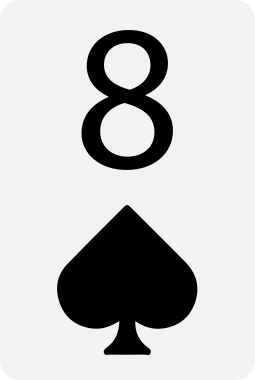
King-Eight Suited is a moderately speculative hand built around two distinct strengths: the king as a high card anchor and the flush draw as a secondary source of equity. It is not a hand you are looking to build a large pot with before the flop, but in the right conditions it can be a profitable and versatile holding.
Before the flop, K8s sits comfortably in the playable but not premium category – a hand that rewards good post-flop decision making more than raw card strength.
What These Odds Show for K8s
The draw odds for K8s are identical to other suited king-x and ace-x hands of a similar gap, reflecting the fact that the rank combination matters less to the raw probabilities than the suited and unpaired structure. The hand misses the flop 53.04% of the time, a figure that underlines the importance of selectivity about when and how to continue.
Pairing up peaks at 47.07% on the turn and settles at 43.67% by the river. When the king pairs, K8s has top pair on most boards – a meaningful advantage over suited hands built around lower cards. Two pair arrives 22.26% of the time by the river, and the flush completes 6.57% of the time – a reliable secondary equity source that gives the hand genuine drawing value on suited flops.
The overcard table is where K8s looks particularly healthy compared to lower suited hands. There is only a 22.55% chance of an overcard appearing on the flop, rising to 35.30% by the river. Only aces outrank the king, so on the vast majority of boards K8s has the highest possible top pair available to it. This is a significant structural advantage over hands like Q8s or J8s, which face overcard pressure far more frequently.
Hand Strength Summary
- Hand type: Suited king, moderately speculative
- Relative strength: Middle tier starting hand
- Dominates: Weaker king-x hands (K2–K7), most low and medium unpaired hands
- Main vulnerability: Ace-high boards, dominated by AK and stronger king-x hands with better kickers
K8s is stronger than its gap suggests thanks to the king’s ability to make top pair on most boards combined with the flush draw’s added equity.
How King-Eight Suited Wins
- Flopping top pair with the king and holding up against weaker holdings
- Completing a flush and winning at showdown – usually a strong flush if not the nut flush
- Building two pair or trips by the river (22.26% and 4.37% respectively)
- Taking uncontested pots in position with well-timed continuation bets on low boards
Unlike a hand like A8s, K8s cannot make the nut flush, but a king-high flush is still an extremely strong hand that loses only to the ace-high flush. In practice this distinction matters less often than it might seem, as opponents holding the ace of the relevant suit without a full flush draw are common.
Main Weaknesses
- The eight is a weak kicker – pairing it creates a vulnerable second pair that is difficult to continue with on most boards
- Dominated by AK and any king with a better kicker (K9 through KQ)
- A king-high flush loses to the nut flush – reverse implied odds are a consideration on very flush-heavy boards
- Misses the flop entirely more than half the time, requiring discipline to fold in the face of aggression
The kicker problem is the central issue. When the king pairs, the hand is often strong, but in spots where an opponent also holds a king, the eight loses to any kicker from nine upwards.
Best and Worst Flop Textures
Strong flops
- King-high boards with two suited cards of the matching suit (top pair plus flush draw)
- Three suited cards completing the flush (made hand, usually very strong)
- Low dry boards where a continuation bet takes the pot and top pair is a safe holding
Dangerous flops
- Ace-high boards (top pair is gone; only the flush draw or a pair of eights remains)
- King-high boards in multiway pots where a better kicker is likely (K-Q-7, K-J-3)
- Coordinated boards where the flush draw is live for opponents and reverse implied odds apply
How It Plays by Position
- Early position: Generally too speculative for a full-ring open; the kicker weakness and post-flop complexity make it difficult to navigate under the gun
- Middle position: Borderline – playable in some formats but should be folded to 3-bets without a strong read
- Late position (button/cutoff): A comfortable open; the king’s strength on most boards combined with fold equity and positional advantage make this a profitable spot
- Blinds: Reasonable defend against steals from the big blind; the overcard odds of just 22.55% on the flop mean the king often dominates the board texture
K8s is a hand that improves substantially with position. The post-flop decisions it creates – particularly around kicker problems and flush draws – are far easier to navigate when acting last.
Common Mistakes with King-Eight Suited
- Over-continuing with top pair when the kicker is clearly outgunned in a contested pot
- Chasing the flush draw without appropriate pot odds or implied odds
- Playing the hand aggressively out of position, where its weaknesses are most exposed
- Failing to fold to 3-bets – K8s is rarely in good shape against a tight 3-betting range
The most common error is misjudging the kicker situation. Top pair kings feels strong, but against any opponent representing a king, the eight loses to the majority of realistic holdings.
Comparison to Similar Hands
- Stronger than: K7s, K6s, K5s and below (marginally better kicker, same structural profile)
- Comparable to: K9s (slightly stronger kicker), Q8s (similar gap, weaker high card)
- Weaker than: KQs, KJs, KTs (significantly stronger kickers with much better post-flop playability)
The gap between K8s and the premium king-x suited hands (KQ, KJ, KT) is meaningful. Those hands can comfortably call 3-bets and build large pots with top pair. K8s cannot, and should be played accordingly.
How King-Eight Suited Performs in Multiway Pots
K8s loses value quickly in multiway pots:
- Top pair with an eight kicker is highly vulnerable against multiple opponents, at least one of whom is likely to hold a better king
- Flush draws carry reverse implied odds risk – another player may hold the ace of the suit
- The hand has limited ability to semi-bluff effectively with multiple players in the pot
In multiway pots, K8s plays best as a drawing hand on suited flops. Top pair alone is rarely a hand to go to war with when three or more players are involved.
FAQ: King-Eight Suited
Is King-Eight Suited worth playing?
Yes, in the right conditions – primarily in position and in unraised or single-raised pots. It is too speculative to play from early position or face significant preflop aggression.
How often does K8s make a flush?
By the river, K8s completes a flush 6.57% of the time. It will almost always be a king-high flush, which is the second-best possible flush.
What is the biggest risk with K8s?
The kicker. Pairing the king is the hand’s primary goal, but the eight loses to any opponent holding K9 through KA, which covers the vast majority of hands that also contain a king.
How does K8s compare to K8 offsuit?
The suited version is meaningfully stronger. The flush draw adds significant equity on suited flops and gives the hand a profitable way to continue in spots where the offsuit version would have to fold.
Related Hands