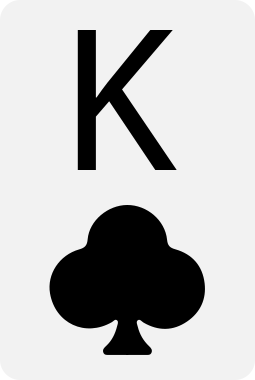
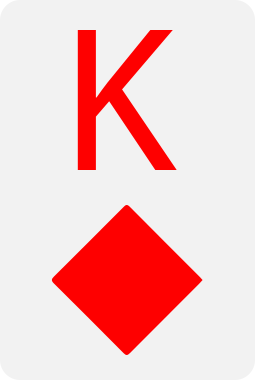
King Eight Offsuit is a weak king-x hand that sits in an uncomfortable middle ground. The king is a powerful high card that dominates most of the deck in raw rank, but paired with an eight and no suit advantage, the hand struggles to generate reliable value in contested pots. It is not the worst hand a player will be dealt, but it is one that is routinely overplayed by players who attach too much significance to the king.
What These Odds Show for K8o
The draw odds for K8o are broadly consistent with other unpaired offsuit hands. It misses entirely on the flop 53.88% of the time, pairs at 46.00% by the river, and arrives at two pair in 22.79% of runouts. The pair rate of 46.00% by the river is slightly higher than many comparable hands, reflecting that both a king and an eight have reasonable board coverage across the range of possible community cards.
The straight column is notable for its 0.00% on the flop, which it shares with a number of two-gap and wider hands. The gap between king and eight means no three-card combination on the flop can complete a straight. By the river that opens to 2.67%, one of the lower straight rates in the offsuit hand category. The king can contribute to broadway straights through ace-king-queen-jack-ten, but that requires four specific cards around it, and the eight contributes to a narrow band of mid-range straights that require similarly specific boards.
The overcard table is where K8o looks most like its premium sibling Pocket Kings rather than its structural peers among weak offsuit hands. Only an ace outranks the king, meaning a 22.55% chance of an overcard on the flop is actually quite low compared to most hands in this category. By the river that rises to 35.30%, which mirrors the Pocket Kings overcard figure exactly, because in both cases only the four aces in the deck constitute overcards to the king. The practical difference is that Pocket Kings uses that low overcard rate as confirmation of strength, while K8o is frequently in trouble even on king-high boards due to the eight kicker.
Hand Strength Summary
- Hand type: Weak king-x offsuit
- Relative strength: Below average, situationally playable in late position
- Dominates: King-seven and below in kicker battles, weaker unpaired hands preflop
- Main vulnerability: Dominated by all other king-x hands with a better kicker, vulnerable in multiway pots
K8o is a hand that looks better than it plays in most contexts. The king provides genuine high-card strength but the eight kicker creates the same category of problems that afflicts all weak ace-x and king-x hands.
How K8o Wins
The cleanest path to winning with K8o is pairing the king on a board where no opponent holds a king, which is most likely in late-position steal situations against limited opposition. King-high boards in heads-up pots against opponents on missed draws or medium pairs represent the hand at its most profitable.
Two pair is the second meaningful outcome. On a board containing both a king and an eight, the hand makes two pair with reasonable disguise. Opponents holding top pair with a better kicker will not realise their kicker is irrelevant until they see the showdown. At 22.79% by the river, two pair is an achievable result, though it requires a fairly specific board texture.
In late position, K8o also functions as a steal and continuation bet hand. The king gives strong board coverage on king-high flops, and even without a pair, a continuation bet on a king-high board represents a credible range in most game dynamics.
Main Weaknesses
The kicker problem is the central weakness of K8o, as it is for all weak king-x hands. Any opponent holding a king with a nine through ace as their second card has K8o dominated the moment a king appears on the board. Against a single opponent, this is a manageable risk. Against multiple callers or a tight pre-flop raiser, the probability of being in a kicker-dominated situation rises sharply, and calling down multiple streets with top pair eight kicker is a consistent way to lose chips.
The 0.00% straight rate on the flop and 2.67% by the river reflects how little the eight contributes to the hand’s straight potential. The king needs a ten, jack, queen, and either an ace or a nine on the board to complete a broadway or near-broadway straight, while the eight needs a four, five, six, seven, nine, ten combination. None of these are board textures that arrive frequently enough to rely upon.
Without the suit advantage, K8o also has no flush draw to fall back on when it misses. The hand is entirely dependent on pairing and the occasional straight draw, both of which are limited here.
Best and Worst Flop Textures
Strong flops
- King-high boards in heads-up pots where opponents are unlikely to hold a king with a better kicker, such as against wide late-position ranges
- Eight-high boards where the eight is top pair and the king provides additional overcard pressure
- King-eight-x boards where the hand immediately makes two pair
Dangerous flops
- King-high boards in multiway pots or against tight callers who are likely holding better kings
- Ace-high boards where the king is no longer the top pair candidate and the hand has nothing
- Boards with heavy straight and flush draw textures where one pair has reduced value even when it is made
How It Plays by Position
- Late position: Where K8o has genuine value. The king provides strong board coverage on king and ace-high flops for continuation bet purposes, and heads-up against a big blind caller the hand can navigate post-flop with confidence on the right boards.
- Early and middle position: A straightforward fold. The risk of running into a better king is highest against tight ranges, and the hand has no backup plan in the form of a flush draw or strong straight potential.
- Big blind: Can complete against a single small raise but should approach post-flop with fit-or-fold discipline. Two pair or better justifies continued investment. A single pair with an eight kicker in a contested pot rarely does.
Common Mistakes with K8o
- Overvaluing top pair – king-top pair with an eight kicker feels strong but is routinely beaten by the same top pair with a better kicker, and calling down three streets against a tight opponent is usually a losing play
- Failing to account for position when entering a pot – K8o played from early or middle position into a raised pot has significantly negative expected value because the hand has no resilience when it runs into domination
- Slow-playing two pair on a king-eight board – the hand needs to charge draws and protect against better hands improving rather than trapping in a spot where runner-runner full houses or rivered sets can still win
Comparison to Similar Hands
The step up to K9o is meaningful. The nine opens additional straight possibilities, improves the kicker situation against typical opponent ranges, and creates a hand that can navigate multiway pots with slightly more confidence. The step across to K8 suited is the more significant improvement, as the flush draw adds a secondary equity path that K8o completely lacks. Among the king-x offsuit hands, K8o sits in the lower half of the range and should be treated accordingly.
How K8o Performs in Multiway Pots
In multiway pots, K8o faces compounding problems. The probability of running into a better king increases with each additional opponent, and the hand has no flush draw or meaningful straight draw to fall back on when top pair is not enough.
The two pair outcome is the one multiway bright spot. On a king-eight board in a three-way pot, K8o makes a strong disguised two pair that can extract value from opponents holding top pair with a better kicker who do not realise the eight on the board has changed the hand ranking. Outside of this specific scenario, multiway pots should be treated with significant caution, and investment beyond the flop with one pair should require strong reads or strong pot odds.
FAQ: King Eight Offsuit
Is K8o playable?
In late position with no action ahead, it has value as a steal hand. In most other contexts, particularly from early position or against a raise, it is better folded.
Why does the overcard percentage match Pocket Kings exactly?
Because both hands have the king as their highest card, and only aces constitute overcards to a king. The four aces in the deck produce the same overcard probability regardless of the second card held.
How does K8o compare to K8 suited?
K8 suited is a notably stronger hand because the flush draw adds a genuine secondary equity path. The suited version can semi-bluff on two-tone boards, realise equity on flush-completing rivers, and play more profitably in multiway pots as a result.
Should you call a raise with K8o?
Rarely. Against a tight raiser the hand is frequently dominated, and against a wide raiser it is marginally ahead but vulnerable. Late position against a very wide opener is the most defensible scenario for a call.
Related Hands