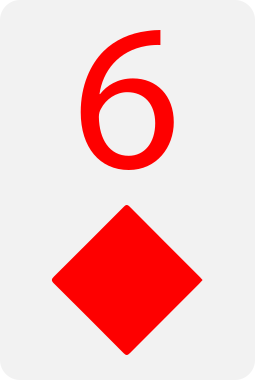
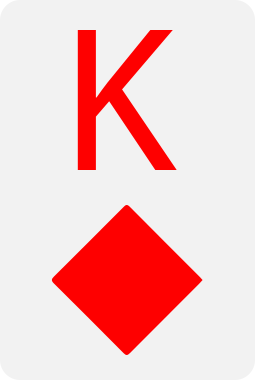
King Seven Offsuit is a weak king-x hand that sits one step below K8o in the kicker hierarchy and shares most of its structural problems. The king provides genuine high-card authority and meaningfully low overcard exposure, but the seven is a low and disconnected secondary card that creates the same kicker domination issues that run through the entire weak king-x offsuit family. K7o is a hand that belongs in the fold the majority of the time, with a narrow positional window where its steal equity and board coverage justify a cheap entry.
What These Odds Show for K7o
The draw odds for K7o are nearly identical to K8o across most categories, with minor differences reflecting the seven rather than the eight as the secondary card. The 53.88% miss rate on the flop, 45.86% pair rate by the river, and 22.79% two pair rate all sit within the expected range for weak unpaired offsuit king-x hands.
The straight column shows a 3.05% completion rate by the river, marginally higher than K8o’s 2.67%. This small difference reflects the seven’s slightly broader mid-range straight connectivity compared to the eight. The seven contributes to straights through three-through-seven, four-through-eight, five-through-nine, and six-through-ten configurations, while the king contributes exclusively to broadway combinations requiring ace, queen, jack, and ten alongside it. Neither path is common, and the 0.00% flop straight rate confirms that immediate straight completion is essentially impossible for this hand. The marginal improvement in straight rate over K8o does not change the hand’s practical profile in any meaningful way.
The overcard table for K7o is identical to K8o, showing 22.55% on the flop and 35.30% by the river. This is expected, since both hands have the king as their highest card and only aces constitute overcards regardless of the secondary card held. The same observation from the K8o analysis applies here: K7o shares its overcard profile with Pocket Kings, but where Kings uses that low overcard rate as a confirmation of strength, K7o faces it with a seven kicker that creates severe domination problems the moment a king appears on the board.
Hand Strength Summary
- Hand type: Weak king-x offsuit
- Relative strength: Below average, one step weaker than K8o in kicker hierarchy
- Dominates: King-six and below in kicker battles, weaker unpaired hands preflop
- Main vulnerability: Dominated by all king-x hands with a better kicker, no flush draw, minimal straight potential
K7o presents the same core tension as all weak king-x offsuit hands. The king creates a psychological pull toward playing the hand that the seven kicker does not support.
How K7o Wins
Pairing the king in a heads-up or short-handed pot where no opponent holds a king is the cleanest and most common winning path. In late position steal situations against wide ranges, king-top pair with a seven kicker is often sufficient to win at showdown or through continued aggression on later streets. The key qualifier is the opponent range. Against a tight caller or in a multiway pot, the probability of a better king being present increases rapidly.
Two pair is the secondary path at 22.79% by the river. On king-seven boards the hand makes two pair with reasonable disguise, and the seven is low enough on the rank ladder that opponents building on top pair frequently do not anticipate it as a relevant board card. This is K7o at its most deceptive, and it is the scenario where the hand can extract the most value from opponents who hold a better kicker but find their kicker counterfeited by the two pair combination.
Broadway straight draws represent the king’s contribution to straight equity on the rare boards where ten, jack, and queen appear together. These are specific and infrequent but are the clearest scenario where the king’s rank position contributes to something other than top pair.
Late position continuation betting on king-high boards is the fourth winning scenario, and perhaps the most consistently applicable. A king on the flop is an extraordinarily credible representation of top pair regardless of the actual holding, and opponents with middle pairs or missed draws frequently fold to a continuation bet without contest.
Main Weaknesses
The kicker problem for K7o is marginally more severe than K8o. Every hand from K8o through KAo, plus all their suited counterparts, dominates K7o in a kicker battle when a king appears on the board. That is eight combinations of king-x offsuit hands and eight suited equivalents, all of which leave K7o drawing to two outs for the win. In practice, any pre-flop caller with reasonable hand selection standards has a meaningful chance of holding one of these dominating hands, and calling down multiple streets with top pair seven kicker is a reliable way to lose chips against such opponents.
K7o’s 3.05% river straight rate versus K8o’s 2.67% reflects the seven’s broader mid-range connectivity, but neither figure is high enough to influence how the hand should be played in most situations. The 0.00% flop straight rate means the hand arrives at the first decision point after seeing community cards with no straight draws available in any scenario.
The absence of a flush draw is the same limitation shared by all offsuit hands in this range. K7s, the suited version of this hand, gains meaningful secondary equity through flush draws that create semi-bluff opportunities and multiway value. K7o has none of these additional paths.
Best and Worst Flop Textures
Strong flops
- King-high boards free of aces in heads-up or short-handed pots where the opponent range is wide enough to be unlikely to contain a better king
- King-seven-x boards where the hand makes immediate two pair with solid disguise
- Low boards in the four-through-ten range that open mid-range straight possibilities around the seven, though these are rarely strong enough to justify significant investment
Dangerous flops
- Ace-high boards where the king loses its top pair candidacy and the hand has nothing
- King-high boards in multiway pots where the probability of a better king rises with each additional player
- Boards with heavy straight or flush draw textures where one pair has reduced value even when it is made
How It Plays by Position
- Late position: The primary context where K7o can be played profitably. From the cutoff or button in an unopened pot, the hand has clear steal equity and can navigate post-flop with reasonable confidence in heads-up situations on king-high boards. The fold equity from a pre-flop raise combined with the king’s board coverage on the most common type of flop makes this a workable steal candidate.
- Early and middle position: A straightforward fold. The kicker problem is most severe against the tight ranges played from those positions, and the hand has no resilience in the form of flush draws or strong straight potential to compensate when dominated. Out of position with a dominated top pair is among the most reliably unprofitable situations in poker.
- Big blind: Can complete against a very small single raise with fit-or-fold discipline on the flop. Against raises from tight early position players, folding is often correct even from the big blind, because the ranges that warrant early position raises contain a disproportionate share of the hands that dominate K7o.
Common Mistakes with K7o
- Overvaluing top pair – king-top pair with a seven kicker is a dominated holding against any opponent with a king and a kicker of eight or better, which describes a meaningful portion of pre-flop callers in any structured game; calling down three streets with this holding against a tight player is a consistent source of loss
- Failing to distinguish between steal situations and value situations – K7o works as a steal because opponents fold without showdown, not as a value hand because the kicker is too weak to win kicker battles at showdown against typical calling ranges; confusing these two modes leads to overcommitting in situations where the hand is behind
- Playing K7o into multiway pots – each additional opponent compounds the kicker problem and reduces the fold equity that makes the hand viable as a steal; in a four-way pot, the probability that at least one opponent holds a better king is high enough to make top pair seven kicker essentially unplayable for significant investment
Comparison to Similar Hands
- Stronger than: K6o, K5o, K4o, K3o, K2o, and all lower king-x offsuit hands in kicker hierarchy
- Weaker than: K8o, K9o, KTo, KJo, KQo, K7s
The step down from K8o to K7o reduces the kicker by one rank, opening up an additional dominated hand in K8o that now beats K7o in a kicker battle. In practical play the two hands are very similar in how they should be approached, and the difference is more visible in specific kicker showdown situations than in the broader strategic framework.
The comparison to K7s is the more significant distinction. The suited version adds flush draw equity that creates secondary equity paths on two-tone boards and enables semi-bluff continuation on connected flops. K7s is a speculative hand with genuine playability in a wider range of situations. K7o requires strict positional discipline and should rarely see significant investment beyond a pre-flop steal attempt or a single continuation bet on the right board.
How K7o Performs in Multiway Pots
In multiway pots, K7o faces compounding kicker problems and reduced fold equity simultaneously. Each additional player increases the probability of a better king being present, and the hand’s inability to fall back on flush draws or meaningful straight potential when top pair is dominated leaves it with very few viable lines in contested multi-street pots.
The two pair outcome is the most valuable multiway scenario. On king-seven boards in a three-way pot, K7o makes disguised two pair that opponents holding top pair with a better kicker will not expect. The pot can be built considerably before opponents realise the seven on the board has changed the hand ranking, and this represents the primary scenario where K7o generates genuine value against multiple opponents.
Outside of this specific outcome, multiway pots should be approached with minimal investment and clear release criteria on the flop. One pair with a seven kicker against multiple opponents is not a hand to build a pot with in most situations.
FAQ: King Seven Offsuit
How does K7o compare to K8o?
The hands are structurally very similar. K7o has a marginally higher straight rate at 3.05% versus K8o’s 2.67% due to the seven’s broader mid-range connectivity, but the seven is one rank weaker as a kicker, meaning K8o now also dominates K7o in a kicker battle when a king appears. The overcard profiles are identical. In practice the two hands should be played in almost exactly the same way.
Why does K7o have the same overcard table as Pocket Kings?
Because both hands have the king as their highest card, and only aces produce overcards to a king. The four aces in the deck create the same overcard probability regardless of what the second hole card is.
Is K7o ever worth playing?
In late position with no prior action it has clear steal value. In most other contexts the kicker problem and absence of secondary equity make it a fold, particularly from early position or against tight raisers.
What is the practical difference between K7o and K7s?
The flush draw is the entire meaningful difference. K7s can semi-bluff on two-tone boards, continue with equity on flush draws, and play profitably in multiway situations where K7o has limited options. K7s is the stronger hand in almost every post-flop scenario that involves a contested pot.
Related Hands