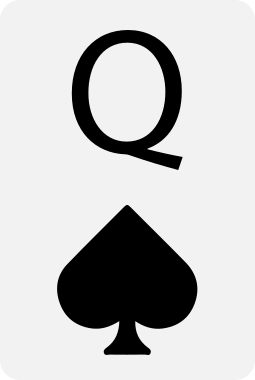
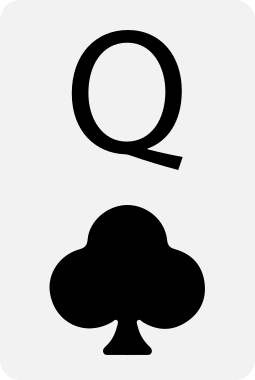
Queen-Seven offsuit is a hand that exists in a specific and uncomfortable position in the starting hand rankings. The queen is a genuinely strong card — the third highest in the deck — but the seven kicker is so disconnected from it that the hand combines a premium high card with essentially dead weight. Q7o is sometimes called a “computer hand” in poker circles, a nickname that refers to its theoretical near-zero expected value in most situations. That label captures something real: Q7o is not terrible enough to be obviously unplayable, and not strong enough to be reliably profitable. It sits in the grey zone where inexperienced players bleed chips gradually rather than catastrophically.
What These Odds Show for Q7o
The draw odds for Q7o are identical to K5o and K6o across most categories — 53.88% high card on the flop, 45.86% pair by the river, 22.79% two pair by the river — which immediately signals that the low card in a high-gap offsuit hand has almost no influence on the draw odds profile. The straight rate matches K6o exactly at 3.05% by the river, reflecting the same large gap between the two cards and the same absence of meaningful straight connectivity.
The overcard table is where Q7o distinguishes itself from the weak kings. With a queen as the top card, two ranks sit above it — king and ace. This produces an overcard rate of 41.43% on the flop, rising to 51.40% by the turn and 59.85% by the river. That flop figure sits comfortably between the 22.55% of king-high hands and the 56.96% of J7o. By the river, Q7o will face at least one overcard on roughly three in five runouts — not as severe as the low connectors, but a meaningful step down from the protection that a king provides.
The practical implication is that a pair of queens, when it arrives, faces overcard pressure less often than a pair of jacks but more often than a pair of kings. The queen is a strong card, but it is not the king, and that difference shows up consistently in the overcard table across every street.
Hand Strength Summary
- Hand type: Weak offsuit queen
- Relative strength: Below average — the seven kicker negates much of the queen’s rank advantage
- Best case: Queen-high board with no king or ace, heads-up, in position
- Main vulnerability: Dominated by any queen with an eight or higher kicker, no straight potential, no flush equity
Q7o is the queen equivalent of K6o — a strong top card paired with a kicker so weak that top pair becomes a trap as often as it becomes a winner. The queen’s higher rank relative to a jack provides better board presence than J7o, but the same kicker problem applies in full.
How Queen-Seven Offsuit Wins
Q7o wins through a set of routes that will be familiar from the weak kings, adjusted for the slightly higher overcard exposure:
- Pairing the queen on a board with no king or ace, heads-up, against an opponent who cannot continue
- Making two pair on a queen-seven board, ideally on a dry texture where opponents are drawing thin
- Stealing uncontested pots preflop from late position where the queen provides credible high-card representation
- Queen-high holding up in a checked-down pot where no opponent pairs
- Taking a pot on the flop with a continuation bet on a low, dry board where the queen represents the strongest possible holding
The seven contributes almost nothing independent of the queen. A pair of sevens on a board with high cards has no realistic claim to best hand, and the seven’s role in straight formations is negligible at 3.05% by the river.
Main Weaknesses
The kicker problem with Q7o is arguably more insidious than with K5o, because the queen appears frequently enough in opponent ranges that kicker confrontations are common. Any player holding Q8 through QA — a wide portion of most reasonable ranges — has Q7o outkicked when both players flop top pair. Specific structural weaknesses include:
- Dominated by a large portion of queen-containing hands, which appear regularly in opponents’ ranges at most table formats
- The seven offers no meaningful drawing equity — 3.05% straight completion by the river is effectively zero for strategic planning purposes
- No flush equity in the offsuit version
- A pair of sevens has almost no showdown value on boards covered by overcards, which occurs 59.85% of the time by the river
- The gap between queen and seven is large enough that the hand provides no straight blocking value worth considering preflop
Best and Worst Flop Textures
Strong flops:
- Queen-high boards with no king or ace and low, disconnected side cards — Q-4-2 rainbow being close to ideal for this hand
- Queen-seven boards giving immediate two pair on a dry, uncontested texture
- Low boards where the queen can be represented credibly on the flop regardless of whether it connected
- Boards where an opponent has clearly missed and a single bet takes the pot
Dangerous flops:
- Any board with an ace or king — occurring on 41.43% of flops, making overcard boards the second most common scenario overall
- Queen-high boards where an opponent holds a better kicker — the most common way this hand loses significant chips
- Coordinated boards where opponents are drawing and Q7o has no draw of its own to semi-bluff with
- Multiway pots on any texture, where the kicker problem and absence of draw equity compound across multiple opponents
How It Plays by Position
Early position:
A clear fold. Q7o cannot withstand the pressure of a full table and offers no compensating equity to justify entering a pot early.
Middle position:
Still a fold at a full ring table. The queen alone is not sufficient to open from middle position when the kicker is this weak. In a short-handed game of four or fewer players, the calculus begins to shift, but it remains a marginal hand even there.
Late position:
Q7o’s natural home, and the only position where it earns any legitimate consideration. From the button or cutoff in an unopened pot, the queen carries meaningful high-card credibility for a steal raise. Opponents will credit a late-position raise with a queen-high holding, which gives fold equity on flops regardless of whether the hand connects.
Blinds:
In the big blind with favourable pot odds against a single steal raise, Q7o can be defended passively. The plan should be straightforward — check-fold most flops, continue only when the flop connects well, and avoid building large pots with top pair given the kicker vulnerability. From the small blind, a fold is correct against most raises.
Common Mistakes with Queen-Seven Offsuit
Q7o produces a specific pattern of mistakes that stems from the queen feeling like a strong card while the seven quietly undermines every postflop scenario:
- Treating a flopped pair of queens as a strong hand without considering how many opponent holdings have the kicker covered
- Continuing for multiple streets with top pair against resistance from an opponent whose range heavily favours better queens
- 3-betting or building pots preflop as if the queen alone justifies aggression — the seven cancels out the hand’s high-card value as a made-hand candidate
- Calling raises out of position where the hand’s already limited postflop playability shrinks further
- Misreading the overcard table — 41.43% on the flop sounds manageable, but it means that nearly half the time you pair the queen, a king or ace has also appeared and an opponent may already be ahead
Comparison to Similar Hands
- Stronger than: Q2o through Q6o, where the kicker is weaker still; J7o, where the top card is lower and overcard exposure is higher at 56.96% on the flop
- Weaker than: Q7 suited, which adds flush equity that fundamentally changes the hand’s character; Q8o and above, where the kicker becomes genuinely competitive; K7o, where the top card dominates more boards
- Similar to: K5o and K6o in draw odds profile — the three hands share nearly identical statistics across most categories, with the overcard table being the primary differentiator
The most instructive comparison is between Q7o and J7o. Both hands pair a mid-range card with a seven kicker, producing the same kicker problem in identical form. The difference is the top card — the queen’s higher rank reduces the flop overcard rate from 56.96% to 41.43%, which is a meaningful improvement. Q7o is a better hand than J7o in the specific sense that its pair of queens holds up more often than a pair of jacks. Whether that improvement is enough to make it playable in a given situation is a separate question, and the answer is usually the same for both: only from late position, only in unopened pots, only with a clear read on the opponents.
How Queen-Seven Offsuit Performs in Multiway Pots
Q7o in multiway pots inherits all of the problems seen with K5o and K6o in that context, adjusted for the higher overcard rate:
- The probability that at least one opponent holds a better queen increases sharply with each additional player in the hand
- A pair of sevens multiway has essentially no showdown value
- The straight rate of 3.05% means draw equity is negligible and cannot offset being behind with a pair
- The 59.85% overcard rate by the river in a heads-up pot becomes even more problematic multiway, where at least one opponent is likely to hold the overcard that beats the queen
- Unlike low connectors, which can occasionally win a large multiway pot with a hidden straight, Q7o has no equivalent surprise weapon
Q7o’s value in multiway pots is as close to zero as any hand on this page. The weak kicker and absent draw equity leave it without a profitable route in most multi-opponent scenarios.
FAQ: Queen-Seven Offsuit
Why is Q7o called a “computer hand”?
The nickname refers to the hand’s near-zero expected value in most contexts — it is not strong enough to profit reliably and not weak enough to be an obvious fold in every spot. Some sources suggest the name comes from early poker simulation software identifying Q7o as sitting almost exactly at the breakeven point of playability, though the precise origin of the term varies.
How does Q7o compare to K5o in practice?
The draw odds are nearly identical across most categories. The key practical difference is the overcard table — K5o sees an overcard on 22.55% of flops, Q7o on 41.43%. This means a pair of queens faces overcard pressure nearly twice as often as a pair of kings, which materially affects how comfortably the hand can be continued on most board textures.
Is Q7o ever worth a 3-bet?
Only as a pure bluff in very specific positional spots against opponents who fold too frequently. The hand has no value as a 3-bet for made-hand purposes.
Does the queen’s rank justify playing this hand more liberally than J7o?
In late position and unopened pots, marginally yes. The lower overcard rate means a pair of queens has more inherent value than a pair of jacks in the same scenario. The kicker problem is identical, however, so postflop discipline remains equally important with both hands.
Related Hands