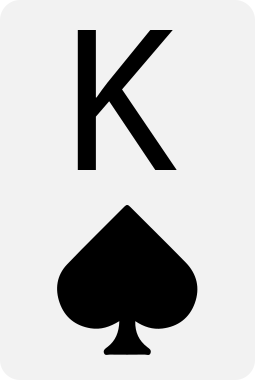
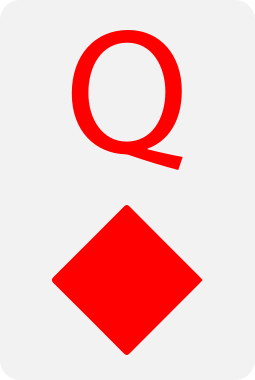
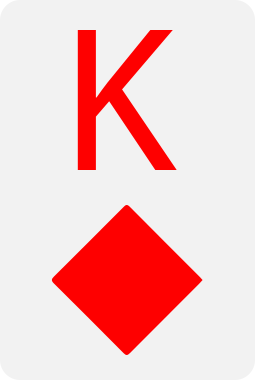
King-Nine Offsuit is a middle-of-the-road starting hand that sits in a genuinely awkward position in the hand rankings. The King is one of the strongest high cards in the deck, but the nine kicker and the offsuit nature combine to create a hand that is profitable only in specific circumstances. It is not weak enough to dismiss out of hand, but it is not strong enough to play without thought.
The core tension with K9o is that it looks stronger than it is. Players who see a King in their hand often overestimate its value, particularly when they are not thinking carefully about the kicker. Against opponents holding KT, KJ, or KQ, K9o is dominated and will lose the majority of pots where both players pair their King.
What These Odds Show for K9o
The draw odds paint a familiar picture for an offsuit broadway-adjacent hand. On the flop, 53.55% of runouts leave you with just high card – meaning no pair, no draw, just King-high. That is a position from which winning at showdown is unlikely without significant bluffing.
The pair odds are solid without being exceptional. By the river you will have a pair 45.29% of the time, two pair 22.66%, and three of a kind 4.43%. These numbers are broadly comparable to other offsuit hands of similar rank but offer no particular edge.
The straight odds are one of the more interesting features of K9o. A straight arrives 0.33% of the time on the flop, 1.50% by the turn, and 4.01% by the river. That 4.01% figure is meaningfully higher than you might expect from a hand with a four-rank gap, and it reflects the fact that both the King and the nine sit at positions in the deck where multiple straight combinations are reachable. A board of T-J-Q gives K9o a straight with the King, while boards running through the seven, eight, ten, or Jack can complete the nine end. It is not a hand to play specifically for the straight, but the draw equity is worth acknowledging.
The flush odds at 1.96% by the river are the baseline for any offsuit hand and do not factor meaningfully into strategy.
The overcard table is where K9o genuinely stands apart from weaker holdings. An overcard to the King appears on the flop just 22.55% of the time, rising to 29.14% by the turn and 35.30% by the river. This is identical to the overcard profile of Pocket Kings, which makes sense – only an Ace beats the King as a higher rank. What this means in practice is that when you pair your King, you are very likely holding top pair. The board will contain a card higher than your King only when an Ace appears, and the odds of that happening on the flop are less than one in four.
Hand Strength Summary
- Hand type: Offsuit king-x
- Relative strength: Above average in absolute terms, but vulnerable to domination within the king-x category
- Dominates: K2o through K8o, most mid pairs, weaker broadway hands
- Main vulnerability: Dominated by KT, KJ, KQ, AK, and any pocket pair above nines
K9o occupies a strange tier where it beats a large portion of all possible hands but is still outclassed within the specific range of hands a typical opponent is likely to open or call with.
How King-Nine Offsuit Wins
K9o takes down pots through a few distinct routes:
- Pairing the King on the board with no better kicker in play
- Making two pair using both hole cards on a compatible board
- Completing a straight, particularly via the ten-jack-queen run giving the King its broadway connection, or through lower board configurations involving the nine
- Winning uncontested pots through preflop aggression from late position
- Taking pots on the flop when opponents miss and fold to a continuation bet
The hand is at its most dangerous when it makes two pair on a board that looks innocuous to an opponent holding just top pair.
Main Weaknesses
K9o has several clear vulnerabilities that keep it outside a standard opening range from early positions:
- Any opponent holding a King with a higher kicker has it dominated before the flop
- The offsuit nature removes flush equity as a factor
- Pairing the nine on a King-high board is a difficult hand to assess, as you are unlikely to be ahead of any opponent who has also connected
- In multiway pots the kicker problem becomes more pronounced as the chance of running into a stronger King increases
- Against tight ranges from early position opponents, K9o is frequently behind
Best and Worst Flop Textures
Strong flops
- King-high dry boards where the nine is an unlikely kicker match for opponents (e.g. K♦ 5♣ 2♠)
- Nine-high boards where you hold top pair with the King well ahead
- Two pair boards using both hole cards (e.g. K♠ 9♦ 3♣)
- Boards with a ten, jack, and queen where the King completes a straight
Dangerous flops
- King-high boards where opponents are likely to hold stronger kickers such as KQ or KJ
- Ace-high boards where your King is no longer top pair and an opponent holding AK or AQ has you in serious trouble
- Coordinated boards that offer opponents draws while you hold just one pair
The best spot for K9o is a King-high board against players who are unlikely to hold a stronger King. The worst is a King-high board in a multiway pot where the field is wide enough that a better kicker is likely to be in play.
How It Plays by Position
- Early position: Not recommended. The range of hands that dominate K9o is too wide among early position callers and raisers to make this profitable.
- Middle position: Marginal. Playable in softer games or when the table is passive, but easily beaten by a standard opening range.
- Late position (cutoff/button): K9o has genuine value here. It is a reasonable steal candidate and performs well against the narrower ranges of the blinds.
- Blinds: A viable defend from the big blind against late position steals, but should not be played aggressively out of position against early position raises.
The overcard odds working in K9o’s favour – only an Ace beats the King – make it easier to navigate postflop than most offsuit hands with a similarly ranked top card. When you pair the King, you usually know where you stand.
Common Mistakes with King-Nine Offsuit
- Opening from early position and getting trapped by a stronger King
- Calling three-bets and being dominated
- Overcommitting on King-high boards against opponents who show continued strength
- Failing to consider that a paired nine on a King-high board is often far behind
- Treating the hand as a premium because of the King rather than assessing the kicker problem honestly
The King creates a psychological pull toward overplaying this hand. Recognising the kicker as a genuine weakness, rather than a minor concern, is the key adjustment.
Comparison to Similar Hands
- Stronger than: K2o through K8o and the offsuit hands below it in the same rank
- Weaker than: KTo, KJo, KQo, AKo, and all suited king-x equivalents
- Broadly similar to: K9s in pair equity, but without the flush potential
King-Nine Suited is a meaningfully stronger hand due to flush equity. Among offsuit king-x hands, K9o sits in the lower half and is best thought of as a positional hand rather than a straightforward value hand.
How King-Nine Offsuit Performs in Multiway Pots
K9o is not built for multiway pots. Its strengths are positional and situational, and both erode quickly when more players are involved:
- Each additional opponent increases the likelihood that a stronger King is at the table
- The nine becomes an almost irrelevant kicker in large fields
- Two pair and set hands become more likely in opponents’ ranges
- The lack of flush equity means fewer ways to outdraw in contested pots
K9o plays best in heads-up pots where you have taken the initiative preflop. The moment it becomes a hand played passively in a multiway pot, its expected value drops considerably.
FAQ: King-Nine Offsuit
Is K9o a strong hand?
It is above average across all possible starting hands but is firmly in the speculative tier when considering the hands a typical opponent is likely to hold. The King is strong, but the kicker is a consistent liability.
What is the biggest danger with K9o?
Kicker trouble on King-high boards. Pairing your King against an opponent holding KT, KJ, or KQ is one of the most common and costly situations this hand creates.
Does K9o have straight potential?
More than you might expect. With a 4.01% chance of completing a straight by the river, boards involving tens, jacks, and queens can give the King a broadway connection, while lower boards can complete through the nine.
How does the overcard situation compare to other hands?
Favourably. Because only an Ace outranks the King, the overcard frequency is low – just 22.55% on the flop. This is a real advantage compared to hands with a Jack or Queen as the top card, where overcards are far more common.
Related Hands