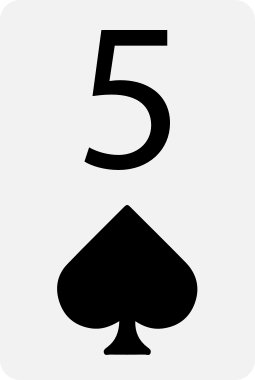
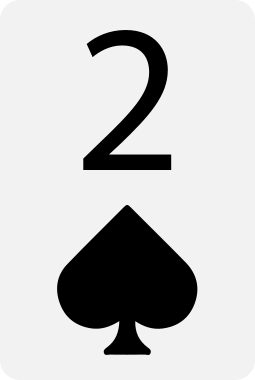
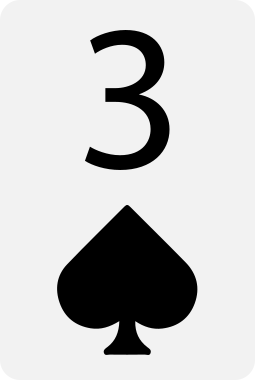
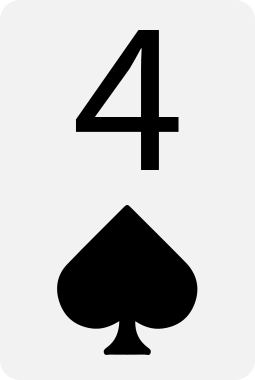
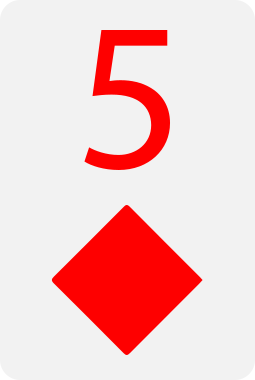
Pocket Fives is a small pair with a single clear objective: flop a set. Everything else the hand can do – holding as the best pair, making two pair, surviving to the river – is secondary to that one outcome. When the set arrives, 55 becomes a powerful and deeply disguised hand capable of winning large pots. When it does not, the hand is almost always in a difficult position.
Before the flop, 55 is a hand you play for implied odds, not for raw card strength. Understanding that distinction is the foundation of playing it correctly.
What These Odds Show for 55
The overcard table delivers the starkest numbers on this page. There is a 98.14% chance of at least one overcard appearing on the flop – near certainty. By the river, that figure reaches 99.91%. In practical terms, an unimproved pair of fives will almost never be the best hand at showdown in a contested pot. Every six through ace outranks the five, meaning virtually every board imaginable will contain at least one card that gives an opponent a higher pair.
The set odds are what justify the hand’s existence as a playable holding. Three of a kind arrives on 10.78% of flops – just under one in nine – and the hand develops further from there, reaching a full house 8.55% of the time by the river. When the set does land, 55 is a monster – deeply hidden behind a board that opponents will rarely associate with a five, creating ideal conditions for extracting maximum value.
The higher pocket pair table compounds the overcard problem. Against a single opponent there is already a 4.41% chance they hold a better pocket pair, and at a full nine-opponent table that rises to 31.29% – nearly one in three. That means in a significant proportion of full-table spots, 55 is not just facing overcards on the board but is already dominated before a single community card is dealt.
Hand Strength Summary
- Hand type: Small pocket pair, set-mining hand
- Relative strength: Lower tier starting hand
- Dominates: Unpaired hands that miss the board entirely on low runouts
- Main vulnerability: Near-certain overcard exposure, frequent domination by higher pocket pairs
55 is almost entirely dependent on flopping a set. Without improvement it has almost no realistic path to winning a contested pot at showdown.
How Pocket Fives Wins
- Flopping a set (10.78%) and extracting maximum value from opponents holding overpairs, top pair, or strong draws
- Improving to a full house by the river (8.55%) and becoming effectively unbeatable
- In unraised or limped pots, occasionally holding as the best pair on very low boards (rare but possible on boards like 4♣ 3♦ 2♠)
- Taking down uncontested pots preflop or on the flop with a well-timed continuation bet on boards where nobody connected
- Four of a kind (0.84% by the river) – an extremely rare but decisive outcome
The set is the dominant win condition by a large margin. The disguised nature of 55 is its greatest asset – on a board of K♠ 9♦ 5♣, opponents holding top pair of kings or a pocket pair of nines will frequently not give credit for trips, which is precisely where the biggest pots are built and won.
Main Weaknesses
- Overcards appear on the flop 98.14% of the time – for practical purposes, an unimproved 55 is never safe in a contested pot
- A 31.29% chance of running into a higher pocket pair at a full nine-player table – domination risk is significant even before the flop
- Straight and flush potential is negligible – 2.35% and 1.95% by the river respectively, and neither is a reliable continuation reason
- The hand has almost no bluffing equity without the set; its entire post-flop value is concentrated in a single outcome
Pocket Fives sits one step below Pocket Sixes on the small pair ladder, and the overcard numbers reflect that clearly. The jump from 95.84% overcard exposure for 66 to 98.14% for 55 illustrates how rapidly overcard risk escalates as the pair rank decreases.
Best and Worst Flop Textures
Strong flops
- Any flop containing a five – the set is achieved and the hand becomes a monster
- Extremely low boards (4♠ 3♦ 2♣) where 55 is the highest pair and overcard risk is temporarily reduced
- Paired boards containing a five (5♠ 5♦ X) – quads, an exceptionally rare but devastating holding
Dangerous flops
- Any board with one or more cards ranked six or higher – which covers essentially every flop
- Coordinated middle boards (8♠ 7♦ 6♣) where straight draws are live, opponents can hold many strong holdings, and 55 has no path forward without a five
- Paired high boards where an opponent’s overpair is now also drawing to a full house
How It Plays by Position
- Early position: A fold in most full-ring scenarios – early position opens invite 3-bets that price out the implied odds required to make set-mining profitable, and the hand has no fallback when it misses
- Middle position: Borderline; viable when stack depths are sufficient and the table dynamic allows cheap flops
- Late position (button/cutoff): The most appropriate home for 55 – cheap flops, maximum control over pot size when the set arrives, and the ability to fold cleanly when it does not
- Blinds: Worth defending from the big blind when pot odds are favourable; the out-of-position constraint limits value extraction when the set hits, but the price of entry is often low enough to justify it
The implied odds calculation is the central decision point for every preflop spot with 55. A rough guideline is that effective stacks need to be at least 15 to 20 times the size of the call to make set-mining profitable over the long run.
Common Mistakes with Pocket Fives
- Continuing past the flop without a set on boards where overcards are present – which is almost every board
- Calling preflop raises without sufficient implied odds to justify the set-mine
- Overplaying two pair – while an improvement on the base hand, two pair with a small pocket pair on an overcard board is still a vulnerable and difficult holding to navigate
- Failing to bet aggressively enough when the set arrives, missing the opportunity to build the pot before the board becomes threatening
The fundamental error is treating 55 as a hand that can win without improvement. On almost every single runout it cannot, and adjusting post-flop strategy to reflect that reality is the cornerstone of playing the hand profitably.
Comparison to Similar Hands
- Stronger than: 44, 33, 22 (marginally – all share the same set-mining profile, lower pairs face even more severe overcard exposure)
- Comparable to: 66 (very similar dynamic – 66 faces slightly less overcard exposure at 95.84% on the flop versus 98.14% for 55, a meaningful difference in practice)
- Weaker than: 77, 88, 99 and above (medium pairs occasionally hold as the best hand without improvement on low boards; 55 almost never can)
The practical difference between 55 and 66 is small in set-mining spots but becomes more apparent in situations where the unimproved pair might occasionally have showdown value. 66 can very rarely hold on extremely low boards; 55 almost never can. Both hands demand the same fundamental approach, but 55 requires even stricter discipline about folding when the set does not arrive.
How Pocket Fives Performs in Multiway Pots
Multiway pots present a familiar trade-off for 55:
- More opponents increases the implied odds when the set is flopped – there are more players to extract value from, and sets become even more profitable in larger pots
- However, with a 31.29% chance of one opponent holding a higher pocket pair at a full table, domination risk before the flop is substantial
- An unimproved 55 in a multiway pot is completely untenable – the probability of someone holding a higher pair or connecting with an overcard approaches certainty
- Even the set carries risk in multiway pots if the board is coordinated – more players means more potential flush draws and straight draws that could be ahead or drawing live
The ideal multiway scenario is a cheap flop with multiple opponents and deep stacks – maximum implied odds when the set hits, minimum cost when it does not. Fold cleanly on any flop that does not deliver a five.
FAQ: Pocket Fives
How often does Pocket Fives flop a set?
Approximately 10.78% of the time – just under one in nine flops. This figure is the same for all pocket pairs regardless of rank.
Should you ever continue past the flop without a set?
Almost never in a contested pot. The 98.14% flop overcard exposure means an unimproved pair of fives has virtually no realistic path to winning at showdown against an opponent who has connected with the board.
How do you play 55 against a preflop raise?
The standard approach is to call and set-mine, provided the effective stack sizes offer sufficient implied odds. If the raise is large or a 3-bet has been made, the hand should generally be folded as the price of entry outweighs the set-mining equity.
What is the difference between 55 and 66?
The overcard exposure is the most meaningful difference – 66 faces overcards on the flop 95.84% of the time compared to 98.14% for 55. In practice this means 66 can very occasionally hold on extremely low boards, while 55 almost never can. Both are set-mining hands requiring the same fundamental approach.
Related Hands