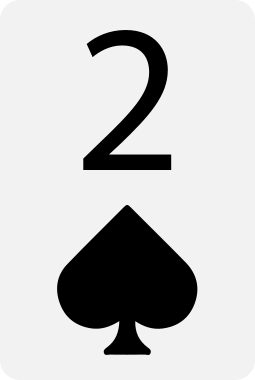
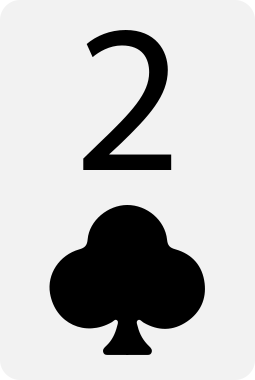
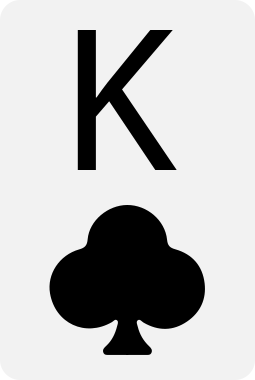
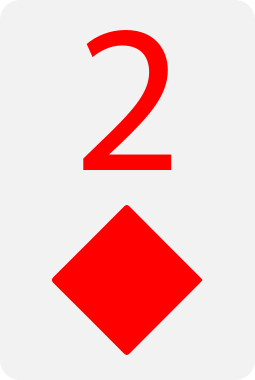
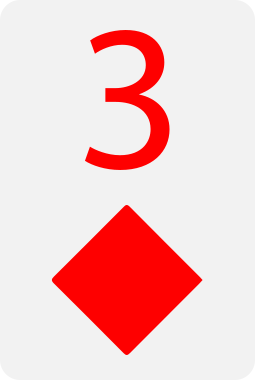
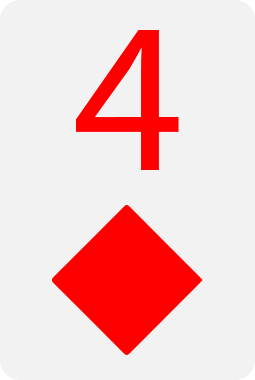
Pocket Twos is the lowest starting hand in Texas Hold’em that arrives with a made pair. It sits at the very bottom of the pocket pair rankings, and unlike every other hand in the deck, it offers zero unimproved post-flop playability against any serious opposition. What it offers instead is a single, clearly defined opportunity: flop a set, win a big pot.
There is a purity to how Pocket Twos should be played. The decision tree is simpler than almost any other hand in the game.
What These Odds Show for 22
The draw odds mirror those of every other pocket pair in the set-mining category – the probability of flopping a set remains 10.78% regardless of rank. By the river, three of a kind settles at 11.77%, with full houses accounting for 8.55% and four of a kind a further 0.84% of runouts. These premium outcomes are where essentially all of the hand’s long-term value lives.
The straight odds are the lowest of any pocket pair at just 1.22% by the river. This is a natural consequence of rank – a Two has only one side from which a straight can extend, and the combinations are limited. The hand has almost no drawing value beyond its set potential.
The overcard table is unique in the entire deck. Pocket Twos shows 100.00% on the flop, turn, and river – the only starting hand where overcards are mathematically certain on every single street. Every card from Three through Ace outranks a Two, so any community card dealt will be an overcard without exception. There is no board texture, however dry or low, that leaves your pair of Twos as the top pair. This is not a marginal disadvantage – it is an absolute constraint that defines everything about how the hand must be played.
The higher pocket pair table reflects the widest vulnerability of any pocket pair. Against a single opponent there is a 5.88% chance they hold a higher pair – and at this rank, every pocket pair from 33 to AA qualifies. At a nine-handed table that rises to 36.33%, meaning more than one in three full-table situations will see at least one opponent already holding a better pair before the flop is dealt.
Hand Strength Summary
- Hand type: Small pocket pair – the lowest in the deck
- Relative strength: Entirely dependent on flopping a set; the pair itself has no post-flop value
- Strengths: Disguised set potential, clear and simple decision-making framework
- Main vulnerability: Overcards are mathematically certain on every street; widest higher pocket pair exposure of any pair
How Pocket Twos Wins
Pocket Twos wins in a narrow and well-defined set of ways:
- Flopping a set of Twos and extracting value from opponents with top pair, overpairs, or two pair who cannot fold
- Improving to a full house or four of a kind in large pots where opponents are pot-committed
- Occasionally stealing small pots uncontested when all opponents check or fold on a dry board
- Winning limped or blind-vs-blind pots where no opponent holds anything meaningful
Outside of flopping a set, the hand has almost no legitimate path to winning at showdown against an opponent who has connected with the board in any way.
Main Weaknesses
Pocket Twos has profound and inescapable limitations:
- Overcards are certain – 100% on every street, no exceptions. The pair can never be top pair on the board
- The highest pocket pair exposure of any pair in the deck, with over a third of nine-handed tables producing at least one opponent already ahead
- Straight potential is the lowest of any pocket pair, at just 1.22% by the river
- Fold equity is minimal post-flop – opponents who have hit anything at all have a pair that beats yours
- Implied odds must be carefully assessed; shallow stacks make set mining with 22 mathematically unjustifiable
Best and Worst Flop Textures
Strong flops
- Any flop containing a Two – the more action the board generates from other hands, the better
- Low connected boards where opponents may also be building strong hands they are willing to commit with
- Boards that give overpair holders confidence, since they become the ideal opponent to stack when you hold a set
Dangerous flops
- Every flop without a Two, which is approximately 89% of them
- Wet boards where a flopped set is vulnerable to straight and flush draws
- Boards that pair a high card, giving overpair holders full house outs of their own
How It Plays by Position
- Early position: A fold against most opens; in passive games a limp may be justifiable if the table dynamic supports it
- Middle position: Viable as a call against an open when stack-to-pot ratio is sufficient to justify set mining
- Late position / Button: The optimal position to play it – maximum control post-flop when the set arrives, and the clearest decision when it does not
- Blinds: Worth defending at the right price from the big blind, but requires firm post-flop discipline on the overwhelming majority of boards where no Two appears
Common Mistakes with Pocket Twos
- Set mining when stack sizes are too shallow to justify the implied odds
- Continuing post-flop without a set – overcards are guaranteed, meaning the pair has no value against any opponent who has connected with the board
- Slowplaying a flopped set on wet boards where draws are present and opponents may escape cheaply
- Overestimating the hand’s playability in early position or in games where post-flop aggression makes realising equity difficult
Comparison to Similar Hands
- Stronger than: No pocket pair – 22 is the lowest pair in the deck
- Weaker than: Pocket Threes and every higher pair, though the practical difference between 22 and 33 is minimal
Compared to suited connectors like 34s, Pocket Twos trades all straight and flush draw potential for the immediate pair equity and explosive set upside. In terms of raw playability, 22 and 33 are the most interchangeable hands in the game – the rank difference affects almost nothing about how they should be approached.
How Pocket Twos Performs in Multiway Pots
Multiway pots offer the best implied odds for set mining – a larger field means a bigger pot when the set arrives. Pocket Twos benefits more from this dynamic than almost any other hand, precisely because its only winning path runs through hitting the set. That said, sets of Twos can be vulnerable on dynamic boards with multiple opponents involved, and extracting full value without being outdrawn requires careful bet sizing. The goal is to be paid off, not to give opponents a cheap draw to a hand that beats even three of a kind.
FAQ: Pocket Twos
Is Pocket Twos the worst starting hand in Texas Hold’em?
Among pocket pairs, it is the weakest. However, it is still a made pair before the flop and has clear value as a set-mining hand, which puts it ahead of many unpaired hands in the right conditions.
How often do you flop a set with Pocket Twos?
Approximately 10.78% of the time – the same as every other pocket pair. Rank does not affect the probability of flopping a set.
Why are the overcard odds 100% for Pocket Twos?
Every card in the deck from Three upward outranks a Two. Since any community card dealt will always be a Three or higher, an overcard is mathematically guaranteed on every street without exception.
When is it not worth set mining with Pocket Twos?
When stack sizes are too shallow. The general rule is that you need roughly 15 to 20 times the preflop call remaining in effective stacks to make set mining profitable. Below that threshold, the implied odds do not justify the call even accounting for the times you flop a set.
Related Hands