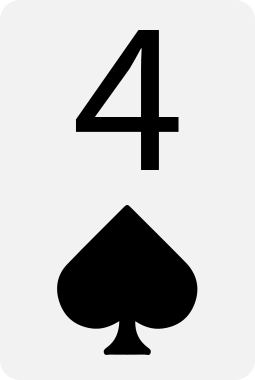
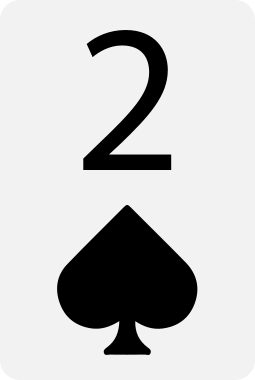
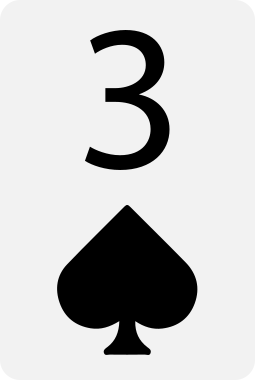
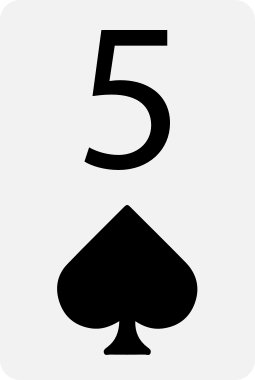
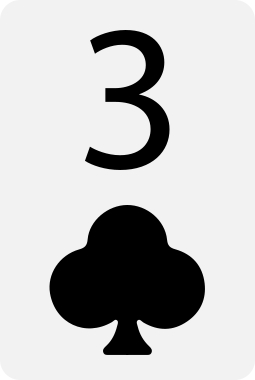
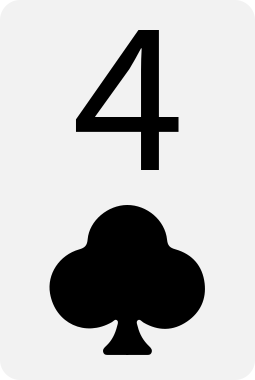
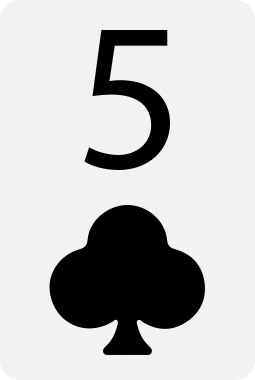
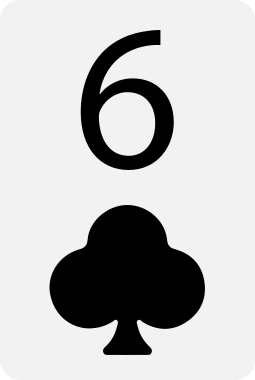
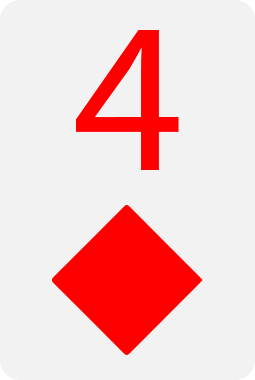
Pocket Fours is a small pocket pair with a clear and well-defined purpose: flop a set or proceed with caution. It arrives with immediate showdown value as a made pair, but that value is fragile against the field. Almost every opponent at the table holds at least one overcard to your Fours, and the board will almost certainly produce overcards too.
It is not a hand you play for its raw strength. It is a hand you play for its set potential and the implied odds that come with it.
What These Odds Show for 44
The draw odds for Pocket Fours are nearly identical to other small pocket pairs, which reflects the mathematical symmetry of the hand category. On the flop, you will have a pair 71.84% of the time – but that pair is already in your hand before the flop, so the real question is what the board brings alongside it.
The set odds are the headline figure. Three of a kind comes in at 10.78% on the flop, which is the roughly 1-in-9 chance that poker players commonly cite for flopping a set with a pocket pair. By the river that figure settles at 11.73%, with the difference explained by the fact that some sets improve further into full houses and four of a kind as the hand progresses.
Speaking of which, the full house odds by the river reach 8.55% and four of a kind lands at 0.84% – both outcomes that are extremely profitable when they occur, typically against opponents who cannot put you on that kind of strength.
The overcard table is stark. There is a 99.39% chance of an overcard appearing on the flop, rising to effectively 100% by the river. This is not a surprise – Fours are beaten in rank by every card from Five through Ace, meaning almost any board card will be an overcard. This single number captures why Pocket Fours cannot be played as a straightforward top-pair hand. If you miss your set, overcards are essentially guaranteed.
The higher pocket pair table is also important. Against a single opponent there is a 4.90% chance they hold a higher pocket pair, rising to 33.34% at a nine-handed table. Combined with the near-certain overcard odds, this reinforces that 44 is a set-mining hand first and everything else second.
Hand Strength Summary
- Hand type: Small pocket pair
- Relative strength: Marginal – heavily dependent on flopping a set
- Strengths: Hidden strength when a set is flopped, guaranteed pair equity preflop
- Main vulnerability: Overcards on virtually every board, dominated by any higher pocket pair
How Pocket Fours Wins
Pocket Fours wins in a few specific ways:
- Flopping a set and winning a large pot against an opponent with top pair or an overpair
- Improving to a full house or four of a kind against a hand that cannot fold
- Winning uncontested pots preflop or on the flop when opponents miss and fold to a bet
- Occasionally holding as the best hand against a very specific narrow range
The vast majority of 44’s long-term profit comes from set mining – the process of calling preflop with the intention of flopping three of a kind and winning a big pot.
Main Weaknesses
Pocket Fours has several critical limitations:
- Overcards appear on the board essentially every hand, making the pair almost unplayable without improvement
- A higher pocket pair has it dominated before the flop, and at a full table that happens roughly one in three times
- Without a set, 44 has very little ability to continue against aggression on most board textures
- Straight and flush potential is minimal – straights come in at under 2% by the river and the hand is offsuit by definition as a pair
Best and Worst Flop Textures
Strong flops
- Any flop containing a Four (four of a kind included)
- Low dry boards where the pair retains some unimproved value (e.g. 2♠ 3♦ 7♣)
- Boards where a set of Fours is well-disguised against likely opponent holdings
Dangerous flops
- Any high card flop where opponents are likely to have connected (A♠ K♦ Q♣ is a nightmare)
- Wet coordinated boards where even a set can be vulnerable to straight or flush draws
- Boards that pair a high card, giving opponents with overpairs a full house draw of their own
How It Plays by Position
- Early position: A fold in many situations, or a limp in casual games; raising for value is rarely justified
- Middle position: Can be played as a set-mine call against an open, but rarely worth raising with
- Late position / Button: Best position to set mine – you can call an open with a clear plan, and position allows you to control pot size post-flop
- Blinds: Defendable from the big blind against a single raiser given the price, but requires discipline to fold when the flop misses
Common Mistakes with Pocket Fours
- Continuing post-flop without a set on boards full of overcards
- Overvaluing the hand preflop and building a large pot before the flop
- Calling off too many chips set mining in situations where implied odds do not justify it
- Slowplaying sets too often on dynamic boards where draws are present
Comparison to Similar Hands
- Stronger than: 22, 33 – marginally, though all small pairs play similarly
- Weaker than: 55, 66 and upward – higher pairs have more unimproved value and face fewer overcards
Compared to a hand like 56s, Pocket Fours lacks the straight and flush potential but has the immediate pair equity. The gap between small pairs and medium pairs (77–99) is meaningful – medium pairs can sometimes hold unimproved on boards with fewer overcards.
How Pocket Fours Performs in Multiway Pots
Set mining with small pairs actually improves in multiway pots in terms of implied odds – more players means bigger pots when you hit. However, sets also become more vulnerable to being outdrawn in multiway situations, particularly on wet boards. The key discipline is recognising that even a flopped set of Fours on a coordinated board requires careful play when multiple opponents are involved.
FAQ: Pocket Fours
Should you raise or limp with Pocket Fours?
It depends on the game format and position. In many situations, calling a raise to set mine is the primary use case. Raising for value preflop is rarely the main objective.
How often do you flop a set with Pocket Fours?
Approximately 10.78% of the time – roughly once every nine flops. That is the core probability that defines how the hand is played.
What do you do if you miss the flop with Pocket Fours?
In most cases, you should fold to any significant aggression. On a dry board with no betting, a single continuation bet may be worthwhile, but continuing with an unimproved small pair on an overcard-heavy board is a losing play in the long run.
Why are overcards such a big problem for this hand?
Because there is a 99.39% chance of one appearing on the flop, your pair of Fours is almost never the top pair on the board. Any opponent holding a single card higher than a Four – which is almost every hand – has immediate pair potential that beats yours.
Related Hands