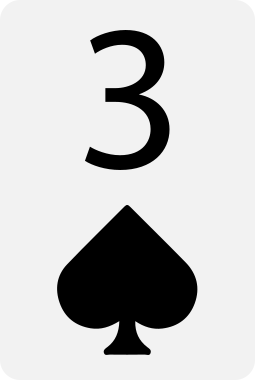
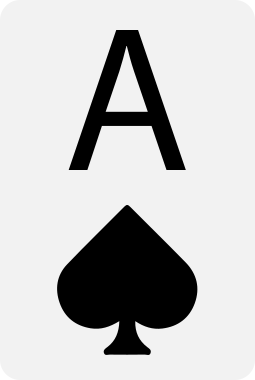
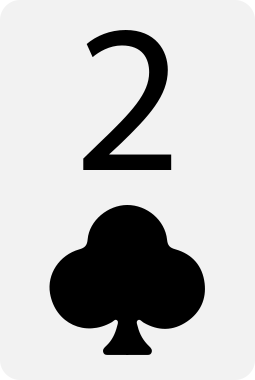
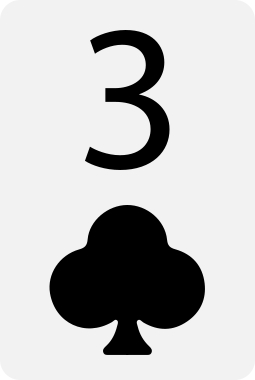
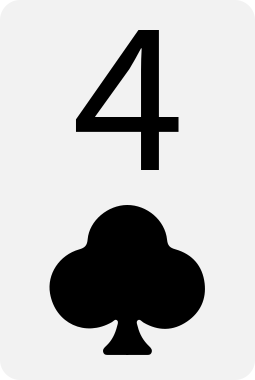
Pocket Threes is the second lowest pocket pair in Texas Hold’em, sitting just above Pocket Twos. Like all small pairs, its identity is almost entirely defined by set mining – the hope of flopping three of a kind and winning a large pot against an opponent who cannot see it coming. As a raw holding, it has almost no unimproved value against a typical field.
What it lacks in strength it makes up for in deception. When Threes do hit a set, the hand is almost completely invisible.
What These Odds Show for 33
The draw odds for Pocket Threes are essentially the same as any other pocket pair – the mathematics of flopping a set does not change based on the rank of the pair. Three of a kind arrives 10.78% of the time on the flop, settling at 11.75% by the river as some sets continue improving into full houses and four of a kind.
The full house figure of 8.55% by the river and four of a kind at 0.84% represent the premium outcomes – hands that are almost always worth a large pot when they occur.
Where Pocket Threes does differ slightly from Pocket Fours is in the straight odds, which drop from 1.97% to 1.59% by the river. This is because Threes sit lower in the rank sequence, limiting the number of straight combinations that include them. It is a minor difference but worth noting – the hand has even less non-set potential than Fours.
The overcard table tells the starkest story of any hand in the deck. There is a 99.90% chance of an overcard appearing on the flop, and by the river that figure rounds to 100%. Every card from Four through Ace outranks a Three, which means the board will almost always contain at least one card that beats your pair. Playing an unimproved Pocket Threes post-flop is close to indefensible against any serious opponent.
The higher pocket pair odds are also slightly more concerning than with Fours. Against a single opponent, there is a 5.39% chance they hold a higher pocket pair – which at this rank means anything from 44 through AA. At a nine-handed table, that rises to 35.03%. More than one in three full-table situations will see at least one opponent holding a pocket pair that already has Threes beaten before a single community card is dealt.
Hand Strength Summary
- Hand type: Small pocket pair
- Relative strength: Among the weakest starting hands – value comes almost entirely from set potential
- Strengths: Disguised strength when a set is flopped, immediate pair equity before the flop
- Main vulnerability: Overcards on virtually every board, higher pocket pairs, almost no unimproved post-flop playability
How Pocket Threes Wins
Pocket Threes wins in a narrow set of ways:
- Flopping a set of Threes and extracting value from opponents holding top pair, overpairs, or two pair
- Improving to a full house or four of a kind in large pots where opponents are committed
- Winning small uncontested pots when all opponents check or fold to a flop continuation bet on a dry board
- Occasionally holding as the best hand in blind-vs-blind or limped pots where opponent ranges are wide and weak
Outside of these scenarios, Pocket Threes has very limited ability to win at showdown.
Main Weaknesses
Pocket Threes has several profound limitations:
- The overcard odds are effectively certain – 100% by the river means the pair is almost always beaten in rank by something on the board
- A higher pocket pair has Threes dominated before the flop, and that happens to at least one opponent in over a third of nine-handed situations
- Straight potential is reduced compared to higher small pairs, with only 1.59% by the river
- The hand has almost no bluff-catching or thin value-betting ability without improvement
- Implied odds only justify set mining when stack sizes are deep enough and opponents are likely to pay off a set
Best and Worst Flop Textures
Strong flops
- Any flop containing a Three – ideally on a board that gives opponents something to be interested in too
- Very low dry boards (e.g. 2♣ 5♦ 8♠) where the pair retains some residual value and aggression can take the pot
- Boards where the set is entirely concealed by the texture
Dangerous flops
- Any broadway-heavy board where opponents are likely to have connected strongly
- Wet boards with flush and straight draws where even a flopped set requires careful navigation
- Boards that pair a high card, giving opponents with overpairs their own full house potential
How It Plays by Position
- Early position: Almost always a fold against a raise; limping is the best case in passive games
- Middle position: Viable as a call against an open where implied odds justify it, but not a hand to build a pot with
- Late position / Button: The strongest position to play it – set mining with position allows better pot control and easier decisions when the flop misses
- Blinds: Defendable at a good price from the big blind, but fold discipline post-flop is essential when the board brings overcards
Common Mistakes with Pocket Threes
- Calling raises where the stack-to-pot ratio does not justify the set mining implied odds
- Continuing post-flop on overcard boards without improvement – which is almost every board
- Building a pot preflop with a hand that needs to see a cheap flop
- Slowplaying sets on boards with active draws, allowing opponents to outdraw a strong but vulnerable hand
Comparison to Similar Hands
- Stronger than: Pocket Twos – marginally, as the rank difference barely affects the core set-mining mathematics
- Weaker than: Pocket Fours and higher pairs, which face slightly fewer overcards and have marginally more unimproved value
Compared to suited connectors like 45s, Pocket Threes trades straight and flush draw potential for the guaranteed preflop pair and the explosive upside of a set. The honest comparison is that 33 and 22 are nearly interchangeable in terms of how they should be played.
How Pocket Threes Performs in Multiway Pots
The implied odds argument for set mining is strongest in multiway pots – more players means a bigger pot to win when the set arrives. However, sets of Threes are particularly vulnerable on coordinated boards in multiway situations, where multiple opponents can be drawing to hands that beat even three of a kind. The key discipline is extracting maximum value when the set arrives while recognising when the board makes even that hand dangerous.
FAQ: Pocket Threes
Is Pocket Threes worth playing?
Yes, in the right conditions. The hand has clear value as a set-mining holding in position with the right stack sizes and implied odds. It should not be played as though the pair itself has significant value.
How often do you flop a set with Pocket Threes?
The same as any pocket pair – approximately 10.78% of the time, or roughly once every nine flops.
How is Pocket Threes different from Pocket Twos?
Very little separates them mathematically. Pocket Threes has a marginally wider range of straight combinations it can contribute to, but in practice the two hands are played almost identically.
What should you do when you miss the flop with Pocket Threes?
In most cases, fold to any meaningful aggression. The overcard odds are essentially 100% by the river, meaning your pair is almost certainly beaten in rank by the board. Continuing without a set is a losing strategy in the long run.
Related Hands