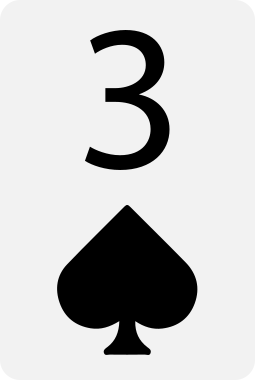
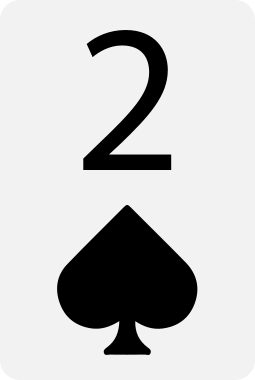
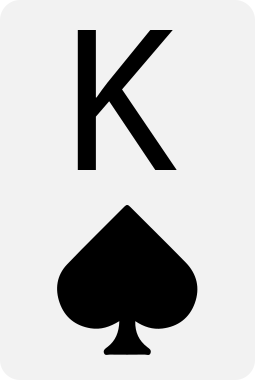
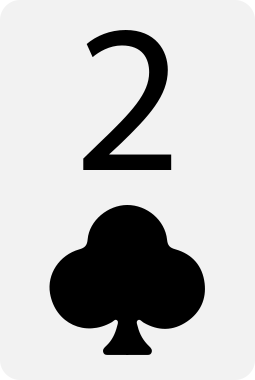
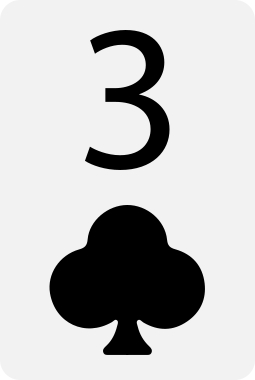
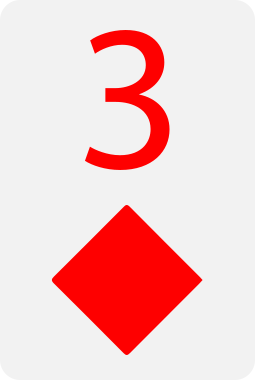
Three Two Suited is the lowest possible starting hand in Texas Hold’em by rank. There is no weaker combination available. Despite that distinction, it retains a small but real edge over its offsuit counterpart thanks to the flush potential that suited hands carry, and it sits in an interesting position as a hand that serious players occasionally deploy deliberately rather than stumble into.
Understanding what it can and cannot do is more useful than simply labelling it unplayable and moving on.
What These Odds Show for 32s
The overcard table delivers the most striking number on this page. On the flop, there is a 99.90% chance of at least one overcard appearing on the board. By the river, that figure reaches 100.00%. In the entire range of possible runouts, there is essentially no scenario in which 32s holds the highest card on the board. This is not a hand that wins through high card strength or top pair under any realistic circumstances.
On the flop, 52.39% of runouts produce nothing better than high card. That is consistent with other weak suited hands, but the overcard exposure compounds the problem significantly. A pair of threes or twos is almost always bottom pair, and bottom pair with no kicker relevance is rarely a hand worth investing chips in.
Where 32s separates itself slightly from hands like 73s is in the straight odds. At 4.70% by the river, the straight rate is modestly higher than many other low hands, and the reason is structural. Three Two is a true connector – there is no gap between the cards – which means it has more straight draw combinations available than gapped hands of similar rank. The wheel draw using A-2-3-4-5 is the primary target, but 32s also connects into 2-3-4-5-6 and 3-4-5-6-7, giving it three distinct straight targets rather than the single or double target available to low gapped hands.
The flush odds of 6.48% by the river are in line with any other suited hand, and the straight flush rate of 0.10% is marginally higher than 73s at 0.06%, again reflecting the connector advantage.
Hand Strength Summary
- Hand type: Weak suited connector (lowest ranked)
- Relative strength: Bottom 1% of all starting hands by rank
- Potential: Flush draws, wheel and low straights, disguised two pair
- Main vulnerability: Overcarded on virtually every board; pairs almost never have value
Despite being the weakest hand by rank, 32s is not as far behind other low suited connectors in raw equity as its reputation suggests. The true connector structure gives it slightly more straight draw equity than its position in the rankings implies.
How 32s Wins
The most common winning path for 32s is completing the flush. At 6.48% by the river it is not frequent, but it produces a strong, often well-disguised hand. Straights are the other primary route, with the wheel being the most likely target given that any ace on the board activates the draw immediately. Two pair on a low board – particularly something like 2♠ 3♦ 7♣ – is a realistic and well-concealed result that can extract significant value from opponents holding a single pair. Straight flushes are rare at 0.10% but represent the ultimate version of what this hand can make.
In position against weak ranges, 32s can also win through well-timed aggression on low, connected boards where the texture naturally favours the kind of hand a caller might hold.
Main Weaknesses
The 100% overcard rate by the river is not merely a statistic – it is the defining constraint on how this hand can be played. Specific weaknesses include:
- Any pair made with either hole card is almost certainly the lowest pair on the board
- The hand cannot win at showdown through high card strength under any circumstances
- Dominated by every other starting hand in terms of raw card rank
- Flush completions are vulnerable to higher flushes from opponents holding suited broadways or suited aces
- Straight completions, particularly the wheel, can lose to higher straights on the same board
Best and Worst Flop Textures
Strong flops
- A-4-5 or A-2-4 giving an immediate wheel straight draw or completion
- 4-5-6 or 4-6-7 providing open-ended straight draw potential
- Monotone boards in your suit, particularly with low cards that reduce the chance of opponents holding higher flush draws
- 2-3-x or 2-3-3 style boards making trips or two pair in a disguised way
Dangerous flops
- Any board above a seven, which is essentially guaranteed given the overcard rate
- High flush-completing boards in your suit where opponents with suited broadways or suited aces are likely ahead
- Boards where the hand makes bottom pair and faces any continuation bet
The honest assessment is that most flops are bad flops for 32s. The hand needs very specific textures to continue with confidence.
How It Plays by Position
- Early position: Never. There is no format or scenario in standard play where opening 32s from early position is correct.
- Middle position: Still a clear fold. The hand cannot justify the investment against the ranges that call or 3-bet from these positions.
- Late position / Button: The only position where 32s has any legitimate use, and only in specific circumstances. Stealing the blinds against weak or tight opponents is the primary application. In an unraised multiway pot with multiple limpers, the implied odds on a flush or straight can occasionally justify seeing a flop cheaply.
- Blinds: In the big blind against a single small open with multiple callers already in, pot odds can justify a call. The hand is genuinely at its best here – the price is right, the pot is multiway, and the draw potential is maximised. In the small blind, the post-flop positional disadvantage makes it harder to realise the hand’s equity.
Common Mistakes with 32s
- Playing it from any position other than late position or the big blind
- Continuing past the flop without a flush draw, straight draw, or two pair minimum
- Over-valuing bottom pair, which is almost the only pair this hand can make
- Calling a raise preflop and then calling again on a board that has not connected
- Treating it as a bluff-catching hand at showdown given its near-zero showdown value unimproved
The hand requires discipline in two directions – folding it preflop in most situations, and also folding it quickly post-flop whenever the board has not provided a clear and strong draw.
Comparison to Similar Hands
- Stronger than: 32 offsuit, and marginally ahead of other low offsuit hands in raw equity
- Weaker than: 43s, 54s, 42s, and essentially every other starting hand by rank
- Similar to: 42s and 52s in terms of overall equity profile, though 32s has a marginally different straight draw distribution
The connector structure gives 32s a genuine edge over 73s and other low gapped suited hands in terms of straight draw frequency. The 4.70% straight rate versus 4.10% for 73s reflects this, small as the gap is. Where 32s falls behind is in the total absence of any board where its unpaired high card matters.
How 32s Performs in Multiway Pots
Of all the weak suited connectors, 32s is arguably the one that benefits most from multiway pots. The reasons are straightforward – its flush and straight draws are deeply disguised at the low end of the board, and when they complete, opponents rarely put a caller on the exact combination. A flopped wheel against a player with two pair or a set in a multiway pot can be a significant pot. Implied odds are at their highest when the hand is unexpected, and 32s is about as unexpected as it gets.
The flip side is that multiway pots also increase the probability of a higher flush draw being in play, and low straights become more vulnerable as more players are involved. The hand benefits from multiway dynamics but is not without risk in them.
FAQ: Three Two Suited
Is 32s really the worst hand in poker?
By rank it is the lowest possible starting hand. However, in terms of actual equity, it is not dramatically behind other weak suited connectors. The gap between 32s and 73s in raw equity is smaller than most players assume.
Why is the overcard rate 100% by the river?
Because every card in the deck from four upwards is higher than the three, and there are enough streets that at least one such card appearing is a mathematical certainty across all possible runouts.
Does being suited make a significant difference for 32s?
More so than for some hands. The flush draw is one of the few reliable paths to a winning hand, and without it the offsuit version has almost no viable route to showdown strength.
What is the best possible outcome for 32s?
Making a straight flush is the peak result at 0.10% by the river. Practically speaking, completing a flush or hitting the wheel in a large pot is the realistic best case scenario.
Related Hands