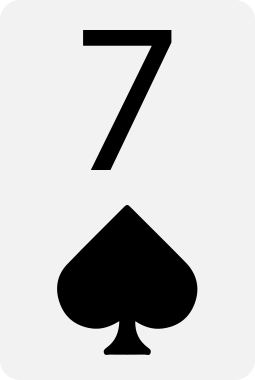
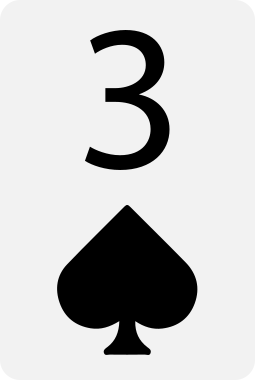
Seven Three Suited is one of the weakest starting hands in Texas Hold’em. It sits near the very bottom of the hand rankings, and while the suited nature gives it slightly more potential than its offsuit counterpart, it remains a hand that experienced players fold without much deliberation in most situations.
That said, understanding why it is weak, and the rare conditions under which it can be played profitably, is useful for any serious student of the game.
What These Odds Show for 73s
The draw odds table paints a clear picture of the challenge this hand faces. On the flop, there is a 52.71% chance of flopping nothing better than high card, meaning more than half the time the board will not connect with either of your hole cards in any meaningful way. That figure drops as the streets progress, but by the river you are still making nothing better than a pair 42.87% of the time.
The flush draw is where suited low hands derive most of their appeal, and the numbers reflect that. The chance of making a flush by the river is 6.52%, which is in line with any other suited holding. It rises from just 0.84% on the flop to 2.92% by the turn, meaning the majority of flush completions come on the river. The straight odds are modest but not trivial – 4.10% by the river – though the gap between seven and three means the straight draws that do materialise tend to be lower-end and vulnerable to higher straights.
The overcard table is perhaps the starkest number on the page. There is a 92.14% chance of an overcard appearing on the flop alone. By the river, that figure rises to 98.76%. In practical terms, this means that almost every single board will contain at least one card higher than your seven, making it exceptionally difficult to win at showdown without significantly improving your hand.
Hand Strength Summary
- Hand type: Weak suited connector (low gapper)
- Relative strength: Bottom 5% of all starting hands
- Potential: Flush draws, low straights, occasional two pair
- Main vulnerability: Almost always dominated; massive overcard exposure
The gap between seven and three means this hand lacks the straight-draw consistency of true suited connectors. It needs to hit specifically to compete.
How 73s Wins
When 73s does win, it tends to do so in one of a few specific ways. Flopping a flush draw and completing it is the most reliable path to a strong hand. Hitting two pair or trips on a low board can also produce winning hands, particularly in situations where opponents are not expecting those specific cards to connect with a preflop caller. Low straights – particularly A-2-3-4-5 using the three, or 3-4-5-6-7 – are rare but possible. Occasionally the hand wins through a well-timed bluff when the board texture allows a credible story, particularly in position on coordinated low boards.
Main Weaknesses
The core problem with 73s is that it needs the board to cooperate almost completely to produce a winning hand, and even then the results are often marginal. Specific weaknesses include:
- A pair of sevens or threes is easily dominated by better kickers
- Low straights are frequently the second-best straight at the table
- Flush completions can still lose to higher flushes, particularly against players who would reasonably hold suited broadways or suited aces
- Nearly every board will contain overcards, making top pair almost impossible to achieve
- The hand has very little preflop equity against any other holding, including other weak hands
Best and Worst Flop Textures
Strong flops
- Low, connected boards where both cards hit (e.g. 3♦ 5♣ 7♠ for two pair, or 4-5-6 for a straight draw)
- Monotone boards in your suit that complete the flush
- Paired low boards where your three or seven makes trips
Dangerous flops
- Any high board, which accounts for the vast majority given the 92.14% overcard rate on the flop
- Boards where you make bottom pair with a weak kicker, inviting continued action from better hands
- Flush-completing boards in other suits that give opponents a stronger flush
On most flops, the correct action with 73s is simply to give up unless you have connected in a clear and meaningful way.
How It Plays by Position
- Early position: Should not be played. The hand has insufficient strength to open from UTG or adjacent seats, and calling raises from here is a significant leak.
- Middle position: Still a fold in most circumstances. The hand cannot withstand a raise and call sequence without inflating a pot with weak equity.
- Late position / Button: The only position where this hand has any viability, and only in specific contexts such as a steal against weak blinds or an unraised pot with multiple limpers offering implied odds on a flush.
- Blinds: In the big blind facing a very small raise with multiple callers already in, the pot odds can occasionally justify continuing. In the small blind, the lack of position post-flop makes it a difficult play even at a discount.
Position is not just important with this hand – it is essential. Without position and the right price, there is rarely a justification for playing it.
Common Mistakes with 73s
- Playing it from early position at all
- Calling a raise with it and then continuing on a board that does not fully connect
- Over-valuing a single pair, particularly bottom pair with a weak kicker
- Chasing a flush draw when the pot odds do not support the call
- Under-estimating how often a completed flush loses to a higher flush
- Bluffing too frequently simply because the hand has no showdown value
The most common and costly mistake is simply playing the hand too often preflop and then compounding the error by continuing on boards that have not meaningfully improved it.
Comparison to Similar Hands
- Stronger than: 72 offsuit, 73 offsuit, 82 offsuit
- Weaker than: 74s, 64s, any true suited connector from 54s upwards
- Similar to: Other low gapped suited hands such as 83s or 62s
The suited nature gives 73s a marginal edge over 73 offsuit, primarily through the flush equity and the small additional equity the flush draw provides in multiway pots. Against most hands it would face in a raised pot however, the gap in equity is significant regardless of suitedness.
How 73s Performs in Multiway Pots
Paradoxically, this is one of those hands that actually prefers multiway pots when it does play, purely because implied odds improve. If the hand makes a flush, straight, or two pair on a low board, it becomes extremely well disguised and the potential to extract value from multiple players increases. In a heads-up pot, 73s has very little equity and limited opportunity to bluff credibly. In a multiway limped pot, the occasional connection with the board can produce unexpected payoffs.
That said, multiway pots also increase the chances that someone else has a better flush draw, a better straight, or dominates any pair you make. The improvement in implied odds does not outweigh the increase in reverse implied odds for the casual player.
FAQ: Seven Three Suited
Is 73s ever a good hand?
It can produce strong made hands in specific runouts, but as a starting hand it is one of the weakest in Hold’em. Situations where it is genuinely correct to play it are rare and highly context-dependent.
Why does the suited nature matter so little here?
Being suited adds roughly 3–4% equity to any starting hand, but when the base hand is this weak, that uplift is not enough to rescue it in most situations.
Can 73s be used as a bluff raise preflop?
Occasionally in late position as a pure steal, yes. Some players use the very bottom of their range as light 3-bet bluffs, but this requires a strong read and the right opponent dynamics.
How often does 73s make a flush?
6.52% by the river, assuming no community cards are set. That is roughly 1 in 15 runouts.
Related Hands