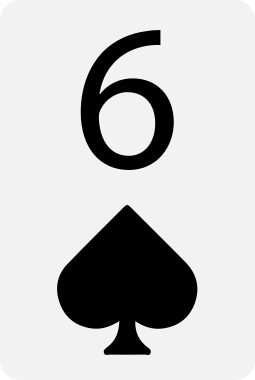
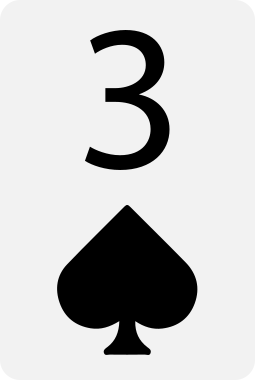
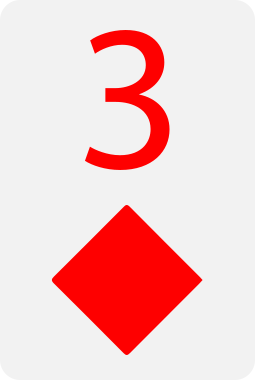
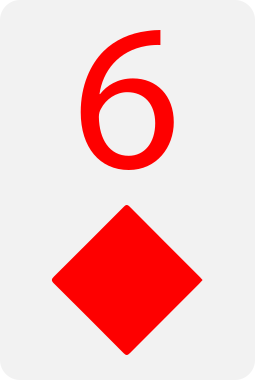
Six-Three Suited is a two-gap suited hand at the lower end of the rank spectrum, sharing its overcard profile with 65s and 64s while producing straight equity closer to the two-gap hands like 96s and 85s. It sits at an intersection of two structural disadvantages – a low rank that guarantees near-certain overcards, and a gap wide enough to restrict straight draws primarily to gutshots. Neither the Six nor the Three is a strong card independently, and what the hand offers is a flush draw, occasional gutshot straight draws, and the possibility of two pair on very low connected boards.
63s is one of the weakest suited hands with any practical claim to playability, and that claim rests almost entirely on position, stack depth, and table conditions rather than on the hand’s raw equity.
What These Odds Show for 63s
The straight odds for 63s land at 5.36% by the river, sitting between 85s at 6.06% and 96s at 6.02% on one side, and below the one-gap hands like 64s at 6.97% and 53s at 7.01% on the other. The two-gap penalty is visible here – 63s produces meaningfully less straight equity than the one-gap hands at the same rank level, while the lower rank compared to 85s and 96s pushes it slightly below those two-gap equivalents as well. The 0.64% flop straight odds match 85s and 96s exactly, confirming the shared two-gap geometric structure. Straight flush potential at 0.11% is consistent with other two-gap suited hands in this range.
Flush equity lands at 6.48% by the river, consistent with other suited hands throughout this series with only marginal variation.
The overcard table sits at 95.84% on the flop, 98.67% by the turn, and 99.60% by the river – identical to 65s and 64s. All three hands have a Six as their highest card, so overcard frequency is determined by the Six regardless of whether the second card is a Five, Four, or Three. The Six is a weak anchor that cannot suppress overcard frequency meaningfully, and the result across all Six-high hands is near-certain overcards from the flop onward. 63s will almost never have the best high card on the board, and no strategy built around pair value or top-card dominance has any basis with this hand.
The meaningful structural comparison is between 63s and 64s. Both have a Six as their anchor card, producing identical overcard tables. 64s has a one-gap structure producing 6.97% river straight equity; 63s has a two-gap structure producing 5.36%. That 1.61 percentage point difference in the hand’s primary draw is the entire case for preferring 64s in most situations where both might be considered.
Hand Strength Summary
- Hand type: Suited hand (two-gap, low rank)
- Relative strength: Weak and highly speculative; among the least justified suited hands with any claim to the playable category
- Main draws: Flush draws, gutshot straight draws on specific board textures, two pair on very low connected boards
- Main vulnerability: Near-certain overcards at 99.60% by the river; two-gap structure limits straight draws to gutshots; the Three contributes minimally in almost all situations; no high-card fallback whatsoever
How 63s Wins
63s has limited winning routes, all of them draw-based:
- Completing a flush draw
- Completing gutshot straight draws on the specific board textures that activate them
- Flopping two pair when both the Six and Three connect on very low board textures
- Building combination draws on the rare boards where a flush draw and straight draw exist simultaneously
- Taking pots through semi-bluffing when a draw is live and opponents cannot comfortably continue
There is no pair-based winning route with 63s in any realistic sense. The Six cannot hold as top pair on virtually any board the table produces, and the Three is not a pair card worth considering independently. Every decision about whether to continue past the flop must be based entirely on draw equity.
Main Weaknesses
- Overcards are near-certain at 99.60% by the river – there is no high-card plan under any realistic board condition
- The two-gap structure limits straight draws to gutshots, producing four outs rather than eight and requiring specific board combinations to materialise
- River straight equity of 5.36% is lower than any one-gap hand at comparable rank levels and lower than two-gap hands at higher rank levels
- The Three is a very weak second card – it contributes almost nothing as a kicker, pair card, or straight draw component beyond very specific low board textures
- Flush draws can be beaten by any opponent holding a higher card of the same suit, and with a Six as the top card that covers most of the deck
- Requires deep stacks, cheap entry, and position to have any justification for playing at all
Best and Worst Flop Textures
Strong flops
- Very low connected boards where a gutshot straight draw materialises (2♠ 4♦ 8♣ or 4♥ 5♦ 8♠ giving draws using the Six or Three)
- Two-tone boards in your suit with some straight draw potential alongside
- Boards where both the Six and Three pair simultaneously on low textures (6♦ 3♣ 9♥ gives immediate two pair, though the Nine requires attention)
Dangerous flops
- Any board above low connected textures – which given the overcard certainty describes the overwhelming majority of all flops
- Low boards completing straights for higher connectors where 63s holds the losing end or has no draw at all
- Monotone flops in a suit you do not hold
How It Plays by Position
- Early position: Should never be opened under any circumstances; the combination of near-certain overcards, gutshot-only straight draws, and the post-flop disadvantage of playing out of position makes this hand entirely unjustifiable from early position in any standard game
- Middle position: Unplayable in most games; even in passive, deep-stacked environments the implied odds model is very difficult to justify given the two-gap straight limitation
- Late position / button: The only position where 63s has any legitimate claim to being played – positional advantage, cheap flop entry, and the ability to fold cheaply when the board produces nothing, which will be most of the time
- Blinds: A very marginal big blind defend against a single late-position raiser when pot odds are genuinely favourable and stack depth is sufficient; disciplined folding on almost all missed flops is essential and non-negotiable
Common Mistakes
- Calling raises from out of position under any circumstances – the already marginal implied odds model that barely justifies 63s in position collapses entirely when playing against a raise from out of position
- Treating the flush draw as strong standalone equity without accounting for its vulnerability to higher flush draws in any multiway situation
- Continuing past the flop with no draw – which will happen on the vast majority of flops given the overcard certainty and the gutshot-only straight draw profile
- Overvaluing a gutshot when it does appear – four outs without additional equity alongside do not justify significant pot investment in most situations
- Confusing 63s with a one-gap connector and playing it with the frequency and aggression appropriate to hands like 64s or 75s
Comparison to Similar Hands
- Stronger than: 63o (without the flush draw this hand has essentially no post-flop equity; the suited nature is the only argument for its existence as a playable hand), 52s (lower rank, even more constrained straight range)
- Weaker than: 64s (one fewer gap, river straight odds improve from 5.36% to 6.97%, and the Four is a marginally better second card on low boards), 65s (zero-gap, dramatically better straight equity at 8.57% with the same overcard profile), 85s (higher rank with identical gap structure – 86.73% flop overcard odds versus 95.84% for 63s, and 6.06% river straight odds versus 5.36%)
The comparison to 85s is particularly instructive for understanding what rank costs in this hand family. Both 63s and 85s are two-gap suited hands. 85s has an Eight as its highest card producing 86.73% flop overcard odds; 63s has a Six producing 95.84%. That nine percentage point difference on the flop, combined with 85s’s higher river straight odds of 6.06% versus 5.36%, makes 85s a meaningfully stronger hand in most situations despite the identical gap structure.
How 63s Performs in Multiway Pots
63s shares the theoretical multiway pot benefits of other low suited drawing hands – larger fields mean larger implied odds when straights and flushes complete, and the disguise factor of a Six-Three on a low connected board is considerable. Opponents simply do not anticipate this hand making the nuts on boards like 2-4-5 or 4-5-7.
In practice, however, the two-gap limitation significantly reduces the frequency with which those disguised straights materialise. Where 65s or 64s can pick up open-ended straight draws in multiway pots and apply combination draw pressure, 63s is limited to gutshots that require more specific board alignment. The flush draw remains the more reliable equity source in multiway situations, and with a Six as the top card any opponent holding a higher card of the same suit has a better flush draw – which in a multiway pot is an increasingly likely scenario.
The net result is that 63s benefits less from multiway pots than one-gap or zero-gap hands at comparable rank levels, while facing the same risks of drawing to second-best hands. It needs cheap entry and deep stacks like all low suited drawing hands, but delivers less when it does connect.
FAQ: Six-Three Suited
How does 63s compare to 64s given they share the same overcard table?
The overcard tables are identical because both hands have a Six as their highest card. The meaningful difference is in straight equity and gap structure. 64s is a one-gap hand producing 6.97% river straight equity with more frequent open-ended straight draws. 63s is a two-gap hand producing 5.36% with almost exclusively gutshot straight draws. Since straights and flush draws are both hands’ primary winning routes, 64s is the stronger hand in most situations, with the 1.61 percentage point straight equity gap being the clearest measure of the difference.
What gutshot draws does 63s pick up most commonly?
The most common configurations involve boards that partially bridge the gap between Six and Three. A board of 4-5-7 gives a gutshot to the Two or Seven using the Six and Three together. A board of 4-5-8 gives a gutshot using the Six. A board of 2-4-5 gives a gutshot to the Seven using the Six. These require specific card combinations and remain infrequent, explaining the 0.64% flop straight figure.
Is 63s ever worth seeing a flop with in a multiway limped pot?
In late position with deep stacks and a genuinely cheap price – yes, marginally. The combination of flush draw potential and the possibility of a disguised straight or two pair on very low boards gives the hand just enough total equity to justify a small investment in the right multiway environment. The discipline required is knowing when to fold cheaply when the flop provides nothing, which given the overcard certainty and gutshot-only straight profile is most of the time.
Where does 63s rank among the weakest playable suited hands?
It sits near the bottom of the category. The combination of near-certain overcards, gutshot-only straight draws, and a Three as the second card places it below most hands with any claim to regular playability. Hands like 43s, 53s, and 32s sit alongside or below it, and hands like 64s, 74s, and 85s are all clearly stronger despite sharing structural similarities. The case for playing 63s is narrower than for almost any other suited hand discussed in this series.
Related Hands