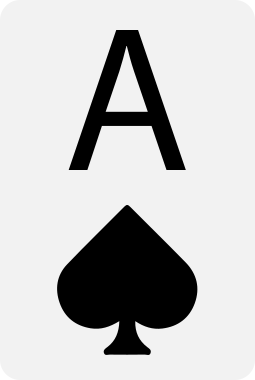
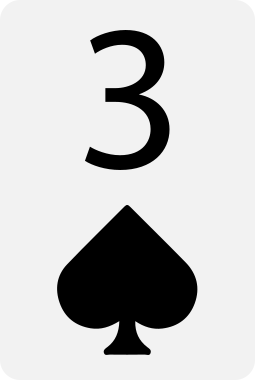
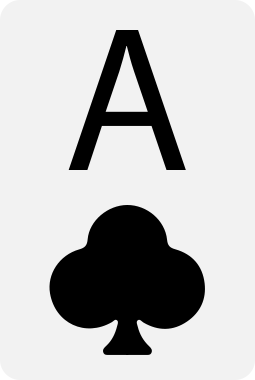
Ace Three Offsuit is one of the weakest hands in the ace-x family. It carries the prestige of an ace but pairs it with a low, disconnected kicker that creates more problems than it solves in the majority of post-flop situations. Understanding when this hand has value and when it is a trap is one of the clearer edges a developing player can develop.
What These Odds Show for A3o
The draw odds for A3o look almost identical to any other unpaired offsuit hand on the surface. It misses the board entirely 53.55% of the time on the flop, arrives at a pair 40.41% of the time, and builds to two pair in 22.66% of runouts by the river. These numbers are fairly standard for the offsuit unpaired hand category.
What the table does not show directly is how often those pairs are actually good. Pairing the ace is strong in isolation, but ace-three kicker problems are severe. Any opponent holding ace-four through ace-king with a paired ace has you dominated, and that scenario is far more common than it might feel at the table. Pairing the three is almost always a losing hand against any caller with reasonable holdings.
The straight rate of 3.68% by the river is low, reflecting the disconnected nature of the hand. A3o can technically contribute to a wheel straight – the ace-two-three-four-five – but this requires two-four-five to appear on the board simultaneously, which is a narrow and specific requirement. The 0.33% flop straight rate confirms how rarely this draw materialises early.
Unlike the Pocket Kings page where the overcard table quantifies the specific threat of aces, A3o has no overcard concern in the traditional sense. The ace is the highest card in the deck, so no board card outranks it. However, the relevant vulnerability here is kicker dominated spots rather than overcard pressure, and that is a distinction worth understanding clearly.
Hand Strength Summary
- Hand type: Weak ace-x offsuit
- Relative strength: Below average, situationally playable
- Dominates: Ace-two offsuit, lower unpaired hands
- Main vulnerability: Dominated by all other ace-x hands, weak in contested pots
A3o is a hand that looks stronger than it plays. The ace is a powerful card, but attached to a three with no suit advantage, it generates difficult situations more often than profitable ones.
How A3o Wins
When A3o wins, it tends to do so in one of three ways. The cleanest is pairing the ace on a board where no opponent holds an ace, which is common in short-handed or late-position steal situations. The second is making two pair with both the ace and the three, which at 22.66% by the river is a reasonable outcome but requires a fairly specific run-out. The third, and perhaps most underappreciated, is the wheel straight. On a board running two-four-five, A3o makes the nut low straight – a hand that is genuinely disguised and can extract significant value from opponents who do not see it coming.
The bluff and semi-bluff category also applies. With an ace in hand, A3o has strong bluffing credentials on ace-high boards where opponents with missed draws or medium pairs are likely to fold to aggression.
Main Weaknesses
The kicker problem is the defining weakness of this hand. In Texas Hold’em, being dominated means your opponent holds the same top card but with a better secondary card, leaving you with very few outs to win the hand. Against ace-king, ace-queen, or even ace-four, A3o is in bad shape the moment an ace appears on the board. The three provides almost no counterweight in this scenario, and calling down with top pair weak kicker is one of the most common and costly mistakes made with hands of this type.
The offsuit nature compounds this. A3 suited gains the ability to chase flush draws as a backup plan, turning marginal post-flop situations into semi-bluff opportunities. Without the suit advantage, A3o must rely almost entirely on pairing and straight draws, both of which are limited here.
The wheel straight dependency is also a fragile crutch. Requiring a two, a four, and a five to appear on the board is a low-probability event, and even when it does occur, a player holding a six in addition to the wheel cards will beat you with a higher straight.
Best and Worst Flop Textures
Strong flops
- Ace-high boards with no other ace-x hands likely in opponent ranges, such as late position steal situations
- Low boards containing a two, four, or five that open wheel draw potential
- Boards where the three pairs and no overcards to the three are present, though this scenario is rarely powerful enough to build a large pot
Dangerous flops
- Any ace-high board in a multiway pot or against a tight caller who is likely holding a better ace
- Boards with middle cards where no pair and no draw materialises
- King or queen-high boards where the hand has neither pair nor meaningful straight equity
How It Plays by Position
- Late position: Where A3o has genuine steal value. The ace gives the impression of strength, and even if called, an ace on the flop gives you a credible top pair bluff against many opponent ranges.
- Early position: A fold in most contexts. The hand is too weak to play for value and too likely to be dominated to commit chips comfortably. Middle position is similarly uncomfortable unless the table is playing passively.
- Big blind: Can call a single raise at a favourable price and play fit-or-fold on the flop, but should rarely invest significantly unless the board connects cleanly.
Common Mistakes with A3o
- Overvaluing top pair – an ace on the flop with a three kicker should prompt caution, not confidence, as a significant portion of any caller’s range contains a better ace
- Failing to recognise domination – A3o plays better as a bluff vehicle than as a value hand in contested pots, but the ace makes it easy to fall in love with
- Chasing the wheel straight – drawing to a hand that will rarely materialise, or that may be beaten by a higher straight even if it does, is a consistent way to bleed chips with this hand
Comparison to Similar Hands
- Stronger than: A2o, low unpaired offsuit hands like 7-3 or 8-2
- Weaker than: A4o through AKo, any suited ace including A3s
The step up to A4o makes a meaningful difference in straight potential. A4o can contribute to both the wheel straight and the A-2-3-4-5 variant with more board flexibility. The step down from A3s to A3o removes the flush draw dimension entirely, which is the single most valuable secondary attribute any ace-x hand can carry.
Against a hand like A3s, the offsuit version loses a significant portion of its playability in multiway pots and on co-ordinated boards. The suited version is a reasonable speculative hand; the offsuit version requires much more selective deployment.
How A3o Performs in Multiway Pots
In multiway pots, A3o is among the more dangerous hands to play. The probability that at least one opponent holds a better ace increases sharply with each additional player, and the hand’s limited straight potential and absence of flush equity means it rarely arrives at a strong enough hand to justify aggression on a contested board.
The one multiway exception is the wheel straight. On a board with two and four or two and five, the draw to the wheel straight has disguised value in a multiway pot and can extract a large pot from opponents who have connected in different ways. Outside of this specific scenario, multiway pots are generally situations to minimise investment with A3o rather than build them.
FAQ: Ace Three Offsuit
Is A3o worth playing?
In late position with no prior action, it can be a reasonable steal hand. In most other contexts, particularly from early position or against a raise, it is better folded.
Why is A3o weaker than it looks?
Because the three kicker is easily dominated by any opponent holding a better ace, which is almost the entire ace-x range above it.
Can A3o make a straight?
Yes, specifically the wheel straight using ace-two-three-four-five. This requires two, four, and five on the board and is a narrow but genuine possibility.
What is the difference between A3o and A3 suited?
The suited version gains meaningful flush draw equity that makes it significantly more playable, especially in multiway pots. A3 suited is a speculative hand with real value; A3o is a situational holding that should be played sparingly.
Related Hands