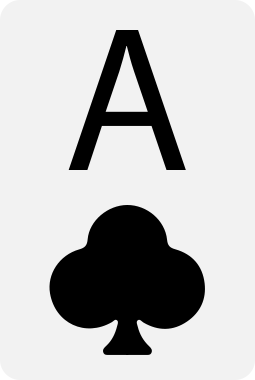
Ace Six Offsuit occupies a familiar and frustrating position in the Texas Hold’em hand rankings. The ace is the most powerful rank in the deck, and its presence gives the hand genuine high-card authority and no overcard vulnerability whatsoever. The six, however, is a low and largely disconnected secondary card that creates kicker problems, limits straight potential, and removes the flush equity that makes the suited version considerably more playable. A6o is a hand that looks appealing in the hole and disappoints on the felt more often than not.
What These Odds Show for A6o
The draw odds for A6o are numerically identical to K8o across every category, which reflects a mechanical reality of hold’em combinatorics. Two unpaired offsuit hands with the same gap between their ranks and equivalent positional distribution across the deck will produce near-identical draw probabilities. The numbers themselves – 46.00% pair rate by the river, 22.79% two pair, 4.45% three of a kind – tell the same structural story as most weak unpaired offsuit hands.
What changes between K8o and A6o is the context around those numbers. The 0.00% straight rate on the flop, rising to only 2.67% by the river, reflects the gap between the ace and six. The ace contributes to broadway straights requiring ten through king on the board, while the six contributes to a narrow band of mid-range straights needing two through five, three through seven, four through eight, or five through nine. These combinations exist but require specific board configurations, and the offsuit nature means none of them come with a flush draw as backup.
Unlike the Pocket Kings and K8o pages, there is no overcard table for A6o. The ace is the highest card in the deck, so no community card can outrank it. This is a genuine structural advantage shared by all ace-x hands and it eliminates one category of board pressure entirely. The relevant vulnerability for A6o is not overcards but dominated kicker situations, and those are considerably more dangerous in practice.
Hand Strength Summary
- Hand type: Weak ace-x offsuit
- Relative strength: Below average, marginal in most contexts
- Dominates: Ace-five and below in kicker battles, most non-ace hands preflop
- Main vulnerability: Dominated by all stronger ace-x hands, weak in multiway pots and raised pots
A6o shares its core problem with the entire weak ace-x offsuit family. The ace is powerful enough to make the hand feel stronger than it is, which is precisely what leads players to overcommit with it in situations where they are drawing thin.
How A6o Wins
Pairing the ace on a board where no opponent holds an ace is the cleanest victory condition. In late position steal situations or heads-up pots against wide ranges, ace-top pair with a six kicker is often good enough to win at showdown or through aggression on later streets.
Two pair is the second meaningful path. At 22.79% by the river, the hand reaches two pair in just under a quarter of all runouts. On ace-six boards in particular, two pair is well disguised. Opponents holding top pair with a better kicker will not realise until showdown that the six on the board has counterfeited their kicker advantage.
The wheel straight is worth noting, though narrowly. With a six in hand, boards containing two, three, four, and five create a six-high straight rather than the true wheel, while boards containing two, three, four, and five with the ace playing low give the actual ace-to-five straight. The six also contributes to two through six straights. These are rare outcomes but genuinely disguised when they occur.
Bluffing and semi-bluffing on ace-high boards is where A6o has perhaps its greatest uncontested value. An ace in hand on an ace-high board is an extraordinarily credible representation of top pair or better, and opponents holding medium pairs or missed draws frequently fold to continuation bets regardless of your actual holding.
Main Weaknesses
The kicker problem with A6o is severe and extends across more of the hand range than most players instinctively appreciate. Every hand from A7o through AKo dominates A6o in a kicker battle when an ace hits the board. That is seven combinations of ace-x offsuit hands alone, plus their suited counterparts, that have A6o in difficult shape the moment top pair is made. Against a table of players with reasonable starting hand standards, the probability that a pre-flop caller holds one of these dominating hands is meaningful enough to warrant significant caution.
The six offers almost nothing in terms of straight connectivity given the ace anchor. Unlike a hand such as A5o, which can make the wheel straight with ace-two-three-four-five using the ace as a low card, A6o’s straight options are almost entirely dependent on the six connecting with mid-range board cards. The ace itself contributes only to broadway, which requires four specific high cards to appear alongside it.
The absence of a flush draw – the defining difference from A6 suited – means the hand has no secondary equity path on two-tone boards. When A6o misses the flop entirely or makes only a marginal pair, there is nothing to fall back on.
Best and Worst Flop Textures
Strong flops
- Ace-high boards in heads-up or short-handed pots against wide pre-flop ranges, particularly when opponent holdings are unlikely to include a strong ace
- Ace-six-x boards where the hand makes a disguised two pair
- Low boards containing threes, fours, fives, and sevens that open straight draw possibilities around the six
Dangerous flops
- Ace-high boards in multiway pots or against tight callers who are likely holding a better ace
- Middle-rank boards where the six pairs weakly and the ace provides no pair
- Any board where continuation bet pressure from an opponent suggests a strong ace
How It Plays by Position
- Late position: Where A6o has genuine steal and semi-steal value. The ace provides board coverage on ace-high flops and a credible bluffing range, and in these spots A6o can be raised or completed with a reasonable expectation of post-flop manageability.
- Early and middle position: A fold in most game types. The hand has no resilience against tight ranges, and being out of position with a kicker-dominated top pair is a reliable way to lose significant chips over time.
- Big blind: Can complete against a single small raise with a fit-or-fold approach. Against raises from tight early positions, folding is often correct even from the big blind, because the range of hands that dominate A6o in those spots is wide enough to make calling unprofitable across enough runouts.
Common Mistakes with A6o
- Treating ace-top pair as a strong hand – in a raised pot against a caller with a tight range, top pair six kicker is frequently behind and should not be the basis for significant investment without additional board support such as two pair or a draw
- Calling three-bets or significant pre-flop raises – the hand has no resilience against strong pre-flop ranges, no flush draw, minimal straight potential, and a kicker dominated by the majority of hands that warrant three-bet aggression
- Ignoring reverse implied odds – when A6o makes top pair and is called on multiple streets, that calling range almost always contains a better ace, and the hand performs best when it wins without significant resistance
Comparison to Similar Hands
- Stronger than: A2o, A3o, A4o, A5o in raw kicker battles, though A5o has marginally better straight connectivity via the wheel
- Weaker than: A7o through AKo, A6s
The comparison to A5o is interesting. A5o ranks below A6o in kicker battles, but the five provides access to the wheel straight using ace-two-three-four-five in a way that gives A5o a specific and genuine equity advantage on low boards. For that reason, many experienced players consider A5o and A4o slightly more useful as bluffing and semi-bluffing hands than A6o, because the wheel draw adds a layer of credibility to low board aggression.
The step to A6 suited is significant. The flush draw transforms the hand from a marginal late-position speculative holding into a genuinely playable hand in a wider range of situations, capable of semi-bluffing, realising equity, and winning pots in multiway scenarios where A6o has almost no path.
How A6o Performs in Multiway Pots
In multiway pots, A6o faces the same compounding problem that affects all weak ace-x offsuit hands. Each additional opponent increases the probability that at least one of them holds a better ace, and the hand has no flush draw or meaningful straight potential to compensate when top pair is not the best hand.
The two pair outcome in a multiway pot is the one scenario where A6o can extract significant value. On an ace-six board in a three-way or four-way pot, the hand has a strong disguised two pair that opponents holding better aces will not expect, and the pot can be built considerably before the reveal. Outside of this narrow scenario, multiway pots should prompt caution and reduced investment with A6o rather than the opposite.
FAQ: Ace Six Offsuit
How does A6o compare to other weak ace hands?
It sits in the middle of the weak ace-x offsuit group. It beats A5o and below in kicker confrontations but is dominated by A7o and above. A5o has a marginal straight-draw edge via the wheel, making the two hands closer in practical playability than their kicker ranking suggests.
Why is there no overcard table for A6o?
Because the ace is the highest card in the deck and cannot be outranked by any community card. Overcard tables only appear for hands where the highest hole card can be beaten by a board card.
Is A6o better than A6 suited?
No. The suited version adds flush draw equity that meaningfully improves the hand’s playability in multiway pots and on two-tone boards. A6s is a speculative hand with genuine value in the right spots; A6o requires much more selective deployment.
Should you ever 3-bet with A6o?
Rarely and only as a bluff in very specific positional and range-based situations. It is not a hand that generates value from 3-betting as a premium holding.
Related Hands