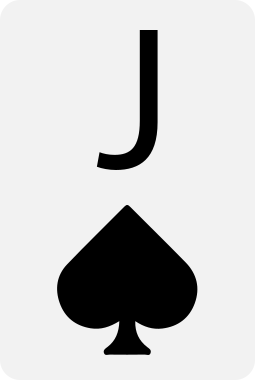
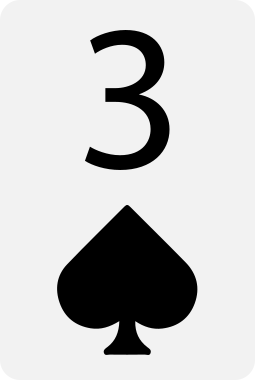
Jack-Three Suited is one of the weakest suited hands in Texas Hold’em that still carries a recognisable high card. The Jack provides a degree of top card credibility, but the three is about as disconnected from it as any kicker can be. With an eight-rank gap between the two hole cards, there is essentially no straight potential, and the hand’s entire case for being played rests on the flush draw and the occasional strong board interaction.
Compared to J6s, which is already a marginal hand, J3s gives up three full ranks of connectivity without gaining anything in return. The flush odds are virtually identical, the pair odds are similar, but the straight equity drops to near zero. This is a hand that experienced players understand as a pure flush-draw vehicle and not much else.
What These Odds Show for J3s
The draw odds table makes the hand’s profile clear. On the flop, 53.04% of runouts produce just a high card – no pair, no draw in most cases, just Jack-high. This mirrors J6s almost exactly on the pair equity side, which makes sense given that the rank gap does not affect how often either card pairs, only how often they combine for straights.
Pair equity settles at 43.54% by the river, two pair at 22.26%, and three of a kind at 4.37%. These numbers are in line with other suited jack-x hands and reflect the basic pair potential of holding a Jack and a small card.
The straight odds are where the eight-rank gap makes itself felt decisively. A straight arrives 0.00% of the time on the flop, just 0.74% by the turn, and 2.89% by the river. Compare this to J6s at 3.19% or Q9o at 5.71%, and the loss of connectivity is stark. The three and the Jack simply cannot combine with any realistic board texture to form a straight in the way that connected or near-connected hands can. The 2.89% river figure exists largely because of the vanishingly rare board configurations that happen to run through specific ranges, not because this is a hand with any meaningful straight draw potential in practice.
The flush odds are where J3s justifies its suited label, and they are identical to J6s to within a rounding margin: 0.84% on the flop, 2.93% by the turn, and 6.57% by the river. This is the hand’s primary and essentially only meaningful draw. When two cards of your suit land on the flop, J3s becomes a flush draw hand and nothing more. The draw is real, the equity is legitimate, but the hand is entirely one-dimensional in a way that even J6s is not.
The full house odds of 2.22% by the river and four of a kind at 0.13% are consistent with all other similar holdings and do not distinguish this hand in any meaningful way.
The overcard table is identical to J6s: 56.96% on the flop, 67.95% by the turn, and 76.31% by the river. In roughly three out of every four hands played to the river, at least one Ace, King, or Queen will be on the board. This means that even when you pair your Jack, you are frequently looking at a board where opponents with broadway holdings have a higher pair. And when you pair your three, you are almost certainly making the weakest pair possible in any given hand.
Hand Strength Summary
- Hand type: Weak suited hand with large card gap
- Relative strength: Bottom fifth of all starting hands
- Potential: Flush draws only; negligible straight equity; occasional disguised two pair
- Main vulnerability: Near-zero straight potential; three is an almost useless kicker; high overcard frequency; vulnerable to higher flushes
J3s is a hand that has exactly one thing going for it – the flush draw – and should be played only when that draw can be pursued cheaply and in position.
How Jack-Three Suited Wins
The ways J3s wins are narrow:
- Completing a flush, ideally against opponents holding top pair or an overpair who cannot fold
- Flopping top pair with the Jack on a board where overcards are absent and opponents hold weaker holdings
- Making two pair using both hole cards on a rare low board that pairs the three alongside the Jack
- Making a set with either card, which is well disguised but no more likely than with any other starting hand
- Winning uncontested pots through preflop steals from late position in the right game conditions
The two pair scenario involving the three deserves a note. A board of J♠ 3♦ 8♣ gives J3s top two pair, a hand that opponents holding top pair with a better kicker will frequently stack off against. This is probably the hand’s highest EV outcome after a flush completion – but it is rare enough that you cannot build a strategy around waiting for it.
Main Weaknesses
J3s has more weaknesses than strengths, and they are pronounced:
- The three contributes almost nothing. It cannot form straights with the Jack, it rarely makes top pair, and as a kicker it is beaten by essentially every other card in the deck
- Straight potential is effectively zero in practical terms
- The flush it makes is Jack-high, which loses to any opponent holding a queen, king, or ace of the same suit who also has a flush
- Overcards appear 76.31% of the time by the river, making top pair with the Jack unreliable
- The hand is entirely dependent on the flush draw, making it one-dimensional and therefore easier for experienced opponents to read correctly
Best and Worst Flop Textures
Strong flops
- Two cards of your suit, turning J3s into a flush draw with the right price to continue
- Jack-high dry boards where no Ace, King, or Queen is present and opponents are likely to hold weaker holdings
- Low boards pairing the three that also pair the Jack, creating unexpected two pair
- Boards that give both a flush draw and any semblance of pair equity simultaneously
Dangerous flops
- High card boards with Ace, King, or Queen present – which happens on more than half of all flops – where your Jack is no longer top pair
- Boards in a different suit where neither card connects and you are left with pure Jack-high
- Any board where you make just a pair of threes, which is almost never ahead of any opponent who continues betting
The honest assessment of most J3s flops is that they will not have helped you. The discipline to fold quickly on boards where the flush draw has not materialised is what separates players who lose slowly with this hand from those who lose quickly.
How It Plays by Position
- Early position: An unambiguous fold in all standard games. There is no case for opening J3s from early position.
- Middle position: Still a fold. The hand’s single draw type and high overcard vulnerability make it unprofitable against the ranges that call or reraise from middle position.
- Late position (cutoff/button): The only position where J3s has any argument for being played, and only in the right game conditions – passive blinds, reasonable steal equity, and a table dynamic where you can see flops without facing three-bets regularly.
- Blinds: Worth completing from the small blind in unraised multiway pots where you can see a flop for minimal additional investment. Not worth defending against a raise from either blind in most circumstances.
Even in late position, J3s is near the bottom of a viable opening range. Many players who include weak suited hands in their steal range draw the line somewhere around J5s or J4s, treating J3s as below the threshold.
Common Mistakes with Jack-Three Suited
- Playing it from any position other than late position or the small blind
- Continuing past the flop without a flush draw, since the straight potential and pair value are both too weak to justify it
- Overvaluing a pair of Jacks made with this hand – top pair with a three kicker is one of the weakest top pair combinations possible and can lose to any opponent holding a Jack with a higher kicker
- Chasing the flush draw without correct pot odds, particularly when the resulting flush could lose to a higher one
- Treating the suited tag as a reason to call raises rather than as a reason to see cheap flops in position
Comparison to Similar Hands
- Stronger than: J2s and the offsuit version J3o
- Weaker than: J4s, J5s, J6s, J7s, J8s, J9s, JTs, and any suited hand with a higher top card or better kicker
- Broadly similar to: Other weak suited hands with large gaps such as Q3s, K3s, or T3s
The comparison to J6s is instructive. J6s already sits at the weaker end of playable suited jack-x hands, but it retains 3.19% straight equity by the river and a slightly better connected feel. J3s gives up that straight equity entirely and gains nothing. The two hands have near-identical flush draw profiles, but J6s is the clearly superior hand for that reason alone. Against J4s and J5s the same logic applies with decreasing severity.
How Jack-Three Suited Performs in Multiway Pots
J3s has a complicated multiway relationship. The logic that applies to all weak flush draw hands applies here in amplified form:
- Multiway pots offer better implied odds when you complete the flush, since more players can pay you off
- However, more players in the same suit family means the Jack-high flush is more likely to lose to a higher flush
- Top pair with a three kicker becomes almost unplayable in multiway pots, where the range of hands that have you beaten is wide
- The absence of straight draw potential means you cannot benefit from the additional implied odds that come with combo draws in multiway situations
The best multiway scenario for J3s is a cheap limped pot in position where the flop delivers two cards of your suit, giving you a flush draw you can pursue with clearly defined pot odds. Outside of that specific situation, multiway pots with J3s are best avoided.
FAQ: Jack-Three Suited
Is J3s ever worth playing?
Only in late position in the right game conditions, and only as a speculative hand where you accept that you need a flush draw on the flop to continue. As a rule, it sits at or below the edge of what most players should include in a late position opening range.
Why is J3s weaker than J6s if they have the same flush odds?
The straight potential. J6s carries a 3.19% chance of making a straight by the river. J3s has just 2.89%, and much of that is theoretical rather than practical. In real board textures, J3s almost never has a straight draw worth pursuing, while J6s occasionally does.
Is a Jack-high flush strong enough to rely on?
It is a completed flush, which is a strong hand in absolute terms, but it is vulnerable to being beaten by any opponent holding a queen, king, or ace of the same suit with a flush of their own. In multiway pots this risk increases.
When should you fold J3s on the flop?
Any time the flop does not deliver a flush draw or an unexpectedly strong made hand such as two pair or a set. Jack-high on a dry board with no suited cards is not worth continuing with against any real resistance.
Related Hands