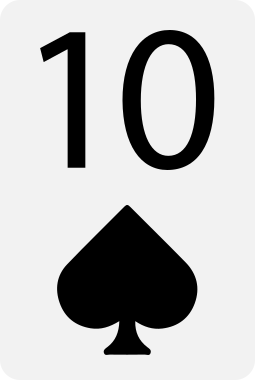
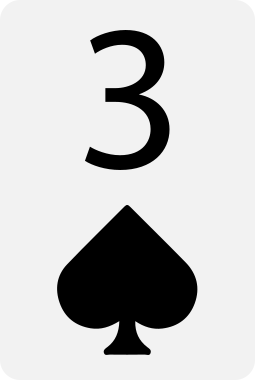
Ten Three Suited sits at the outer edge of the ten-high suited hand family, one step below Ten Four Suited and two steps below Ten Five Suited in terms of lower-card rank. Like its nearest neighbours in this group, it cannot make a straight using both hole cards – a ten and a three are seven ranks apart, well beyond the five-card span of any possible straight – and it shares the same flush equity and overcard exposure that define all ten-high suited hands.
What distinguishes Ten Three Suited from Ten Four and Ten Five Suited is subtle but measurable. The straight odds are slightly lower because the three contributes to fewer possible straights than the four does when the board provides the remaining cards. The three is also a marginally weaker card in every respect where card rank matters: as a kicker, as a made pair, and as a contributor to two-pair combinations. For a hand category where the differences between adjacent holdings are already small, Ten Three Suited represents the point at which those incremental losses begin to add up into a hand that is harder to justify even in the most favourable spots.
What These Odds Show for T3s
The high card rate on the flop is 53.04%, consistent with Ten Four and Ten Five Suited. There is no material difference at this level – a ten and a three miss the flop at almost the same rate as a ten and a four or a ten and a five.
The pair rate on the flop is identical at 40.41%. By the river it reaches 43.40%, fractionally higher than Ten Four Suited's 43.27%. This small upward movement in pair rate is counterbalanced by the lower quality of the pair when the three is the card that connects – three-high pair is the weakest possible made pair and rarely has any genuine showdown value.
Two pair by the river comes in at 22.26% and three of a kind at 4.37%, both consistent with the T4s and T5s figures. The hand's ability to make these hands is driven largely by the board rather than by any particular property of the hole cards themselves at this rank, which is why the figures remain stable across this group.
The straight odds show the clearest point of differentiation. There is a 0.00% chance of a straight on the flop, 0.84% by the turn, and 3.24% by the river. That river figure is lower than both Ten Four Suited and Ten Five Suited, which both reach 3.59%. The difference reflects the fact that a three can be part of three distinct straights – ace through five, two through six, and three through seven – compared to the four, which can appear in four different straights. Each step down in the lower card's rank reduces the number of possible single-card straight contributions, and that reduction shows up directly in the river figure.
The flush odds are 6.56% by the river, identical to Ten Four and Ten Five Suited. The flush draw does not care which non-ten card you hold – it is determined by suit alone, and since all three hands share the same suit structure, the flush equity is the same. The straight flush sits at 0.00% through the turn and 0.02% by the river, a figure representing the most remote of statistical footnotes rather than a genuine decision factor.
The overcard table shows 69.47% on the flop, 79.86% by the turn, and 86.87% by the river – identical to Ten Four and Ten Five Suited for the same reason as always. The ten is the top card, and overcard exposure is determined by the highest hole card, not the lower one. Roughly one flop in three will arrive with no card above a ten, giving the hand its occasional top-pair opportunity.
Hand Strength Summary
- Hand type: Weak suited large gapper
- Relative strength: Bottom tier of all starting hands; below Ten Four Suited on lower-card rank alone
- Best case: Flush in a multiway pot with appropriate implied odds
- Main vulnerability: No two-card straight equity, weakest possible low card for kicker or pair purposes, flush is the entirety of the drawing game plan
Ten Three Suited is a hand where the suited component is carrying the full weight of the hand's speculative value, and even that weight is the same as it is for every other suited hand – nine flush outs when the draw is live, no more and no less.
How Ten Three Suited Wins
Ten Three Suited wins by making a flush. That is the primary scenario, and in most well-played games it is the only scenario worth actively planning for. When three cards of the hand's suit arrive on the flop, the hand has a live draw to a ten-high flush – a made hand that beats all lower flushes and loses only to opponents holding a jack, queen, king, or ace of the same suit.
The secondary route is pairing the ten on a low board. When the flop comes with all cards below ten, which happens roughly 30% of the time based on the overcard odds, the hand has top pair in a deeply disguised configuration. Opponents have no way to put a three in your range, which means ten-pair hands played by Ten Three Suited have a deceptive quality that can extract value from players holding weaker made hands on low boards.
Beyond these two scenarios, the hand has very limited options. The three contributes almost nothing to board interaction in most runouts.
Main Weaknesses
The seven-rank gap is the largest possible for a ten-high suited hand before reaching ten-two, and it is reflected throughout the hand's profile. No board can produce a straight that uses both the ten and the three. The three is the weakest kicker available to a ten-high hand – ace through four all outrank it as a pairing card – and a pair of threes has almost no independent value.
The hand's equity is one-dimensional in a way that even Ten Four Suited slightly avoids. While the difference between a four and a three is small in absolute terms, the four can appear in one additional straight combination, and that marginal difference is enough to show up in the river straight odds. As hands become weaker, these small differences matter more because there is less overall equity to absorb them.
Playing this hand without a strong flush draw on the flop offers very little reason to continue in most pots. Unlike more connected hands where a partial draw or a weak pair can have combined equity worth calling with, Ten Three Suited rarely assembles enough pieces post-flop to justify persistence against meaningful pressure.
Best and Worst Flop Textures
Strong flops
- Three cards of your suit, giving an immediate flush draw
- All-low boards below the ten, giving top pair with a hidden three
- Boards pairing the ten with two cards of your suit, giving top pair and a backdoor flush draw with turn and river cards to work with
Dangerous flops
- Any high board where both cards have missed
- Boards of mid-range cards where flush draws are present for opponents but not for you
- Boards pairing the three with any opponent interest, making bottom pair on an overcard-heavy board an indefensible position
How It Plays by Position
- Early position: A fold. Ten Three Suited does not have the equity to play from early position in any standard game format.
- Middle position: A fold in most games. The hand is too weak structurally to open or call from middle position unless table conditions are unusually passive and multiway pots are reliably available for a small price.
- Late position: The only position where the hand has any real home. On the button in an unopened pot it can serve as a steal, and in multiway limped pots it can see a cheap flop with the flush draw as a plan.
- Blinds: Taking a free or cheap flop from the big blind is fine. Committing anything meaningful to defend against a raise is not recommended.
Common Mistakes
The most common mistake with Ten Three Suited is treating it as approximately equivalent to Ten Five or Ten Six Suited because it shares the ten. The lower card's rank has a meaningful impact on straight equity, kicker value, and two-pair potential, and the hand is genuinely weaker than its ten-high companions with more connected lower cards.
Chasing a flush draw in a heads-up pot without any additional equity is another frequent error. A flush draw alone completes roughly one in three times by the river, and if the pot does not offer sufficient implied odds to justify those odds, the hand is a losing proposition even when played on a live draw.
Over-continuing with a pair of threes is also an issue. Three-high pair on a board with a ten and two other overcards to the three is not a made hand worth protecting – it is simply the weakest possible pair on a dangerous board.
Comparison to Similar Hands
The broader pattern across Ten Five, Ten Four, and Ten Three Suited is one of incremental but consistent decline as the lower card moves further from the ten. The flush equity stays constant, the overcard exposure stays constant, and the straight equity shrinks with each step down.
How Ten Three Suited Performs in Multiway Pots
As with all suited hands in this category, multiway pots are the most favourable environment. Larger pots increase the return on a completed flush, and the deceptive nature of a ten-high flush made with a three in the hole is difficult for opponents to read. The more players in the pot, the more likely at least one of them has connected with something they are willing to bet on, and those players become the hand's implied-odds source when the flush arrives.
The limited straight equity is again the ceiling. Hands that can flop a straight draw alongside a flush draw, creating two-way equity with fifteen or more combined outs, have substantially higher multiway value than Ten Three Suited, which is always drawing to just nine flush outs when the draw is live.
FAQ: Ten Three Suited
How does Ten Three Suited compare to Ten Four Suited?
The draw odds are nearly identical across most categories, with the one measurable difference being straight odds – 3.24% by the river for T3s versus 3.59% for T4s. The three is also a weaker kicker and a weaker made pair. Both hands are weak overall; T4s has a marginal edge.
Is there any straight this hand can make using both cards?
No. A ten and a three are seven ranks apart, and no straight spans more than five consecutive ranks. Any straight made while holding T3s uses only one of the hole cards, with the board providing the other four required ranks.
Is the flush draw worth the same with a three as with a four or five?
Yes. Flush equity is determined purely by suit, and nine cards of your suit remain in the deck regardless of whether your non-ten card is a three, four, or five. The flush draw itself is identical; the difference lies only in what happens when the draw misses and the hand has to rely on its other properties.
At what point does a ten-high suited hand become worth playing regularly?
As the lower card moves closer to the ten and the gap narrows, straight equity increases and the hand becomes more genuinely playable. Hands like Ten Seven Suited and Ten Eight Suited have enough connectivity to function as real speculative holdings. Ten Three Suited is several steps removed from that threshold.
Related Hands