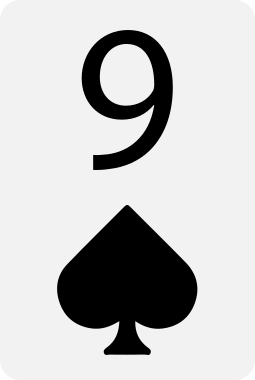
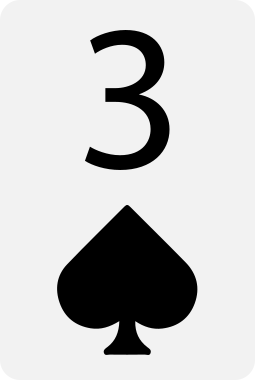
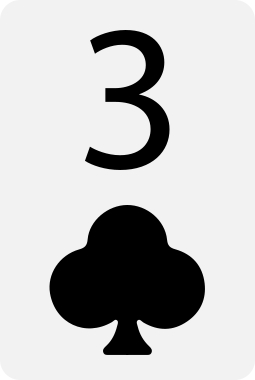
93s is one of the weakest suited hands in Texas Hold’em. The nine and three are six ranks apart, making any straight combination essentially impossible without the board delivering a very precise set of middle cards, and the three is among the lowest kickers you can hold alongside any high card. The suited nature provides the hand’s only meaningful value, and even that value is limited by the weak high card. In the vast majority of situations, 93s is a fold before the flop.
Where 94s at least has the marginal consolation of a four – a card that occasionally finds itself in low straight draws – the three in 93s is almost entirely dead weight beyond its flush contribution. The hand should only ever be considered in the most favourable circumstances: unraised pots, in position, with a cheap price to see a flop.
What These Odds Show for 93s
The draw odds for 93s are identical to those of 94s, which is instructive in itself. The difference between a three and a four as a kicker is so small that it produces no measurable change in the probability distributions across hand types. On the flop, 93s is still a high card 53.04% of the time – more than half of all flops produce nothing made. By the river that figure falls to 17.84%, but the hands being made in the meantime are rarely strong enough to win contested pots.
The pair rate of 40.41% on the flop suffers from the same problem as all weak suited hands: pairing either card gives you something, but rarely something good. A pair of threes is almost always bottom pair. A pair of nines is top pair on a low board but is under immediate pressure from any overcard on the turn or river, which the overcard table confirms will appear 93.27% of the time by the river.
The flush rate of 6.56% by the river is the hand’s ceiling for making a genuinely strong holding. That figure is the same across all unsuited gap combinations at this rank level, and it represents the only realistic route to winning a large pot. The straight rate of 3.19% by the river is theoretically present but practically irrelevant – the specific board cards required to complete a straight with a nine and a three are so demanding that it should never be a primary consideration when deciding whether to continue.
The overcard table is as stark as it gets. A 79.29% chance of an overcard on the flop means that in roughly four out of every five hands, the board immediately challenges whatever pair value you have. By the river, 93.27% of runouts will contain at least one card higher than your nine.
Hand Strength Summary
- Hand type: Speculative suited hand, lower tier
- Relative strength: One of the weakest playable suited holdings in the game
- Primary draw: Flush potential
- Secondary draw: Negligible – pair value is weak, straight potential is near zero
- Main vulnerability: Dominated by virtually every other hand, three kicker loses to any paired board, overcards appear on nearly 80% of flops
How 93s Wins
93s wins pots through a very narrow set of outcomes:
- Making a flush and beating a non-flush hand at showdown
- Flopping an unlikely two pair or trips combination on a very low board
- Winning uncontested through a steal or semi-bluff on a missed board
- Rivering two pair against an opponent who also missed
The hand has virtually no legitimate value as a made hand beyond the flush. Any pot won through pair value alone should be treated as a fortunate outcome rather than an expected result.
Main Weaknesses
- The three kicker is the defining weakness of 93s compared to other weak suited nines. Where 94s at least pairs the four to create a low but occasionally relevant pair, a pair of threes is almost always the worst possible pair on any board it appears on.
- The straight gap of six ranks is the widest a two-card combination can be while still technically permitting a straight, and the specific cards needed to bridge that gap make it an unreliable draw.
- Top pair with a nine is already a fragile holding. Top pair with a three is rarely relevant at all. In most multiway pots, both cards are effectively drawing dead for pair value as soon as any opponent holds a five or higher.
- The 93.27% overcard rate by the river means this hand almost never has an uncontested top pair by showdown.
Best and Worst Flop Textures
Strong flops
- Two or three cards of your suit, giving you a flush draw or made flush
- Extremely low boards such as 3♣ 3♦ 2♠ or 9♣ 3♦ 2♠, where you make a full house, trips, or two pair on a rare texture
- Any board that allows you to semi-bluff credibly with a flush draw in position
Dangerous flops
- Any board with two or more broadway cards, where both your nine and three are irrelevant
- Paired boards where you have no piece and cannot represent much
- Low boards where an opponent holding a better low pair has you outkicked
How It Plays by Position
- Early position: Always a fold. There is no scenario in a standard game where opening 93s from early position is correct.
- Middle position: A fold in all but the most unusual circumstances. The hand cannot justify the investment against the ranges that call from middle position.
- Late position: The only marginally viable spot, and only against weak or passive blinds. Even then, it requires careful judgement about whether a cheap flop is genuinely cheap.
- Big blind: The one position where 93s can see a flop without losing value. Completing or calling a very small raise in the big blind is the hand’s most natural home.
Common Mistakes with 93s
- Continuing past the flop without a flush draw or strong made hand. The hand’s equity collapses rapidly once you have identified that the flop has not connected. A high card on the flop with 93s is almost always a fold to any aggression.
- Treating the nine as a genuine high card. Against most opponents who have voluntarily entered a pot, a nine is a low card, not a high card. Betting for value with top pair nine on most boards is a mistake.
- Overestimating the straight potential. The nine-to-three gap does technically permit straights, but requiring three perfectly placed board cards makes it an unreliable draw that should not factor into calling decisions.
- Playing the hand out of position. The flush draw needs position to be profitable. Without it, you cannot control pot size when you miss and cannot extract value efficiently when you hit.
Comparison to Similar Hands
- 93s vs 93o: As with all weak suited hands, the offsuit version is entirely unplayable and should always be folded.
- 93s vs 94s: The four in 94s is marginally more useful than the three, offering slightly better two-pair combinations on low boards and a fractionally improved kicker in all-in scenarios. In practice the difference is small, but 94s is the stronger hand.
- 93s vs 83s: The nine gives 93s better high-card value than 83s, making it slightly more capable of winning pots through pair value on low boards, though both hands are weak.
- 93s vs 65s: The contrast is significant. 65s is a connected suited hand with genuine straight and flush potential, making it a much stronger speculative holding than 93s despite both being in the lower tiers of playable hands.
How 93s Performs in Multiway Pots
Like 94s, the best case for 93s in a multiway pot is a made flush with multiple opponents to pay it off. The flush draw’s implied value increases as more players enter, and a completed flush in a four or five-way pot can win a significant pot.
Everything else about 93s deteriorates in multiway pots. Pair value becomes worthless, semi-bluffs are less credible, and the frequency of someone holding a better hand increases with every additional player. Play 93s in multiway pots for the flush and nothing else, and release it cleanly when the flush draw does not materialise.
FAQ: 93s
Is 93s ever correct to play?
In very specific situations – unraised big blind, cheap button limp in a passive game – yes. As a general rule it is a fold, but the suited component gives it just enough to warrant seeing a cheap flop occasionally.
How does 93s differ from 94s in practice?
The practical difference is small. The three kicker is slightly worse than the four in two-pair and outkicker scenarios, but the draw odds are identical and neither hand belongs in a standard opening range.
What is the ideal scenario for 93s?
Flopping a flush draw in a multiway pot in position, then hitting the flush on the turn or river against opponents holding top pair or two pair who are unwilling to fold.
How often does 93s make a flush by the river?
6.56% of the time from the starting hand, the same rate as other weak suited combinations at this rank level.
Related Hands