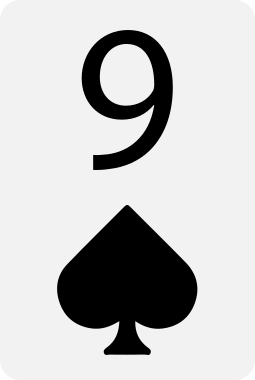
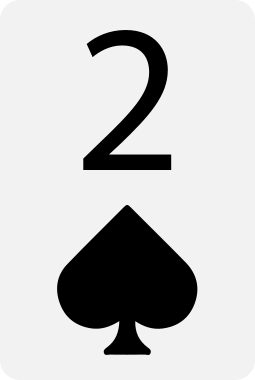
Nine Two Suited is a weak starting hand that sits in the category of holdings most experienced players fold without much deliberation. The nine provides a modest rank anchor and the suit adds genuine flush equity, but the two is one of the least useful secondary cards in the deck, creating a gap so wide that straight draws are nearly non-existent and pair strength is deeply unreliable. This is a hand defined more by its limitations than its possibilities.
What These Odds Show for 92s
The draw odds table for 92s follows the familiar pattern of weak unpaired hands. It misses entirely on the flop 53.04% of the time, pairs at 43.54% by the river, and reaches two pair in 22.26% of runouts. None of these numbers are unusual for the category, but the context around them matters considerably.
The most telling number in the straight column is the 0.00% on the flop. Unlike most suited hands, including the closely related 62s which at least has a route to the wheel straight on the right flop, 92s cannot complete a straight on the flop under any circumstances. The gap between nine and two is simply too wide. There is no combination of three community cards that bridges that distance into a made straight. By the turn that opens up slightly to 0.74%, and by the river it reaches 2.84%, but these are among the lowest straight rates of any suited hand and reflect a hand that has effectively abandoned one of the two primary equity paths available to suited connectors.
The flush column is where 92s earns what value it has. A 6.57% chance of completing a flush by the river, with 0.84% arriving already complete on the flop, is consistent with other suited hands and represents genuine equity. A flush draw on the right board gives this hand approximately 35% equity with two cards to come, which is the clearest reason a player might ever see a flop with it.
The overcard table is substantially more forgiving than the 62s equivalent, which reached 99.60% by the river. For 92s, the river overcard probability is 93.27%, and on the flop it sits at 79.29%. That still means roughly four in five flops will contain a card higher than the nine, but it does acknowledge that a nine-high board is at least a realistic possibility. When it occurs, top pair with a two kicker is a difficult hand to play with confidence, but it is at least top pair, which 62s can almost never claim.
Hand Strength Summary
- Hand type: Weak suited two-gapper with a disconnected low card
- Relative strength: Bottom tier, marginally above 72s and the very lowest suited hands
- Dominates: Almost nothing preflop
- Main vulnerability: Dominated by virtually the entire hand range, no straight draw potential on the flop, kicker problems when pairing the nine
92s has one genuine weapon – the flush draw – and one modest advantage over the very worst hands in the deck, the occasional nine-high board. Everything else about the hand points toward folding.
How 92s Wins
The flush is the clearest and most reliable route to winning with 92s. Arriving at a flush from a holding that opponents will never put you on is one of the more effective ways to extract unexpected value, particularly from players who have built a hand on a different part of the board and cannot release it when the third suit card arrives. A nine-high flush is not the nut flush, but against opponents without a higher flush card it is a winning hand.
Two pair provides the other meaningful path, particularly on boards that contain both a nine and a two. This is an infrequent but disguised outcome. An opponent holding top pair or an overpair has no reason to fear a two on the board until the pot is already inflated.
In steal situations, 92s can win without showdown in late position against passive opponents who fold to flop continuation bets. The suited nature adds a layer of credibility to semi-bluff lines that the offsuit version entirely lacks.
Main Weaknesses
The gap between nine and two is the defining structural problem of this hand. Unlike 65s or 54s, where the connected ranks open multiple straight draw possibilities, or even 62s, which can access the wheel straight, 92s has no practical path to a straight on the flop and only narrow possibilities by the river. At 2.84%, the straight rate is lower than almost any other suited hand outside of the ace-x suited category where straights are similarly constrained.
When the nine pairs, the two kicker is almost always a liability. Against any opponent holding a nine with a better secondary card – which is the majority of hands that voluntarily enter pots – top pair two kicker is a dominated holding. The familiar kicker problem that affects all weak ace-x hands applies here too, just one rank lower.
The flush, while the hand’s best asset, is not the nut flush. Any opponent holding a higher card in the same suit has a better flush, and the nine does not block many of those combinations. Getting into a large pot with a nine-high flush requires reading the board and opponent range carefully.
Best and Worst Flop Textures
Strong flops
- Two cards of your suit, providing a live flush draw with good implied odds
- Nine-low boards where the nine is genuinely top pair and no opponent is likely holding a better nine
- Boards containing a two alongside lower cards where two pair potential exists with some disguise
Dangerous flops
- High boards with no flush draw, which represent a large proportion of all possible flops
- Boards with a single suited card that invite further investment in a draw that completes less than a third of the time from the turn
- Any board where the hand has paired the two and faces aggression, as bottom pair with no draw is almost always behind
How It Plays by Position
The positional requirements for 92s are even stricter than for hands like J8o or A3o. The absence of any straight draw on the flop means the hand is entirely dependent on flush draws and pair strength, both of which need favourable board textures and cheap entry to be profitable.
- Late position: Can justify a steal raise or a loose limp on passive tables where flops are cheap and opponents fold to pressure on missed boards. The suited nature lends enough post-flop equity that on the right flop, continuation is reasonable.
- Early and middle position: A clear fold. From early or middle position the hand has no business entering raised pots.
- Big blind: Even completing against a small single raise is marginal. The combination of weak rank and no straight potential makes this a borderline call at best, and the hand should be released quickly on any board without a flush draw or an immediate strong pair.
Common Mistakes with 92s
- Playing from out of position – without straight draw potential, 92s relies almost entirely on the flush draw to generate equity in contested pots, and flush draws are far more valuable in position where you can control the pace of betting
- Overvaluing the flush draw without considering whether it is the best flush – nine-high flushes lose to any opponent who holds a higher card in the suit, and on boards with significant pre-flop action that is a meaningful risk
- Treating top pair as a strong hand – top pair two kicker against a field of pre-flop callers should be played cautiously and released under serious pressure
Comparison to Similar Hands
The comparison to 93s is instructive. Adding just one rank to the secondary card opens a small number of additional straight combinations and improves the kicker situation modestly when pairing the nine. The comparison to 72s is also worth noting. Seven Two Offsuit is historically cited as the worst starting hand in poker, and 92s is meaningfully better solely because of the suit. That is damning with faint praise, but it accurately reflects where this hand sits.
Among suited hands, the jump from 92s to 95s or 96s is significant. Those hands retain the flush potential while adding genuine straight connectivity, producing a hand that can play profitably in far more situations.
How 92s Performs in Multiway Pots
In multiway pots, 92s faces the same dynamic as other weak suited hands. The flush draw gains implied odds because more players means more chances to extract value when it completes, but the pair strength becomes even more marginal in a field of multiple callers.
The two kicker becomes a significant problem in multiway pots specifically. In a three or four-way pot, the probability that at least one opponent holds a nine with a better kicker, or has connected with the board in a way that dominates bottom or middle pair, is substantially higher. The hand should be played with minimal investment in multiway pots unless the flush draw is live and the pot odds are compelling.
Multiway pots do provide one upside for this hand’s disguised equity. A flush or a nine-two two pair in a contested multiway pot can extract large amounts from opponents who have built their ranges on different parts of the board and cannot find a fold.
FAQ: Nine Two Suited
Why does 92s have a 0.00% straight rate on the flop?
Because the gap between nine and two is too large for any three-card combination to bridge into a complete straight. A straight requires five consecutive ranks, and there are not three cards between two and nine that connect them. The two would need a three, four, five, and six on the board, and the nine would need five through eight. Neither scenario can complete on the flop alone.
Is 92s better than 72 offsuit?
Yes, meaningfully so. The suit adds flush draw equity that transforms the hand’s potential in the right spots. Seven Two Offsuit is often cited as the worst hand in poker for good reason, and 92s sits considerably above it.
When should you ever play 92s?
In late position with no action ahead, or completing from the big blind at a very favourable price. The hand needs a cheap flop and should be abandoned quickly on any board that does not offer a flush draw or an immediate strong pair.
What makes 92s different from 62s?
The nine gives a slightly higher rank ceiling and reduces the overcard probability from 99.60% by the river to 93.27%. The trade-off is that 62s at least has access to the wheel straight using the two, which 92s cannot use in the same way given the large gap to the nine.
Related Hands