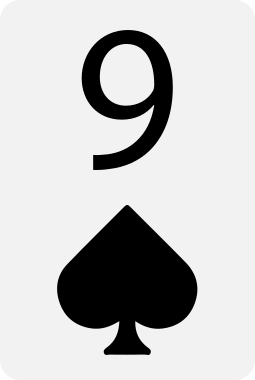
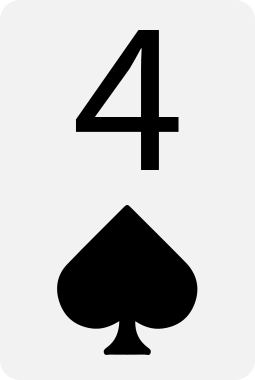
94s is a speculative starting hand that sits firmly in the lower tier of playable holdings in Texas Hold’em. The nine and four share no meaningful connectivity – they are five ranks apart, too wide a gap to form a straight without catching three very specific middle cards – and the suited nature is the only real asset the hand brings to the table. In most situations, 94s is not a hand you play for raw high-card strength or pair value. When it is played, it is played for its flush potential and nothing else.
The hand has no place in an opening range from early or middle position and is generally considered a fold even from late position at tighter tables. In loose passive games, on the button, or in the big blind facing no raise, it can occasionally be worth seeing a flop cheaply. The key word is cheaply. Any significant investment preflop with 94s is difficult to justify.
What These Odds Show for 94s
The draw odds table makes the hand’s limitations immediately visible. On the flop, 94s still has a high card more than half the time, at 53.04%. That figure alone signals how often this hand arrives at the flop with nothing made and no strong draw to fall back on. By the river, high card drops to 17.84%, which reflects the board pairing or improving the hand over time, but those improvements are rarely the kind that win at showdown.
The pair rate on the flop is 40.41%, which looks reasonable until you consider that pairing a nine or a four is often going to be bottom pair or a weak middle pair on most boards, vulnerable to overcards and outright behind most opponents who have entered the pot. The two pair rate climbs to 22.26% by the river, but getting to the river as a speculative hand is expensive unless the flop cooperates immediately.
The flush draw is where the hand has genuine equity. The flush rate reaches 6.56% by the river, and combined with the straight flush probability, the suited component provides a meaningful percentage of this hand’s total winning potential. That 6.56% is not an impressive number in isolation, but it represents the hand’s primary path to winning a large pot. When you flop a flush draw – which happens roughly once in every nine to ten times you see a flop with a suited hand – you pick up enough equity to continue, particularly in position.
The overcard table is stark. There is a 79.29% chance of an overcard appearing on the flop, rising to 93.27% by the river. With only a nine as the highest card, the board will almost always contain at least one card that beats your top pair. This is not a hand that can comfortably bet for value on most boards.
Hand Strength Summary
- Hand type: Speculative suited hand
- Relative strength: Lower tier starting hand, outside most standard opening ranges
- Primary draw: Flush potential
- Secondary draw: Pair with weak showdown value
- Main vulnerability: Dominated by nearly every other hand, frequently outkicked, overcards appear on 79% of flops
How 94s Wins
When 94s does win a hand, it is almost always through one of the following routes:
- Making a flush and winning at showdown against a non-flush hand
- Flopping two pair or trips on an unlikely board
- Taking down an uncontested pot through a well-timed bluff or semi-bluff
- Rivering a pair or two pair against a missed draw
The hand rarely wins through sheer pair value. If you find yourself calling streets with only a pair of nines or a pair of fours, you are almost certainly behind against any opponent who has played back at you.
Main Weaknesses
- The gap between the nine and the four eliminates most straight possibilities. Unlike hands such as 97s or 86s, where a straight is a realistic draw, 94s cannot realistically target a straight without the board running out almost perfectly.
- Top pair on a nine-high board puts you against a field of overcards. Even when you hit, you are playing a weak top pair that cannot withstand much aggression.
- The hand is dominated by any suited hand with a nine alongside a better kicker, and outkicked badly on most paired boards. A nine with a poor kicker is one of the classic traps in Texas Hold’em – it looks like a made hand but loses quietly to anyone holding a better nine.
- The overcard problem is severe. By the river there is a 93.27% chance the board contains a card higher than your nine, which means opponents with any piece of the board are frequently ahead.
Best and Worst Flop Textures
Strong flops
- Monotone flops in your suit, giving you a made flush immediately
- Flops containing two cards of your suit, putting you on a flush draw with outs
- Low boards such as 4♣ 4♦ 2♠ or 9♣ 4♦ 2♠, where you make trips or two pair on an unlikely texture
Dangerous flops
- Any high board with broadway cards, where your nine is now bottom of the deck in terms of high-card value
- Paired boards where you have no piece, and any continuation needs to be a pure bluff
- Boards that give you one pair but feature multiple straight and flush draw possibilities for opponents, making it dangerous to build a pot
How It Plays by Position
- Early position: A clear fold in virtually all circumstances. The hand cannot withstand the ranges that open from early positions, and you have no positional advantage to help compensate.
- Middle position: Still a fold at all but the loosest tables. The implied odds do not justify entering from here.
- Late position: The only position where 94s becomes a marginal consideration. On the button against weak opposition, or completing from the small blind, the hand can occasionally be worth a cheap look.
- Big blind: The most natural spot to see a flop with 94s. If the pot is unraised or the raise is very small, the price of calling is low enough to justify chasing the flush draw.
Position matters enormously with hands like this. Out of position, even when you do hit your flush, it is difficult to extract value and easy to get outplayed. In position, you have control over the pot size and can more easily fold when the board misses you.
Common Mistakes with 94s
- Overvaluing a pair. Hitting a pair of nines on a king-high board and continuing aggressively is a common way to lose money. The pair is vulnerable and rarely the best hand against an opponent who has played back at you.
- Calling raises from out of position. The flush draw is valuable, but it needs the right environment to be profitable. Calling a raise out of position with a weak suited hand leaks chips over time.
- Slow playing a flush. When you do make the flush, particularly in a multiway pot, slow playing creates risk. An opponent on the board can make a full house, and you want to charge draws to continue.
- Bluffing too frequently on missed draws. The hand misses the flop entirely more than half the time. Firing multiple barrels as a bluff on a hand with no real equity is expensive and rarely the right play unless you have a specific read.
Comparison to Similar Hands
- 94s vs 94o: The suited version is the only viable form of this hand. The offsuit version has no redeeming features and should always be folded.
- 94s vs 95s: Even the addition of one rank in the kicker position meaningfully improves the hand. 95s retains the flush draw but adds slightly better two-pair combinations and a few more backdoor straight possibilities.
- 94s vs 84s: The nine gives 94s marginally better high-card value, but 84s is similarly weak. Neither hand belongs in a standard opening range.
- 94s vs 65s: This comparison illustrates the problem with 94s clearly. 65s has a connected structure that gives it genuine straight potential alongside its flush draw, making it a far more versatile speculative hand.
How 94s Performs in Multiway Pots
Paradoxically, 94s can be slightly more comfortable in multiway pots than heads-up, for one reason: the flush draw increases in implied value when more players are in the pot. If you make a flush in a four-way pot, there are more chips to win. The flip side is that your pair outs become nearly worthless in multiway scenarios, since someone is very likely to hold an overcard or better combination.
In multiway pots, the strategy simplifies considerably. Play the hand purely for the flush draw. If you miss the flush draw entirely, release the hand at the first sign of aggression.
FAQ: 94s
Is 94s ever a profitable hand?
Over large samples, 94s played incorrectly is a losing hand. In the right spot – cheap flop, in position, with flush draw potential – it can show a profit, but those spots are narrow.
Should you ever raise with 94s?
Only as an occasional steal attempt from the button or cutoff in late position against weak blinds, where the hand is functioning as a bluff rather than a value hand.
What is the best possible outcome with 94s?
Flopping a flush or a flush draw in a multiway pot with implied odds to continue, then hitting the flush on the turn or river and getting paid by a hand holding top pair or an inferior flush.
How often does 94s make a flush by the river?
Approximately 6.56% of the time from the starting hand, without any additional community card information factored in.
Related Hands