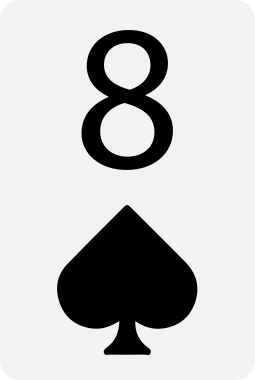
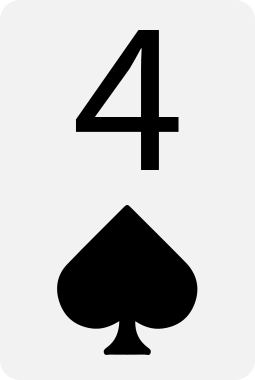
Eight Four Suited is a weak speculative hand sitting in the lower tier of suited holdings in Texas Hold'em. It combines a three-rank gap with low card values, leaving it without the high-card strength to compete on raw power or the tight connectivity to function as a reliable drawing hand. Where hands like Eight Six Suited or Eight Seven Suited can build genuine straight equity across a wide range of board textures, Eight Four Suited is too gapped to access most of those combinations and too low-ranked to fall back on showdown value when draws miss.
That said, it sits in an interesting middle ground between the near-zero straight potential of a hand like Ten Five Suited and the narrow but real straight draws available to something like Five Two Suited. It has a modest range of straights it can make, a live flush draw, and enough deceptive potential on the right board to occasionally produce a result that a stronger starting hand could not replicate.
What These Odds Show for 84s
The headline figure from the draw odds table is one that will be familiar to anyone who has reviewed weak suited hands: 52.71% of flops produce a high card result. In more than half of all runouts, Eight Four Suited arrives at the flop with nothing made and no obvious direction. By the river, 17.40% of hands still finish as high card, which represents the proportion of runouts where the hand simply never found any traction across all five community cards.
Pairing one of the two hole cards on the flop happens 40.41% of the time, consistent with most unsuited non-pair hands. As with all weak suited gappers, what matters here is which card pairs. Pairing the eight gives a mid-range made hand with some ability to withstand pressure on the right board. Pairing the four produces a very weak holding that requires significant improvement to be worth continuing with. By the river the pair rate rises to 42.73%, and with two pair coming in at 22.14%, the combined probability of holding at least a pair at showdown covers most realistic post-flop outcomes for this hand.
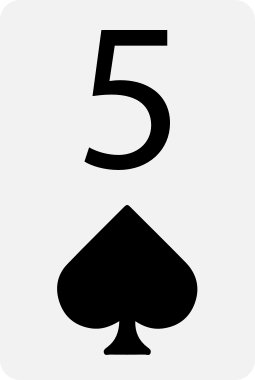
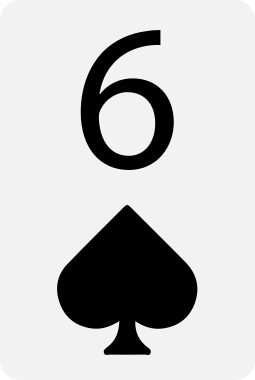
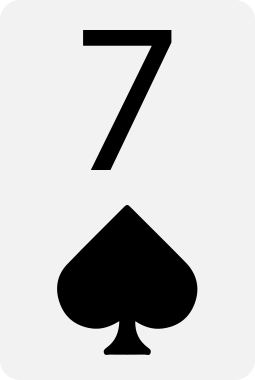
The straight odds tell a more interesting story than Ten Five Suited but a more limited one than the best suited gappers. There is a 0.32% chance of flopping a straight outright, rising to 1.66% by the turn and 4.45% by the river. These numbers reflect a hand that has some straight-making ability but cannot do it consistently or across a wide variety of board textures. The straight combinations available to Eight Four Suited are limited to boards that connect through the five, six, and seven, and that range of possibilities is narrow enough that straight equity should never be the primary reason to continue in a hand.
The flush remains the most consistent premium draw available. At 6.52% by the river it is broadly in line with other suited hands at this rank, and unlike the straight, the flush draw is one-dimensional in a reliable way – either the board brings three of your suit or it does not, and when it does, the path forward is clear. The straight flush probability comes in at 0.01% on the flop and 0.06% by the river, which is a real number but one that should never influence decisions.
The overcard table is significant. There is an 86.73% chance of an overcard appearing on the flop, rising to 96.90% by the river. This is considerably higher than Ten Five Suited's 69.47% flop figure and reflects the reality that an eight is not a high card – it sits near the middle of the deck and will frequently be outranked by what lands on the board. Top pair with an eight requires a very specific low board to be meaningful, and those boards are the minority of flops.
Hand Strength Summary
- Hand type: Weak suited gapper
- Relative strength: Lower tier of all starting hands, below mid-suited gappers
- Best case: Flush in a multiway pot, or a straight on a well-connected low board
- Main vulnerability: Low straight equity, weak high-card ceiling, poor kicker when paired
Eight Four Suited is a hand that needs conditions to align before it becomes playable post-flop. It is not strong enough to play for its own sake and not connected enough to reliably draw to a premium hand.
How Eight Four Suited Wins
Eight Four Suited wins most often by completing a flush draw and showing down a made flush in a pot large enough to justify the preflop investment. The suited component is the single most reliable path to a meaningful result, and on boards where the flush arrives, the disguise is strong because opponents rarely put a four in your hand alongside the eight.
The second winning path is a straight on a low, connected board where the five, six, and seven are available in the right combination. These boards also tend to be ones where opponents holding high cards have missed, creating fold equity on top of the made hand value.
Less commonly, it wins by pairing the eight on a board with smaller cards, giving top pair in a situation where opponents have also missed or hold only draws.
Main Weaknesses
The three-rank gap is the primary structural problem. It limits the hand to a small subset of possible straights and means that most connected-looking boards still fail to give Eight Four Suited any real draw equity. A hand like Eight Six Suited can use a board of five, seven, nine in a variety of ways. Eight Four Suited cannot make use of most of the boards that suit connected holdings.
The four is also a liability. As a kicker it is among the weakest available, and as a made pair it holds almost no showdown value against a field that has seen any action. The eight-four combination lacks the kind of synergy where both cards contribute meaningfully to the hand's potential in most spots.
The overcard frequency of nearly 87% on the flop is a consistent reminder that this hand will rarely be ahead unimproved, and the few spots where it is are on boards so low that opponents are likely to have missed entirely.
Best and Worst Flop Textures
Strong flops
- Three low cards of your suit, giving a flush draw immediately
- Boards pairing the eight with two cards below four, giving top pair in a heavily disguised way
- Low connected boards that include a five and a six or a five and a seven, giving an open-ended or gut-shot straight draw alongside potential pair outs
Dangerous flops
- High boards where both cards have missed and no draw is present
- Boards pairing the four against any level of opponent interest
- Boards with two or three cards above eight where the flush draw would produce a low flush that itself could be beaten
How It Plays by Position
- Early position: A fold in almost all circumstances. Eight Four Suited does not have the raw strength or the drawing potential to justify voluntarily putting money in from out of position against an unknown range.
- Middle position: Still not a hand to open or call raises with in most games. In very loose passive games with a high likelihood of a multiway limped pot, there is an argument for seeing a cheap flop, but these spots are uncommon at competent tables.
- Late position: The most viable position for this hand. As an unopened pot steal from the cutoff or button it has some playability, and in multiway limped pots it can see a flop cheaply with implied odds that justify the speculative investment.
- Blinds: A free look from the big blind is worth taking. Defending against raises with Eight Four Suited is generally not correct outside of very specific exploitative scenarios.
Common Mistakes
The most common mistake is continuing past the flop with only bottom pair or a gutshot draw without clear pot odds. Eight Four Suited has enough moving parts that players sometimes convince themselves they have more equity than they do. A pair of fours with an inside straight draw to a non-nut straight on a board with overcards is not a situation that justifies continued investment.
Another error is overvaluing the suited element on boards where a low flush would not be the best possible flush. Chasing a four-high or five-high flush in a multiway pot risks completing a hand that still loses to a higher flush, spending multiple streets of calls to arrive in a second-best position.
Playing the hand out of position for significant money is also a mistake. Eight Four Suited genuinely needs position to realise its potential, and even then the potential is limited.
Comparison to Similar Hands
How Eight Four Suited Performs in Multiway Pots
Eight Four Suited is better in multiway pots than in heads-up situations, though this is true of almost all speculative hands and should not be interpreted as the hand being strong in either context. The flush draw pays more in a larger pot, and the rare straights that do arrive tend to be well-disguised on boards where multiple opponents may have connected with something that is still worse.
The key consideration in multiway pots is implied odds. Because Eight Four Suited needs to improve significantly to win, and because improvement is not guaranteed even across all five streets, the preflop price needs to be small relative to the potential payoff when the hand connects.
FAQ: Eight Four Suited
Is Eight Four Suited ever worth playing voluntarily?
Only in late position in a multiway pot or as a positional steal in the right circumstances. It is not a hand to build a habit around.
How much does the suited component help this hand?
It adds the flush draw and the small straight flush possibility, which together give the hand occasional premium outcomes it would otherwise never reach. The offsuit version of this hand has almost no redeeming qualities; the suited version at least has a plan when it flops three to a flush.
What is the realistic best outcome with Eight Four Suited?
Flopping a flush draw with a pair or a straight draw alongside it, and completing the flush by the river in a pot where opponents have committed chips with hands they believe are good. That combination of equity and deception is where the hand delivers its best results.
How does Eight Four Suited compare to Eight Four Offsuit?
The suited version is strictly better due to flush equity and the small improvement in straight flush odds. In practice, both versions of this hand are losing propositions in most situations, but 84s at least has a meaningful draw to work with when it flops well.
Related Hands