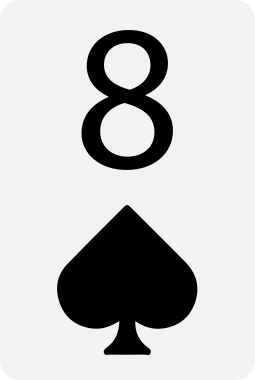
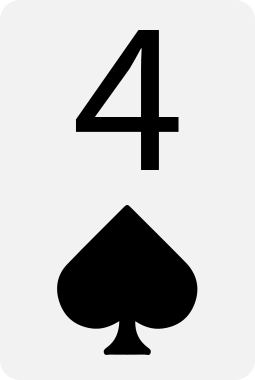
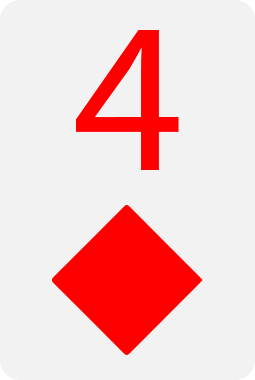
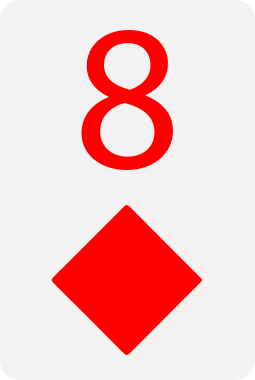
Eight Four Offsuit is a weak starting hand sitting in the lower middle of the deck with no high card strength, no flush draw potential, and only partial connectivity between its two components. The eight offers modest pair value on low boards, but the four is too far removed to generate reliable straight draws using both cards together, and without any suited bonus there is no secondary equity path when the board fails to connect with either hole card meaningfully.
84o occupies familiar territory among weak offsuit hands in this rank range – stronger than the lowest possible holdings due to some straight draw potential and a slightly more useful high card than a five or six, but not meaningfully playable in most standard situations. Its profile is closest to 95o, sharing the same general structure of a mid-low card paired with a low card across a three-rank gap, though the eight provides marginally more pair value in specific board contexts.
What These Odds Show for 84o
The high card outcome on the flop is 53.55%, consistent with other hands of similar connectivity such as 95o and 63o. More than half of all flops leave 84o completely unimproved, and by the river that figure falls to 18.83% – sitting between 95o’s 18.60% and 63o’s 18.60%, reflecting the near-identical drawing profiles shared across this tier of weak offsuit connectors.
The pair probability on the flop is 40.41%, the standard figure for all non-paired starting hands. Pairing the eight gives middle pair on many boards, which carries slightly more playability than pairing a two, three, or four, but remains a vulnerable holding in any contested pot. Pairing the four produces a very low pair that is difficult to defend on almost any board texture. As with every hand in this category, the quality of a paired outcome depends entirely on which hole card connects and what the rest of the board looks like.
The straight odds by the river are 4.76%, lower than 95o’s 5.13% but higher than hands with larger gaps between their components such as J4o (3.47%) or J5o (3.85%). On the flop there is already a 0.33% chance of having completed a straight, and by the turn that rises to 1.72%. The eight and four, separated by three ranks, can both contribute to straights involving fives, sixes, and sevens, making this a hand where straight draw potential is a genuine rather than purely theoretical consideration. The five, six, and seven form a connecting bridge between the two hole cards, and when the board delivers two of those three cards, 84o picks up an open-ended straight draw that represents its most credible path to a strong made hand.
The overcard odds define the hand’s limitations clearly. There is an 86.73% chance of an overcard appearing on the flop, climbing to 96.90% by the river. With no card above an eight, the hand faces overcards on the board in virtually every hand played to completion. Any pair of eights or fours is middle or low pair in the vast majority of situations, and the eight cannot function as a reliable top pair card against most opponent ranges. This overcard exposure is more severe than 95o’s 93.27% by the river, reflecting the eight’s lower rank compared to the nine, but less extreme than the near-total figures seen with hands like 42o or 52o.
Hand Strength Summary
- Hand type: Weak offsuit low connector
- Relative strength: Bottom third of all starting hands
- Best feature: Genuine straight draw potential when the board delivers fives, sixes, and sevens in combination
- Main vulnerability: No high card above an eight, no flush draw, severe overcard exposure, weak pair value in most board contexts
84o does not win through conventional hand strength. On the occasions it does win at showdown, straight completions and two pair on very low boards are the most likely explanations.
How 84o Wins
84o has a limited but identifiable set of winning paths:
- Completing a straight on boards rich in fives, sixes, and sevens
- Picking up open-ended straight draws on the flop and realising that equity on later streets
- Flopping two pair on very low boards where both the eight and four connect simultaneously
- Winning uncontested pots through late position aggression before showdown on boards that miss everyone
- Opponents with weak holdings folding to pressure on dry low boards where the eight represents some credible strength
The hand rarely wins at showdown through pair strength alone, and without flush draw potential it has no semi-bluff mechanism on draw-heavy boards.
Main Weaknesses
84o is held back by a combination of structural problems common to this tier of starting hand:
- No high card above an eight means it is outranked at pair strength by the majority of starting hands
- No suited component removes flush draw equity entirely
- Overcard exposure of 96.90% by the river makes top pair an extremely unlikely outcome – virtually every board will feature at least one card higher than the eight
- The three-rank gap between eight and four means straight draws require specific board textures to connect both cards, reducing the reliability of that equity compared to tighter connectors
- Pairing the four produces a very weak made hand that struggles to withstand pressure from opponents with any board presence
- The eight kicker, while better than a two or three, still loses to any opponent holding a nine or better when both players pair the top card on the board
Best and Worst Flop Textures
Strong flops for 84o:
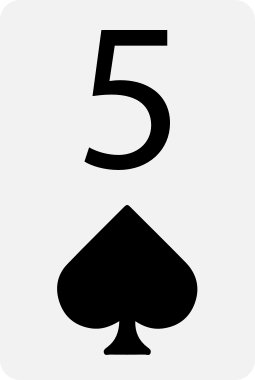
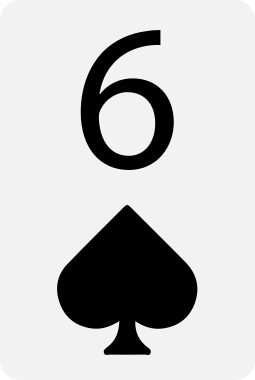
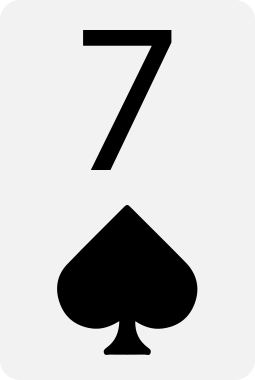
- Boards containing two cards between the eight and four, such as 5♠ 6♦ 7♣, delivering either a completed straight or an open-ended straight draw depending on exact combinations
- Very low boards where the eight is close to the top card and two pair possibilities exist with the four
- Dry, low boards where positional aggression can take down uncontested pots before showdown
Dangerous flops for 84o:
- High card boards featuring nines, tens, jacks, queens, kings, or aces, which the overcard odds confirm will occur on the overwhelming majority of flops
- Flush draw boards where opponents can apply pressure and 84o has no equivalent semi-bluff mechanism
- Any flop that generates meaningful action from opponents, since 84o rarely holds enough hand strength to call bets without a strong draw already in place
How It Plays by Position
- Early position: A fold in all standard situations. 84o does not have the high card strength or draw equity to justify entering pots against players yet to act.
- Middle position: Still a fold in virtually all games. The hand benefits from position but not enough to compensate for its structural weaknesses in contested pots.
- Late position / button: The most viable spot, limited to steal attempts in unraised pots against passive blinds, or very cheap multiway limps where straight draw implied odds might justify the minimal investment required.
- Blinds: From the big blind it can see cheap flops in limped pots at no additional cost. The hand performs best here when the flop delivers open-ended straight draw texture, and should be abandoned quickly when it does not.
Position is the primary determinant of whether 84o belongs in a hand at all. Even in the best position it remains a speculative holding that requires specific board conditions to justify continuing past the flop.
Common Mistakes with 84o
- Continuing past the flop with a single pair of fours or eights in contested pots without accompanying straight draw equity
- Overestimating the straight draw potential – 4.76% by the river is real but requires specific board delivery and does not justify meaningful preflop or flop investments
- Entering pots from early or middle position on the basis that an eight is a reasonable card to hold
- Calling raises with 84o from any position, as the hand is a significant underdog to the vast majority of realistic raising ranges
- Playing the hand without a clear understanding of what the flop needs to look like for continuing to make any sense
Comparison to Similar Hands
- Stronger than: 83o, 82o, and other eight-x hands with weaker or more disconnected second cards, where connectivity decreases and kicker value falls further
- Weaker than: 85o, 86o, 87o, where connectivity improves and straight draw potential becomes more frequent and reliable
- Similar to: 95o and 74o, which share the same three-rank gap profile between their components and broadly comparable draw odds and overcard exposure figures
The suited version, Eight Four Suited, is a considerably more playable hand. The flush draw adds a second genuine equity path, transforms many marginal flops into semi-bluffing opportunities, and justifies playing in a broader range of positional spots. 84o offers none of that flexibility and should be treated as the speculative, position-dependent hand it is.
How 84o Performs in Multiway Pots
84o presents a familiar multiway picture for hands of this type. Its straight draw potential benefits modestly from being in larger pots, since more players increase the implied odds of getting paid off when a well-disguised low straight completes. However, the negatives are significant:
- More opponents increase the chance that someone holds a better eight or connects more strongly with the board
- Any pair of fours becomes essentially worthless in multiway pots where multiple players are likely to hold overcards to both hole cards
- Without flush equity, 84o cannot apply credible semi-bluff pressure on draw-heavy boards at any point in the hand
- The hand’s best multiway scenario – completing a straight against opponents who did not anticipate the low end of the board being in play – arrives at 4.76% by the river, which remains a relatively infrequent outcome
In cheap limped multiway pots, 84o can occasionally justify its presence on the strength of straight implied odds alone, particularly when position allows for a low-cost look at the flop. This remains a niche application rather than a general strategic approach.
FAQ: Eight Four Offsuit
Is 84o ever worth playing?
In very specific circumstances. The big blind facing a cheap limp and late position steal opportunities are the two most defensible spots. Against any raise or from any early position, it should be folded without deliberation.
How does 84o compare to 95o?
The two hands share a nearly identical structure – both feature a mid-low card and a low card separated by three ranks, both have genuine if limited straight draw potential, and both suffer from severe overcard exposure. 95o has a marginally better high card in the nine, slightly better straight odds at 5.13% versus 4.76%, and slightly lower overcard exposure at 93.27% versus 96.90% by the river. In practice the two hands occupy the same tier and should be approached the same way.
What is 84o’s best realistic outcome?
Picking up an open-ended straight draw on the flop cheaply from the big blind or button – specifically on a board delivering two of the five, six, or seven – then completing the straight against opponents who underestimated the hand’s drawing potential.
Why does 84o have better straight odds than J4o despite being a weaker hand overall?
Because straight potential is determined by proximity of the two hole cards in rank, not by how high they are. The eight and four are separated by three ranks, meaning boards containing fives, sixes, and sevens can connect both cards into straight combinations. The jack and four are separated by six ranks, making simultaneous straight contributions from both hole cards far less achievable. Overall hand strength and straight draw potential measure different things, and in this case the lower hand has a structural advantage in one specific category.
Related Hands