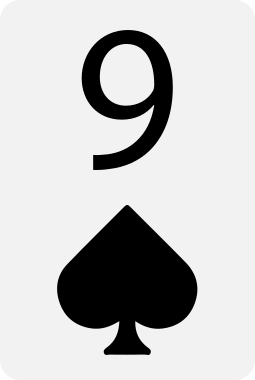
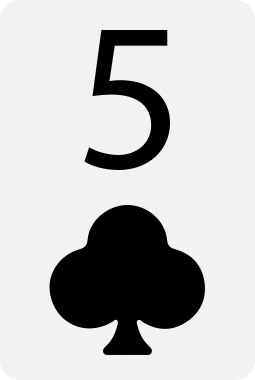
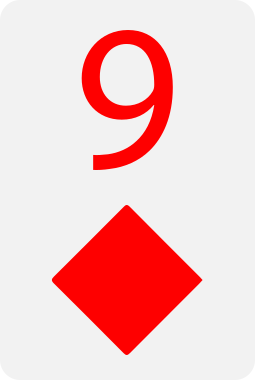
Nine Five Offsuit is a weak starting hand that sits in the lower middle of the deck with no high card strength, no suited bonus, and only partial connectivity between its two components. The nine offers modest top pair potential on low boards, but the five is too far removed to generate reliable straight draws using both cards together, and without flush draw equity there is no secondary path to winning when the board fails to connect.
95o occupies a similar tier to other weak offsuit hands in this rank range, marginally better than the weakest holdings due to some straight draw potential, but not meaningfully playable in most standard situations. Its profile rewards understanding rather than frequency of play.
What These Odds Show for 95o
The high card outcome on the flop is 53.55%, slightly lower than hands with a complete rank gap such as J5o or Q2o. That marginal improvement reflects the fact that the nine and five are close enough in rank that boards occasionally deliver straight draw texture around them. By the river, the high card figure drops to 18.60%, the same endpoint reached by 63o, suggesting that despite the difference in rank, both hands share a similar overall ability to connect with the board.
The pair probability on the flop is 40.41%, consistent with all non-paired starting hands. A paired nine gives middle pair on many boards, which has more playability than pairing a two or three but remains a vulnerable holding in contested pots. A paired five produces a low pair that is difficult to defend on almost any board texture. Neither outcome carries the kind of confidence that comes from holding a genuine high card.
The straight odds are the most meaningful positive differentiator for 95o. A straight by the river arrives 5.13% of the time, which is considerably higher than J5o (3.85%) or J6o (3.43%). Even on the flop there is a 0.33% chance of having already completed a straight, and by the turn that rises to 1.83%. The nine and five, separated by three ranks, can both contribute to straights involving sixes, sevens, and eights, making this a hand where straight draw potential is a genuine rather than theoretical consideration. It is still relatively infrequent, but it represents the hand’s most credible path to a strong made hand.
The overcard odds reframe the hand’s limitations clearly. There is a 79.29% chance of an overcard appearing on the flop, climbing to 93.27% by the river. With no card above a nine, the hand faces a near-constant stream of overcards on the board. Any pair of nines or fives is low to middle pair in the vast majority of situations, and the nine cannot function as a reliable top pair card against most opponent ranges. This is the defining constraint on 95o’s playability.
Hand Strength Summary
- Hand type: Weak offsuit low connector
- Relative strength: Bottom third of all starting hands
- Best feature: Genuine straight draw potential when the board delivers six, seven, and eight combinations
- Main vulnerability: No high card, no flush draw, severe overcard exposure, weak pair value in most situations
95o is not a hand that wins through conventional strength. On the occasions it does win at showdown, straight completions and two pair on low boards are the most likely explanations.
How 95o Wins
95o has a limited but identifiable set of winning paths:
- Completing a straight on boards rich in sixes, sevens, and eights
- Flopping two pair on very low boards where both the nine and five connect
- Winning uncontested pots through late position aggression before showdown
- Opponents with weak holdings folding to pressure on boards that miss them as badly as they miss 95o
- Picking up open-ended straight draws on the flop and realising that equity on later streets
The hand rarely wins at showdown through pair strength alone, and it has no flush draw to generate additional semi-bluff opportunities on draw-heavy boards.
Main Weaknesses
95o is limited by a combination of structural problems:
- No high card above a nine means it is outranked by the majority of starting hands in terms of pair value
- No suited component removes flush draw equity entirely
- Overcard exposure of 93.27% by the river makes it nearly impossible to hold a top pair – almost every board will feature at least one card higher than the nine
- The gap between nine and five means straight draws require the board to deliver very specific textures, reducing the reliability of that equity
- Pairing either card produces a vulnerable made hand that struggles to withstand pressure from opponents with any board presence
- The nine kicker, while better than a two or three, still loses to any opponent holding a better nine when both players pair the top card
Best and Worst Flop Textures
Strong flops for 95o:
- Boards containing two cards between the nine and five, such as 6♠ 7♦ 8♣, which deliver either a completed straight or an open-ended straight draw
- Very low boards where the nine is close to the top card and two pair possibilities exist
- Dry, low boards where position-based aggression can take down uncontested pots
Dangerous flops for 95o:
- High card boards featuring aces, kings, queens, or jacks, which the overcard odds confirm will occur on the vast majority of flops
- Boards that deliver straight draw texture for opponents with better connected holdings
- Any flop where opponents show genuine aggression, since 95o rarely has the hand strength to call meaningful bets without a strong draw
How It Plays by Position
Early position:
A fold in all standard situations. 95o does not have the high card strength or draw equity to justify entering pots against players yet to act.
Middle position:
Still a fold in virtually all games. The hand benefits from position but not enough to compensate for its structural weaknesses in contested pots.
Late position / button:
The most viable spot, limited to steal attempts in unraised pots against passive blinds, or very cheap multiway limps where straight draw implied odds might justify the minimal investment.
Blinds:
From the big blind it can see cheap flops in limped pots. The hand performs best here when the flop delivers straight draw texture, and should be abandoned quickly when it does not.
Position is the primary determinant of whether 95o belongs in a hand at all. Even in the best position it remains a speculative holding that requires specific board conditions to have any confidence continuing.
Common Mistakes with 95o
- Continuing past the flop with a single pair of fives or nines in contested pots without additional draw equity
- Overestimating straight draw potential – the 5.13% river figure is real but requires specific board conditions and does not justify large preflop or flop investments
- Entering pots from early or middle position on the basis that a nine is a reasonable card to hold
- Calling raises with 95o from any position, as the hand is a significant underdog to the overwhelming majority of realistic raising ranges
- Playing the hand without a clear plan for what the flop needs to deliver to justify continuing
Comparison to Similar Hands
- Stronger than: 94o, 93o, 92o, and other nine-x hands with weaker or more disconnected second cards
- Weaker than: 96o, 97o, 98o, where connectivity improves and straight draw potential becomes more reliable and frequent
- Similar to: 85o, 75o, and other weak offsuit hands in the mid-rank range where modest straight potential exists alongside poor pair strength and severe overcard exposure
The suited version, Nine Five Suited, is a considerably more playable hand. The flush draw equity adds a second genuine winning path, transforms marginal flops into semi-bluffing opportunities, and justifies playing in a broader range of positions and pot sizes. 95o offers none of that flexibility and should be treated as the speculative hand it is.
How 95o Performs in Multiway Pots
95o presents a mixed multiway picture. Its straight draw potential benefits from being in larger pots, since more players are likely to pay off a well-disguised straight. However, the negatives are significant:
- More opponents increase the chance that someone holds a better nine or connects more strongly with the board
- Any pair of fives or nines becomes increasingly dangerous as more players see the board
- Without flush equity, 95o cannot apply credible semi-bluff pressure on draw-heavy boards
- The hand’s best multiway scenario – completing a straight against opponents who did not see it coming – is relatively infrequent at 5.13% by the river
In cheap limped multiway pots, 95o can occasionally justify its presence on the strength of straight implied odds alone, particularly when position allows for a free or near-free look at the flop. This remains a niche application rather than a general strategy.
FAQ: Nine Five Offsuit
Is 95o ever worth playing?
In very specific circumstances. The big blind facing a cheap limp and late position steal opportunities are the two most defensible spots. In all other situations it should be folded, particularly against any raise.
Why does 95o have better straight odds than J5o despite the jack being a higher card?
Because straight potential depends on how close together the two hole cards are in rank, not how high they sit. The nine and five are separated by three ranks, meaning boards containing sixes, sevens, and eights can connect both cards into straight combinations. The jack and five are separated by five ranks, making joint straight contributions far less common.
What is 95o’s best realistic outcome?
Picking up an open-ended straight draw on the flop cheaply from the big blind or button, then completing it against opponents who underestimated the hand’s disguised potential.
How does 95o compare to Nine Five Suited?
Nine Five Suited is a substantially better hand. The flush draw adds a second genuine path to winning, supports semi-bluffing on many boards where 95o has no recourse, and justifies playing in a wider range of spots. The difference in playability between the suited and offsuit versions of this hand is more pronounced than for hands that already hold a strong high card.
Related Hands