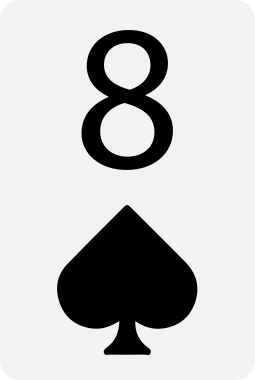
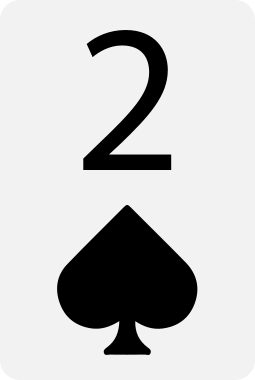
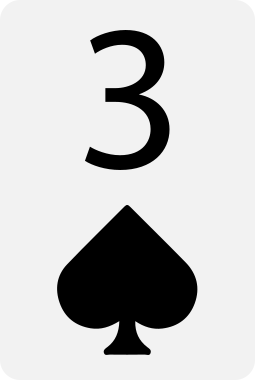
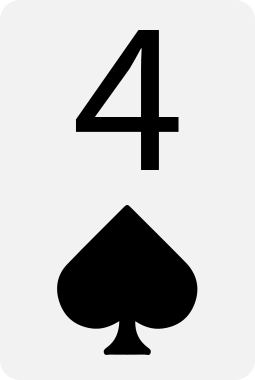
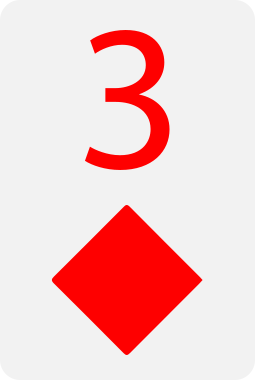
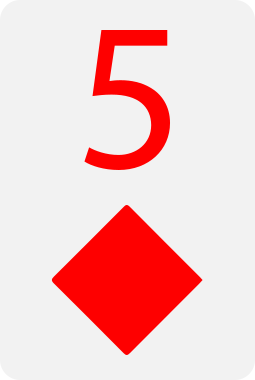
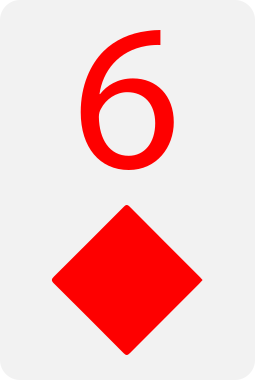
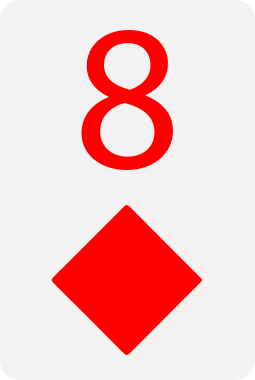
Eight Seven Offsuit is one of the more playable hands in the speculative connector category. The one-gap connectivity between the eight and seven gives the hand genuine straight potential that separates it meaningfully from the two-gap and disconnected hands lower in the range. It will not win by brute force and it requires favourable conditions to realise its equity, but in the right spot it can arrive at strong, disguised made hands that extract significant value from opponents who never saw them coming.
What These Odds Show for 87o
The straight column is where 87o immediately distinguishes itself from most of the hands covered so far. A 1.31% straight completion rate on the flop is not a large number in isolation, but it is among the highest of any offsuit non-paired hand outside of premium connectors, and it reflects genuine structural connectivity. By the turn that rises to 4.36%, and by the river the hand completes a straight 9.08% of the time. That is a meaningful equity path that hands like K8o, A6o, and J8o simply cannot match.
The straight draw picture is even more significant than the completion rate suggests. On many flops, 87o will have an open-ended straight draw rather than a made straight, meaning eight outs to complete on the next card. That draw equity – which does not show directly in the completion percentages – is what makes connected hands genuinely dangerous to play against. An opponent who knows you have an open-ended straight draw still faces roughly 32% equity against them with two cards to come, which changes the entire dynamic of the pot.
The pair rate of 42.73% by the river is consistent with comparable hands, but as with J8o, the pair strength of 87o is modest. Pairing the seven frequently produces bottom or second pair, while pairing the eight is marginally better but still vulnerable on most board textures.
The overcard table tells an honest story about the hand’s vulnerability. On the flop, 86.73% of boards contain at least one card higher than the eight. By the river that figure reaches 96.90%, meaning the hand will almost never have the highest card on the board. Top pair is a rare and fragile outcome with 87o, which reinforces why the straight is the primary winning mechanism.
Hand Strength Summary
- Hand type: Speculative one-gap offsuit connector
- Relative strength: Below average overall, above average within the speculative connector category
- Dominates: Little preflop, generates post-flop equity through straight draws
- Main vulnerability: High overcard exposure, weak pair strength, no flush draw
87o is a hand built entirely around post-flop potential. It enters pots to make straights and disguised two pair hands, not to win with high card or top pair.
How 87o Wins
The straight is the primary winning mechanism and the reason the hand is worth discussing at all. At 9.08% by the river, 87o reaches a straight more than twice as often as J8o and roughly three times as often as K8o or A6o. More importantly, it arrives at straight draws on many more flops than the completion rate suggests. On a board of six-nine-x or five-six-x or nine-ten-x, the hand has an open-ended or double-gutshot draw that provides significant continuing equity.
Straights made with 87o are also well disguised. An opponent who raised with ace-king and bet a nine-ten-six board has no particular reason to fear an eight-seven until the five or jack completes the straight and the money goes in.
Two pair is the secondary path, at 22.27% by the river. On eight-seven-x boards the hand makes immediate two pair, and on boards where both cards pair across the flop and turn the hand can arrive at a deceptively strong holding against opponents building on top pair.
In late position, 87o also functions as a semi-bluff vehicle on connected boards. A nine-ten flop with two players gives 87o eight outs to the best hand and credible fold equity when representing a made straight or strong pair.
Main Weaknesses
The overcard exposure is the defining constraint of the hand. With 96.90% of rivers containing at least one card higher than the eight, 87o almost never makes top pair and is regularly navigating boards where its pair holdings are second, third, or bottom pair. This forces the hand to rely on the straight draw, and when the straight does not materialise, the hand has very little left.
The offsuit nature removes the flush draw that makes suited connectors like 87s significantly stronger. A hand like 87s can have both straight draw and flush draw equity simultaneously on certain boards, creating combined drawing hands of eighteen or more outs. 87o has no such luxury, and on boards where the straight draw is weak or non-existent, it is left with vulnerable pair holdings and no backup plan.
The hand also requires more board cooperation than its suited counterpart. Without the flush draw, every flop that does not contain two consecutive or near-consecutive cards to the eight and seven is effectively a miss, and that represents the majority of all possible flops.
Best and Worst Flop Textures
Strong flops
- Six-nine-x or five-six-x boards that open an open-ended straight draw immediately
- Nine-ten-x boards where the hand has a double-gutshot to both the six and the jack
- Eight-seven-x boards where the hand makes top two pair with strong protection against draws
- Low connected boards in the five-through-ten range generally give the hand the most working room
Dangerous flops
- High unconnected boards such as ace-king-queen where the hand has neither pair nor draw
- Paired high boards where continuation bets signal strength the hand cannot compete with
- Boards with a single card in the five-through-ten range but two high disconnected cards that offer no straight path and no pair
How It Plays by Position
- Late position: Where 87o has genuine value. The straight potential justifies seeing a flop cheaply, and in position the hand can be navigated efficiently – continuing on connected boards and folding quickly on misses without significant investment.
- Early and middle position: A fold in most structured contexts. The hand needs cheap flops and an information advantage post-flop. Out of position, facing a bet on a missed board, the hand has almost nothing to work with and the straight draw can become an expensive chase.
- Big blind: Can complete against a single raise at a reasonable price and benefits from seeing a flop in a defined spot. The key is discipline on the roughly half of all flops where neither pair nor draw materialises.
Common Mistakes with 87o
- Overcommitting to a straight draw without the correct pot odds – an open-ended straight draw has approximately 32% equity with two cards to come, but investing heavily on the turn without the right price turns a theoretically sound draw into a practical money-loser
- Playing from out of position and calling multiple streets on a draw – 87o needs to control the cost of drawing, and out of position that control is significantly harder to maintain
- Falling in love with bottom pair – pairing the seven on most boards produces a marginal holding that is losing to a wide range of opponent holdings, and continuing because of a residual straight draw requires careful pot odds assessment rather than instinctive calling
Comparison to Similar Hands
- Stronger than: 86o, 85o, 97o in certain straight configurations, J8o and other two-gap offsuit hands
- Weaker than: 87s, 98o, JTo, T9o, 76o in terms of straight connectivity
The comparison to 87s is significant. The suited version adds flush draw equity that transforms marginal flop situations into semi-bluff opportunities and creates combined drawing hands with far greater equity. The step up to 98o is also meaningful, as the higher ranks give the hand access to more broadway-adjacent straights and marginally better pair strength on typical boards. Among the offsuit connector family, 87o sits at a reasonable mid-point, above the two-gap hands and below the fully connected premium connectors.
The comparison to 76o is worth noting specifically. Both are one-gap connectors, but 76o has slightly more symmetry in its straight combinations, while 87o benefits from slightly better rank coverage and less severe overcard exposure given the eight as the top card rather than the seven.
How 87o Performs in Multiway Pots
In multiway pots, 87o’s straight potential becomes more valuable and its pair strength becomes less relevant simultaneously. Completing a straight in a three or four-way pot and getting paid by opponents holding two pair, top pair, or an overpair is one of the more profitable scenarios this hand creates. The disguised nature of eight-seven in a raised multiway pot is a genuine asset.
The risk is calling multiple streets on a draw in a multiway pot where the price is not right. When the straight draw does not complete, the hand has almost nothing, and the investment in chasing it across multiple streets without adequate pot odds is a clear negative expectation play regardless of how compelling the implied odds feel in the moment.
In multiway pots, 87o performs best by seeing cheap flops, continuing when the draw is live, and building pots only after the straight completes or a very strong two pair is made.
FAQ: Eight Seven Offsuit
How does 87o compare to 87 suited?
87s is meaningfully stronger. The flush draw adds a secondary equity path that creates combined drawing hands of eighteen or more outs on certain boards, enables semi-bluff aggression, and generates value in multiway pots where 87o has limited options.
Why is 87o considered playable when other offsuit hands with similar pair rates are not?
The straight potential is the key differentiator. A 9.08% straight completion rate by the river, combined with frequent open-ended straight draw equity on the flop, gives the hand a genuine path to a strong made hand that disconnected hands simply do not have.
What is the best flop for 87o?
A six-nine board of any composition gives the hand an open-ended straight draw to both the five and the ten, representing eight clean outs with two cards to come. A five-six board is similarly strong. These are the flop textures where 87o transitions from a speculative holding to a hand with significant equity.
Should you chase a straight draw with 87o on the turn?
Only with the correct pot odds. With one card to come on the turn, an open-ended straight draw has approximately 17% equity, which requires roughly five-to-one pot odds to call profitably. Without that price, folding is correct.
Related Hands