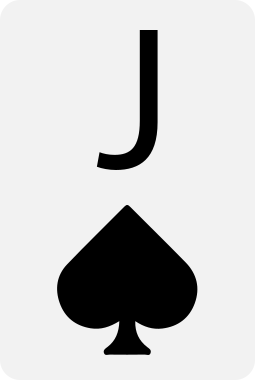
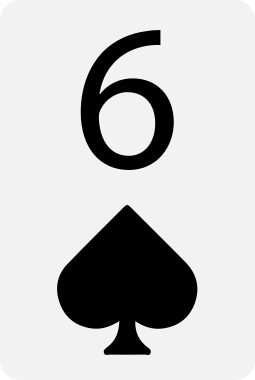
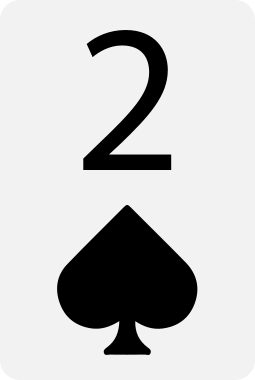
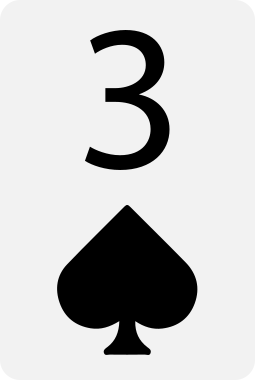
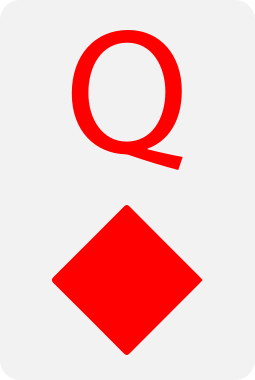
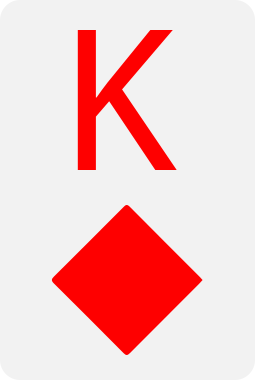
Jack-Six Suited is a marginal starting hand in Texas Hold’em. The suited nature gives it a layer of potential that the offsuit version entirely lacks, but the gap between Jack and Six means it sits at the weaker end of suited hands overall. It is not a hand to build a strategy around, but in the right position and the right game, it has enough going for it to be played selectively.
The combination is awkward. A Jack is a respectable high card but is dominated by Ace, King, and Queen-high hands. The six offers little in the way of connectivity and the five-rank gap between the two cards limits straight possibilities considerably. What redeems J6s is its flush potential and the occasional opportunity to make a disguised strong hand.
What These Odds Show for J6s
The draw odds are characteristic of a weak suited hand. On the flop, 53.04% of runouts leave you with just a high card – meaning more than half the time you are looking at a board you have not connected with at all. This makes continuation betting without improvement a costly habit.
The flush equity is where J6s earns its suited premium. There is an 0.84% chance of flopping a flush outright, rising to 2.93% by the turn and 6.56% by the river. That 6.56% figure by the river is the most significant differentiator between this hand and its offsuit equivalent. While it is not a high number in isolation, it represents a real additional way to win that changes how the hand can be played in position.
Pair odds settle at 43.40% by the river, with two pair at 22.26% and three of a kind at 4.37%. The straight odds are more interesting than you might expect given the card gap – 3.19% by the river – but the Jack-Six combination only connects with specific board textures to get there, and it is not a draw to rely on.
The overcard odds are where J6s really shows its vulnerability. A card higher than the Jack will appear on the flop 56.96% of the time. By the river, that rises to 76.31%. This means that in roughly three out of every four hands you play to the river, at least one Ace, King, or Queen will be present on the board, frequently making your Jack irrelevant as a top card.
Hand Strength Summary
- Hand type: Weak suited one-gapper
- Relative strength: Bottom quarter of all starting hands
- Potential: Flush draws, occasional disguised two pair or trips
- Main vulnerability: Dominated by most broadway hands; high overcard frequency on the board
J6s is a hand that can make strong hands but rarely the strongest hand. The flush it makes will often be the second-best flush when facing another suited player in the same suit.
How Jack-Six Suited Wins
J6s wins through deception and board interaction rather than raw card strength:
- Flopping or completing a flush, particularly against opponents holding one-pair hands
- Making two pair with both hole cards on a well-distributed board
- Flopping top pair with a Jack and getting action from a weaker holding
- Completing a straight in the small number of board configurations that allow it
- Taking down pots preflop with a well-timed steal from late position
Its wins tend to be bigger when the hand connects strongly, because opponents often do not give credit for a six being in play.
Main Weaknesses
J6s has several meaningful weaknesses that keep it outside a standard opening range from most positions:
- A Jack alone is regularly out-kicked or dominated by broadway holdings
- The six contributes very little unless it pairs alongside the Jack for two pair
- Overcards land on the board over three quarters of the time by the river, which is among the highest overcard frequencies of any hand with a Jack as the top card
- The five-card gap between Jack and Six prevents most of the straight combinations that make suited connectors valuable
- Even completed flushes can lose to higher flushes when another player holds suited cards in the same suit with a higher top card
Best and Worst Flop Textures
Strong flops
- Two cards of your suit (giving you a flush draw to work with)
- Jack-high boards where the six plays as a hidden kicker against single-pair opponents
- Low boards pairing the six where an opponent is unlikely to give it credit (e.g. 6♠ 3♦ 2♣)
- Two pair boards using both hole cards (e.g. J♦ 6♥ 2♠)
Dangerous flops
- Any flop with an Ace, King, or Queen – which happens on over half of all flops
- Coordinated boards in a different suit where you pick up no draw equity
- Jack-high boards where opponents with AJ, KJ, or QJ are likely to have you dominated on the kicker
The ideal flop for J6s is one that either gives you two pair, a flush draw, or a Jack with a board that is unlikely to have connected with better hands.
How It Plays by Position
- Early position: Not a hand to open. The overcard vulnerability and weak kicker make early position play unprofitable without a very specific table read.
- Middle position: Still marginal. Worth folding in most standard games.
- Late position (cutoff/button): The most natural home for J6s. Fold equity combined with the hand’s ability to flop something disguised makes it a viable steal candidate in the right spot.
- Blinds: Can be used to complete from the small blind in unraised pots but is not worth defending against a raise in most circumstances.
Position is not just helpful with J6s, it is close to essential. The hand is difficult to play profitably out of position against any real aggression.
Common Mistakes with Jack-Six Suited
- Overvaluing the suited nature and calling raises you should be folding
- Continuing past the flop with just Jack-high when the overcard danger is obvious
- Playing it as a bluff hand and getting called by better holdings repeatedly
- Chasing flush draws without the correct pot odds
- Making a pair of sixes and committing chips when you are almost certainly behind
The suited tag gives J6s just enough appeal to tempt players into spots they should not be in. Discipline with this hand means recognising when the board has not given you a reason to continue.
Comparison to Similar Hands
- Stronger than: J5s, J4s, J3s, J2s, and the offsuit version J6o
- Weaker than: J7s, J8s, J9s, JTs, and any suited hand with a higher top card
- Broadly similar to: Other weak suited one-gappers such as Q7s or T5s
The offsuit version, J6o, loses the flush equity that is arguably the main reason to consider J6s at all. The gap to J7s is also notable – one extra rank of connectivity opens up significantly more straight combinations.
How Jack-Six Suited Performs in Multiway Pots
J6s does not thrive in multiway pots. The reasons are straightforward:
- More opponents means a higher probability that someone holds a Jack with a better kicker
- Flush completions lose value when more players could be drawing to the same suit with higher cards
- The hand’s straight potential is low enough that multiway implied odds for that draw are rarely justified
- A pair of sixes in a multiway pot is a very vulnerable holding
The hand plays best in position, heads-up, ideally in a pot you have shown initiative in preflop. In passive multiway limped pots it can occasionally see a cheap flop and connect, but the expectation should be kept modest.
FAQ: Jack-Six Suited
Is J6s a good hand to play?
Not in most situations. It is a speculative hand best suited to late position play in the right table dynamics. In early or middle position it is generally a fold.
Why play J6s at all?
The suited nature gives it flush potential, and the Jack offers occasional top pair value. In position with a passive table, it can be a profitable steal or speculative hand.
Does the flush draw make J6s worth chasing?
Only with the right pot odds. A flush will arrive by the river roughly 6.56% of the time from the start, and on the flop with a flush draw you will complete it around one in three times by the river.
How bad is the overcard problem for J6s?
Significant. With overcards hitting the board 76.31% of the time by the river, the Jack will frequently not be the highest card on the board, which limits its value as a top pair holding.
Related Hands