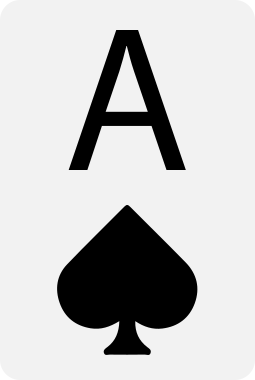
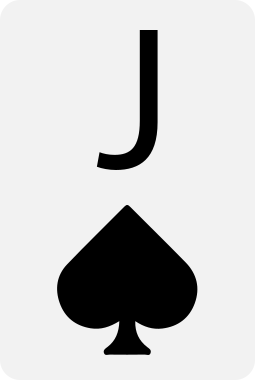
Ace-Jack Suited is a hand that many players love, and for good reason – it looks the part. An Ace, a broadway Jack, suited, with real potential across multiple draw types. It is a genuinely strong hand that sits comfortably in the top tier of non-premium holdings and plays well across a variety of game formats and stack sizes.
But AJs also occupies a position in the rankings where context matters enormously. It is the third in the line of suited Ace-x broadway hands, and while the gap from AKs to AQs is meaningful, the gap from AQs to AJs is more significant than the raw card difference might suggest. Understanding why is central to playing this hand profitably.
What These Odds Show for AJs
The draw odds for AJs are largely familiar. The hand arrives at the flop without a pair 52.71% of the time – identical to AKs and AQs, reflecting the shared structure of two unpaired hole cards. When it does connect, one pair is the most common outcome at 40.41% on the flop, settling at 43.00% by the river. Two pair completes in 22.14% of all runouts, and the flush arrives in 6.52% of hands – again closely tracking the other suited Ace-x hands.
The straight draw is where a clear pattern emerges across these broadway combinations. AJs makes a straight in 3.79% of runouts by the river – higher than AKs at 3.09% and AQs at 3.44%, but below KQs at 4.70%. This reflects the Jack’s position in the broadway range – it can sit in the middle of straights more readily than a King or Queen paired with an Ace, but has fewer combinations available to it than KQ’s centrally-placed pairing. The straight flush rate of 0.06% also nudges slightly higher than AKs, for the same structural reason.
What the tables do not show directly, but what shapes AJs’s real-world performance more than any single figure, is the dominated kicker problem – and with AJs, that problem is wider than with any of its suited Ace-x predecessors.
Hand Strength Summary
- Hand type: Strong suited broadway hand
- Relative strength: Top 10–15 starting hands
- Dominates: AT, KJ, QJ, JT, and weaker Jack-x and Ace-x combinations
- Main vulnerabilities: All pocket pairs preflop; dominated by AK and AQ on Ace-high boards; KJ situation on Jack-high boards is less clean than it appears
AJs is a strong hand that plays best with position and aggression. Its weakness lies not in what it can become, but in how often the boards it connects with are also the boards where stronger hands have it dominated.
How Ace-Jack Suited Wins
AJs reaches the best hand through several paths:
- Makes top pair with a decent kicker when an Ace or Jack hits the board
- Completes the nut flush in its suit – always the highest possible flush when the Ace is suited
- Makes straights at a rate of 3.79% by the river, via broadway and Jack-high straight combinations
- Applies pressure through semi-bluffing when flush and straight draws overlap
- Dominates weaker Ace-x hands (AT, A9, A8) that share the same top card on Ace-high boards
The nut flush draw remains one of AJs’s strongest assets. As with AKs and AQs, any flush made with AJs using the Ace’s suit is the best possible flush – there is no scenario where a higher flush beats it. On boards where a flush draw develops in the Ace’s suit, AJs can apply considerable pressure because its draw is both clean and unbeatable at completion.
Main Weaknesses
AJs has a kicker vulnerability that extends across three hands rather than two. When an Ace falls on the board:
- AK has top pair with a King kicker – AJs is dominated
- AQ has top pair with a Queen kicker – AJs is still dominated
- Only against AJ itself (a chopped pot) or weaker Ace-x hands does top pair play cleanly
When a Jack falls on the board:
- AK still has an overcard and may have picked up a straight draw
- AQ has a higher overcard and a gutshot to broadway
- KJ and QJ both have top pair and may have the Jack outkicked depending on the board
The result is that AJs’s most natural connecting cards – Aces and Jacks – regularly produce boards where the hand is either dominated or in a more complicated spot than it appears. This is meaningfully different from AKs, where connecting with an Ace almost always produces the best top pair, and from AQs, where only AK presents the kicker problem on Ace-high boards.
Other weaknesses include:
- Behind all pocket pairs before the flop
- Misses the flop entirely 52.71% of the time
- The dominated kicker issue is harder to read and navigate than with higher Ace-x hands, because opponents are less likely to 3-bet AQ or AJ as a bluff – making their aggression more credible
Best and Worst Flop Textures
Strong flops
- Ace-high boards with no King or Queen in the opponent’s likely range – top pair with a usable kicker
- Jack-high boards against wide ranges – top pair with an Ace overcard
- Two cards of the Ace’s suit – nut flush draw with two strong cards
- T-9 or Q-T boards – open-ended straight draw to a broadway or Jack-high straight, often combining with the flush draw
- Low, dry boards – overcards retain significant fold equity and pot-control is straightforward
Dangerous flops
- Ace-King or Ace-Queen boards – the kicker problem is at its worst; AK and AQ now have two pair while AJs has top pair dominated
- Jack-high boards against tight ranges where KJ and QJ are plausible holdings
- Boards where the flush draw is in a different suit and drawing equity is lost
- Multiway pots on high boards where multiple players may have connected in ways that dominate AJs
How It Plays by Position
- Early position: A raise is standard in most games, though some tighter strategies prefer to open AJs from middle position rather than UTG. It is a hand that greatly benefits from position postflop, and early-position opens invite 3-bets from ranges that often dominate it.
- Middle position: Standard raise. A solid hand to build pots with against wide calling ranges.
- Late position: Where AJs performs best. The combination of position, fold equity, and drawing potential makes it a comfortable hand to play through multiple streets.
- Blinds: Playable, but navigate carefully on any board containing an Ace – the dominated kicker issue is hardest to manage out of position against aggression.
AJs in the Ace-x Suited Hierarchy
Looking across AKs, AQs, and AJs, the draw odds tables are remarkably similar. The flush rate is virtually identical across all three (6.53%, 6.53%, 6.52%). The high card flop rate is the same (52.71%). The two pair river rate is the same (22.14%). Even the full house, four of a kind, and straight flush rates barely move.
What changes – and what matters in practice – is the kicker hierarchy and the straight rate. The straight rate climbs modestly with each step down the broadway ladder (3.09%, 3.44%, 3.79%), reflecting the increasing centrality of the lower card within straight combinations. But the kicker issue grows in the opposite direction: each step down from AKs adds one more hand that dominates AJs on the most natural connecting board. AKs is dominated by nothing on an Ace-high board. AQs is dominated by AK. AJs is dominated by both AK and AQ.
This is not a reason to avoid AJs – it is a reason to understand it clearly and play it with appropriate selectivity postflop.
Common Mistakes with Ace-Jack Suited
- Treating AJs like AKs or AQs and over-committing on Ace-high boards without accounting for the wider kicker vulnerability
- 3-betting out of position against tight ranges where AK and AQ are common, then facing difficult decisions on Ace-high flops
- Failing to use the nut flush draw as an aggressive semi-bluffing tool when suited cards appear
- Over-valuing top pair of Jacks against opponents who show sustained aggression – many of those ranges contain better Jacks or Ace-x holdings
- Under-estimating the hand’s strength against wide ranges and playing it too passively, sacrificing fold equity that makes it profitable
Comparison to Similar Hands
- Stronger than: ATs, KJs, QJs, AJo, and most non-premium holdings
- Behind: All pocket pairs, AKs, AKo, AQs, KQs
- Marginally higher straight rate than AQs (3.79% vs 3.44%), but with a meaningfully wider kicker vulnerability on connecting boards
Examples:
- Against QQ: AJs is an underdog at roughly 32%, but with two live overcards and flush equity
- Against AQs: AJs is dominated on Ace-high boards – approximately 27% to win overall
- Against KJs: AJs is a clear favourite – the Ace is a dominant overcard on most boards
How Ace-Jack Suited Performs in Multiway Pots
AJs retains meaningful drawing equity in multiway pots, particularly through the nut flush draw and its straight potential. However, the kicker vulnerability compounds in larger fields – more players means a higher probability that at least one holds AK or AQ, making Ace-high boards increasingly dangerous to continue on aggressively. The hand is best played heads-up in position, where its semi-bluffing tools and postflop flexibility can be fully exploited without the compounding risk of multiple dominating kickers.
FAQ: Ace-Jack Suited
Is AJs a premium hand?
It is a strong hand, comfortably in the top tier of non-premium holdings, but it is not a premium hand in the same category as AKs or the top pocket pairs. The kicker vulnerability on Ace-high boards is a real and recurring limitation that keeps it a step below.
Should you 3-bet AJs?
In position against late-position openers with wide ranges, yes. Out of position against tight early-position ranges where AK and AQ dominate, calling and playing postflop is often the better approach. The hand is strong enough to 3-bet selectively – not routinely.
How do you play AJs on an Ace-high flop?
Proceed carefully. Check the opponent’s likely range before committing. Against a wide range that includes many non-Ace hands, a continuation bet can work well. Against tight, aggressive ranges where AK and AQ are common, pot-controlling and avoiding large pots on top pair is often the right adjustment.
What is the difference between AJs and AJo?
Approximately 3–4% equity in most match-ups, plus the nut flush draw and the ability to semi-bluff with combined flush and straight equity simultaneously. The suited nature also makes certain semi-bluffing lines far more powerful by combining draw types on the same board.
Related Hands