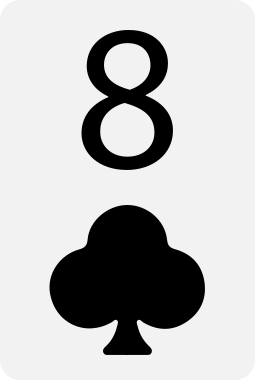
Ace-Eight Offsuit is a hand that occupies familiar territory for anyone who has read the page on Ace-Nine Offsuit – a respectable Ace paired with a kicker that sits just below the threshold of genuine comfort. A8o is marginally weaker than A9o in almost every measurable way, but the differences are small enough that the strategic considerations are nearly identical. The Ace remains the dominant feature of the hand, the eight contributes modestly, and the absence of a suit match caps the hand’s ceiling in the same way it does for all offsuit ace-x holdings.
Where A8o sits in the broader landscape is clear: it is above average against random hands but firmly in dominated territory against the kinds of ace-x hands opponents actually play. The kicker problem is real, persistent, and the primary factor in how this hand should be approached at every stage.
What These Odds Show for A8o
The draw odds are nearly identical to A9o, with small but consistent differences that reflect the slightly lower kicker rank. On the flop, 53.88% of runouts produce just a high card – the same figure as A9o, which makes sense given that neither the ace nor the eight paired is more or less likely than the ace or nine pairing. This means the majority of flops leave A8o in the same position as most offsuit ace-x hands: relying on the Ace as an unpaired top card while assessing whether the board has connected favourably.
Pair equity by the river sits at 45.86%, fractionally below A9o’s 46.00%, and two pair arrives at 22.79% – identical to A9o. Three of a kind comes in at 4.45%, full house at 2.22%, and four of a kind at 0.13%, all consistent with similar holdings.
The straight odds are the most notable point of difference between A8o and A9o. A straight arrives 0.00% of the time on the flop, 0.77% by the turn, and 3.05% by the river. A9o reached 2.67% by the river, making A8o a meaningfully better straight candidate despite ranking lower overall. This is because the eight sits in a more central position in the deck than the nine, with more board configurations running through it in both directions. Boards involving four, five, six, seven or five, six, seven, nine or six, seven, nine, ten all offer straight combinations that the eight can complete in conjunction with the Ace or independently. The Ace additionally contributes to broadway straights through the ten-jack-queen-king run, giving A8o a dual-ended straight profile that is modestly better than A9o’s.
The flush odds sit at the standard 1.96% by the river for any offsuit hand and play no meaningful role in strategy.
Hand Strength Summary
- Hand type: Offsuit ace-x
- Relative strength: Above average across all starting hands; dominated by stronger ace-x holdings
- Dominates: A2o through A7o, most mid and low pairs, weaker broadway hands
- Main vulnerability: Dominated by A9o through AKo; kicker problems persist on ace-high boards throughout
A8o is in an almost identical strategic position to A9o. The one rank difference in the kicker creates no meaningful change in how the hand should be approached, though it does very slightly narrow the range of ace-x hands it is ahead of.
How Ace-Eight Offsuit Wins
A8o wins through the same routes as other offsuit ace-x hands:
- Pairing the Ace on a board where no opponent holds a stronger kicker
- Making two pair with both hole cards on a compatible board, particularly a disguised two pair on a low board where the eight plays unexpectedly
- Completing a straight through the multiple board configurations that involve the eight, including the broadway end via the Ace
- Taking down pots through preflop aggression in late position where fold equity is available
- Winning on boards where opponents miss entirely and fold to a well-timed continuation bet
The straight potential with A8o is a mild but genuine additional weapon. A five-card run that includes the eight appears more often than many players expect, and the combination with the Ace’s broadway connectivity gives A8o a slightly broader straight draw profile than its rank might suggest.
Main Weaknesses
The weaknesses of A8o are the weaknesses of all offsuit ace-x hands with a medium kicker, applied here with full force:
- Dominated by ATo, AJo, AQo, and AKo – all hands that an opponent is likely to hold in a raised pot
- Also behind A9o in kicker terms, meaning the range of ace-x hands that have it dominated is one wider than for A9o
- The offsuit nature removes all flush equity
- Top pair with an eight kicker is vulnerable on ace-high boards against any player holding a stronger ace
- Pairing the eight on an ace-high board is a difficult and usually losing position
- Out of position, the kicker problem becomes harder to manage across multiple streets
Best and Worst Flop Textures
Strong flops
- Ace-low boards where the eight is an unlikely kicker match for opponents (e.g. A♦ 5♣ 2♠)
- Eight-high boards where top pair and top kicker is a strong holding
- Two pair boards using both hole cards (e.g. A♠ 8♦ 3♣)
- Boards offering a straight draw through combinations involving the eight, such as five, six, seven or six, seven, nine
Dangerous flops
- Ace-high boards where opponents are likely to hold stronger kickers – the most common and costly scenario with this hand
- Boards where both an Ace and a nine or higher card are present, increasing the likelihood that an opponent holds a dominating ace-x hand
- Coordinated boards that miss entirely but offer drawing opportunities to opponents
The central challenge of A8o post-flop is the same as with all medium ace-x hands: when you hit your Ace, you need to assess quickly whether your kicker is likely to be the problem. On ace-high boards against early position raisers with tight ranges, an eight kicker is frequently not enough.
How It Plays by Position
- Early position: A fold in standard games. The range of hands that dominate A8o is too wide among the kinds of opponents who play back from early position.
- Middle position: Marginal. Playable in softer or more passive games, but vulnerable to three-bets from players holding stronger ace-x hands.
- Late position (cutoff/button): The natural home for A8o. Fold equity, positional advantage through the streets, and the reduced range of the blinds make this a viable and occasionally profitable open.
- Blinds: A reasonable defend from the big blind against late position opens. The Ace provides enough equity to call in most single-raise scenarios, though out-of-position play demands caution on ace-high boards.
The strategic framework for A8o by position is essentially the same as A9o. Both hands need position to navigate the kicker problem effectively, and both become significantly harder to play profitably when forced to act out of position against aggression.
Common Mistakes with Ace-Eight Offsuit
- Playing it from early position and running into a dominated spot against a stronger ace
- Calling three-bets and committing to a pot where the range advantage strongly favours the opponent
- Over-valuing top pair with an eight kicker on ace-high boards, particularly when opponents show continued aggression across multiple streets
- Ignoring the straight draw potential on boards that offer it – there are spots where pot odds justify continuing with A8o that players miss by not recognising the draw
- Treating it as equivalent to A9o when the kicker difference, while small, does matter in close spots
Comparison to Similar Hands
- Stronger than: A2o through A7o
- Weaker than: A9o, ATo, AJo, AQo, AKo, and all suited ace-x equivalents including A8s
- Broadly similar to: A9o in almost every strategic respect, with a marginally worse kicker profile but comparable or slightly better straight draw potential
The comparison to A8s is the most relevant for understanding what A8o is missing. A8s carries flush draw equity that adds meaningful additional ways to win, particularly on boards where A8o has nothing but top pair and a vulnerable kicker. The suited version is the clearly superior hand.
How Ace-Eight Offsuit Performs in Multiway Pots
A8o faces the same multiway challenges as other offsuit ace-x hands, and they are significant:
- Each additional opponent increases the probability that a stronger ace is in the hand
- The eight kicker becomes a greater liability as the field widens, since the chance of running into AJ, AQ, or AK somewhere at the table rises sharply
- Board-pairing hands and draws become more common across wider fields, making one pair with a weak kicker a difficult hand to play for large amounts
- The lack of flush equity means fewer ways to outdraw in contested multiway pots
A8o is a heads-up hand at heart. It plays best in single-opponent pots where you have taken the initiative preflop, reducing the likelihood of running into a dominating ace-x combination and making post-flop decisions cleaner.
FAQ: Ace-Eight Offsuit
How does A8o compare to A9o?
They are very similar hands with nearly identical draw profiles. A9o has a marginally better kicker, which slightly narrows the range of ace-x hands that dominate A8o further. A8o has modestly better straight draw potential by the river at 3.05% compared to A9o’s 2.67%, which partially offsets the kicker disadvantage.
What is the biggest risk with A8o?
Kicker trouble on ace-high boards. Pairing the Ace against an opponent holding A9 through AK is the most common and costly scenario this hand creates, and it happens frequently in raised pots where stronger ace-x hands are over-represented.
Should A8o be played differently to A9o?
Not in any fundamental way. The positional requirements, the post-flop assessment process, and the threshold for continuing against aggression are essentially the same. The marginal kicker difference matters in very close spots but does not change the overall approach.
Is the straight potential worth considering with A8o?
Yes, modestly. The 3.05% river straight probability is genuine and comes from multiple board configurations. On boards that offer a straight draw, pot odds may justify continuing in spots where a player thinking only about pair equity would fold. It is not a primary draw to build around, but it is worth recognising.
Related Hands