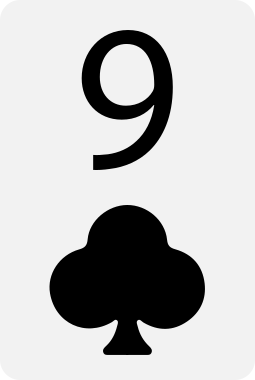
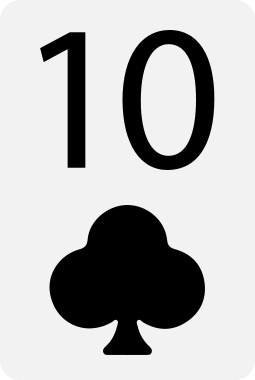
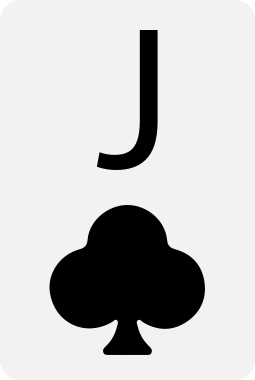
Jack-Nine Offsuit is a one-gap offsuit hand with genuine straight potential and a meaningful high-card anchor in the Jack. It is not a premium hand and not a suited connector, but it sits comfortably in the category of playable speculative hands with a clear identity: a straight-drawing hand that also has legitimate top-pair value on a wide range of boards. The Jack suppresses overcard exposure significantly compared to lower-ranked offsuit hands, and the one-gap structure between Jack and Nine gives enough straight combinations to make the draw equity real rather than theoretical.
What J9o lacks relative to its suited equivalent is the flush draw – and as with T9o versus T9s, that absence has consequences beyond just the raw flush percentage. Without flush draws, the combination draw situations that make suited connectors so dangerous become unavailable, and the hand’s ceiling in post-flop play is correspondingly lower.
What These Odds Show for J9o
The straight odds are the hand’s most compelling feature. At 0.98% on the flop, 3.41% by the turn, and 7.42% by the river, J9o has strong straight equity for an offsuit hand – higher than any suited hand covered in this series except the zero-gap connectors at comparable ranks. The one-gap structure between Jack and Nine gives meaningful straight combinations in both directions, and the Jack-high straights it completes tend to be strong holdings that opponents with top pair and overpairs will not easily release.
The flush odds tell the familiar offsuit story: 0.00% on the flop, 0.43% by the turn, and 1.95% by the river. These figures represent backdoor possibilities only – there is no flush draw to speak of, and the hand should never be played with flush equity as part of the plan. The straight flush odds of 0.02% reflect the same constraint.
The overcard table sits at 56.96% on the flop, 67.95% by the turn, and 76.31% by the river – identical to J7s. This makes sense: both hands have a Jack as their highest card, so overcard frequency is determined by the Jack in both cases regardless of the second card. The Jack is a strong anchor that puts overcard exposure well below the figures seen for Eight, Nine, and Ten-high hands, giving J9o genuine top-pair potential on a broad range of boards. A Jack-high board is top pair against most realistic opponent ranges, and it occurs on a meaningful proportion of all flops.
Hand Strength Summary
- Hand type: Offsuit one-gap hand
- Relative strength: Solid speculative hand; one of the stronger offsuit non-premium holdings in this range
- Main draws: Straights (good combinations for a one-gap hand at this rank), Jack top pair on boards without an Ace or King, Nine top pair on specific lower boards
- Main vulnerability: No flush equity beyond negligible backdoor odds; combination draw situations unavailable; kicker vulnerability when the Jack pairs against better Jack-x holdings
How J9o Wins
J9o wins through multiple routes and board textures:
- Completing straight draws, which are well disguised on mid-range boards where the Jack and Nine both have plausible connections
- Pairing the Jack for top pair on boards without an Ace or King
- Making two pair using both hole cards on connected boards
- Pairing the Nine for a strong second pair in situations where the board supports it
- Winning through positional aggression on boards that favour a Jack-high or Nine-high range
- Dominating weaker Jack-x and Nine-x holdings in heads-up situations
The Jack and Nine together cover a wide range of board textures. On boards with a Jack, the hand has top pair. On boards without a Jack but with a Nine, it has a strong middle pair. On connected mid-range boards, it has straight draw potential. Few offsuit non-premium hands cover that many board textures with legitimate equity.
Main Weaknesses
J9o has several clear limitations that define how it should be played:
- No flush draw equity in any meaningful sense – the 1.95% river figure is backdoor noise rather than planned equity
- Combination draw situations are inaccessible – unlike J9s, this hand cannot simultaneously threaten a straight and a flush
- Kicker vulnerability when the Jack pairs – AJ and KJ both hold better kickers and are common holdings opponents play strongly on Jack-high boards
- The one-gap structure produces lower straight equity than zero-gap connectors like T9o at 9.13% or JTo; J9o’s 7.42% is meaningful but not at the same level
- Overcard exposure of 76.31% by the river means Aces and Kings appear on most runouts, reducing the Jack’s top-pair frequency
Best and Worst Flop Textures
Strong flops
- Jack-high boards with low-to-mid disconnected cards (J♠ 5♦ 2♣) – top pair with manageable kicker concerns against most ranges
- Mid connected boards giving open-ended straight draws (8♠ T♦ Q♣ or 7♥ 8♦ T♠ giving draws in multiple directions)
- Boards pairing the Nine where middle pair is strong and the straight draw is simultaneously available
Dangerous flops
- Ace or King-high boards – the Jack steps down from top pair and the Nine has limited value
- Monotone boards where opponents pick up flush draws that J9o cannot match
- Boards completing straights for higher connectors where J9o is drawing to the lower end
How It Plays by Position
- Early position: Borderline; stronger than most speculative hands at this level but the one-gap offsuit nature makes it difficult to play comfortably against tight early-position ranges that frequently 3-bet
- Middle position: A reasonable open in most games; the Jack and straight potential give it enough equity to justify building small pots
- Late position / button: An excellent position for J9o – strong steal candidate, pair value on a wide range of boards, and open-ended straight draw potential on mid-range textures
- Blinds: A clear big blind defend against most raises; the combination of Jack top-pair potential and genuine straight equity makes it one of the stronger offsuit non-premium hands to call with from the blinds
Common Mistakes with Jack-Nine Offsuit
- Treating J9o like J9s and overestimating post-flop equity – the absence of flush draws is a genuine ceiling on the hand’s potential
- Overcommitting with Jack top pair without accounting for kicker vulnerability against AJ and KJ, both of which are commonly held by opponents who play aggressively on Jack-high boards
- Continuing on boards with no pair, no straight draw, and no backdoor equity when the hand has completely missed
- Drawing to the low end of a straight without recognising when a higher connector holds the better end – J9o completing a straight on a 7-8-T board is strong, but an opponent holding QJ has a higher straight
- Playing too passively when an open-ended straight draw is live, missing semi-bluff opportunities that have genuine equity
Comparison to Similar Hands
- Stronger than: J8o (one additional gap, meaningfully lower straight equity), T9o is broadly comparable to J9o with different strengths – J9o has better overcard suppression, slightly lower straight equity
- Weaker than: J9s (the suited version adds approximately 6.4 percentage points of flush equity and combination draw access – the same substantial gap that separates T9s from T9o), JTo (zero-gap, significantly stronger straight equity at comparable ranks)
- Nuanced comparison: T9o has zero-gap connectivity producing 9.13% river straight equity versus J9o’s 7.42%. J9o has a stronger anchor card in the Jack producing 56.96% flop overcard odds versus 69.47% for T9o. Neither is clearly superior – T9o makes straights more often, J9o has top pair more often. The choice between them in a given situation depends on which equity type is more valuable on the specific board and against the specific opponent.
How J9o Performs in Multiway Pots
J9o performs reasonably well in multiway pots by offsuit non-premium hand standards. Its straight potential scales well with pot size – when J9o completes a straight in a multiway pot, the implied odds against opponents holding sets, two pair, and overpairs are excellent. The Jack also provides top-pair value in multiway pots on boards where no Ace or King is present, which is a more reliable equity source than lower-ranked offsuit hands have.
The primary limitation in multiway pots is the absence of flush equity. Opponents with flush draws have an equity source J9o cannot match, and in multiway pots the probability that at least one opponent holds a flush draw on most textured boards is significant. Where J9s can apply combination draw pressure in large fields, J9o is limited to straight draws and pair value – a meaningful ceiling in situations where flush draws are live.
FAQ: Jack-Nine Offsuit
How significant is the gap between J9o and J9s in practice?
More significant than the offsuit penalty alone suggests. J9s adds approximately 6.4 percentage points of flush equity, which is the obvious difference. But the deeper impact is in combination draw situations – J9s can simultaneously threaten a straight and a flush on textured boards, creating 15-out situations that are extremely difficult for opponents to play against. J9o cannot access those spots at all, which means its maximum post-flop equity in any given situation is lower even when the straight draw is equally strong.
How does J9o compare to T9o?
The two hands represent different trade-offs. T9o has zero-gap connectivity producing 9.13% river straight equity – significantly higher than J9o’s 7.42%. J9o has a stronger high-card anchor in the Jack producing 56.96% flop overcard odds versus 69.47% for T9o. In straight-heavy situations T9o has the edge; on boards where pair value matters more, J9o is stronger. Both are solid offsuit speculative hands and the choice between them is situational rather than absolute.
What straights does J9o make and how strong are they?
J9o can make straights ranging from Seven-high (7-8-9-T-J) to King-high (9-T-J-Q-K). The King-high straight using a Q-K board alongside the J and 9 is a very strong holding. The seven-high straight using a 7-8-T board is more vulnerable to higher straights. The range of combinations is good for a one-gap hand and covers both strong and moderate straight holdings depending on the board.
Is J9o playable from early position?
Borderline. It has more going for it than typical early-position speculative hands – the Jack’s overcard suppression, genuine straight equity, and multiple board textures it connects with make it stronger than most one-gap offsuit hands. But the absence of flush draws and the kicker vulnerability against AJ and KJ mean it can be difficult to play against the tight ranges that 3-bet early-position opens aggressively. In looser games it is defensible from early position; in tighter, more aggressive environments it is better reserved for middle and late position.
Related Hands