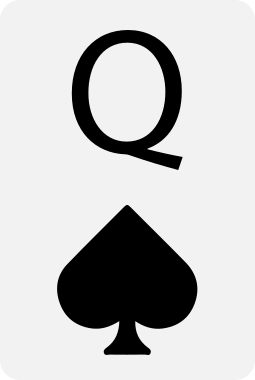
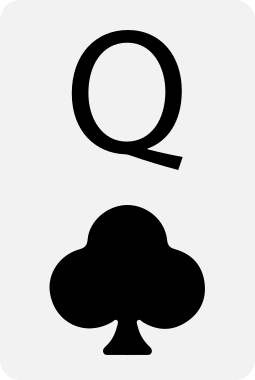
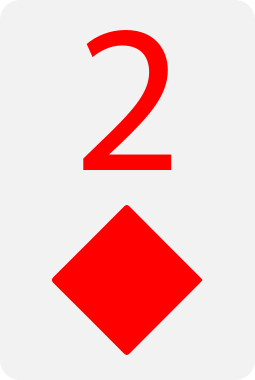
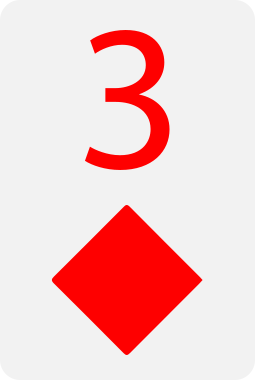
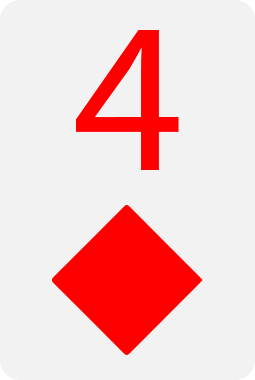
Queen Ten Offsuit is a speculative broadway hand sitting in an interesting middle ground – too strong to dismiss, but not strong enough to play straightforwardly in every spot. It connects well with the board and has genuine straight potential, but it relies heavily on improving to win at showdown.
Before the flop, QTo has no immediate showdown value. It is a drawing hand that needs the board to cooperate.
What These Odds Show for QTo
The draw odds table tells a clear story: this hand starts weak and needs to improve. On the flop, QTo still has a high card as its best hand 52.90% of the time, meaning more often than not the flop does nothing meaningful for you. That figure drops to 17.85% by the river, which reflects how many runouts eventually produce at least a pair – but it also highlights how often you can be left with nothing through multiple streets.
The pair odds peak at 47.13% by the turn before settling at 43.58% by the river, which is a sign that many paired flops are later outrun by stronger hands forming.
The most interesting number for QTo is the straight odds – 0.98% on the flop rising to 7.47% by the river. That nearly 1-in-13 chance of rivering a straight is a meaningful part of this hand’s appeal. Q-T has strong straight connectivity, with J being the card that completes the most natural draw, but it also wraps around broadway combinations involving A, K, and J.
The overcard table is worth paying attention to here. With a Queen as your highest card, any Ace or King on the board is an overcard. The chance of at least one appearing on the flop is 41.43%, rising to 59.85% by the river. That means in the majority of runouts, at least one card outranks your best hole card – a significant consideration when deciding how much confidence to place in top pair.
Hand Strength Summary
- Hand type: Speculative broadway connector
- Relative strength: Playable in position, marginal out of position
- Strengths: Straight potential, two overcards to medium pairs, disguised hand strength when it hits
- Main vulnerability: Dominated by AQ, KQ, AT, KT, and any higher pair
How Queen Ten Offsuit Wins
QTo wins in a few distinct ways:
- Flopping top pair with a strong kicker and holding
- Completing a straight, particularly on J-high or K-J boards
- Making two pair on a coordinated board
- Taking down uncontested pots with a well-timed continuation bet on the right board textures
The hand’s value is largely realisation-dependent – it needs to see cheap flops and have the opportunity to get away from it when the board misses entirely.
Main Weaknesses
QTo has several meaningful vulnerabilities:
- Easily dominated – a Queen with a better kicker (AQ, KQ) has it in bad shape when both hit top pair
- The offsuit nature removes flush equity entirely, leaving only straight and pair potential
- High card board pressure – with overcards appearing nearly 60% of the time by the river, top pair is rarely a comfortable holding
- Vulnerable in multiway pots where straight draws get there more often against you than for you
Best and Worst Flop Textures
Strong flops
- Jack-high boards (Q♠ T♦ J♣ gives you the nut straight)
- Queen-high dry boards where top pair holds (Q♦ 7♣ 2♠)
- Ten-high boards where you have an overpair to the board with straight draws developing
Dangerous flops
- Ace or King high boards where your Queen is no longer top pair
- Paired boards where two pair potential is neutralised
- Monotone flops where flush draws are present but you cannot participate in them
How It Plays by Position
- Early position: Generally a fold or a marginal open at best in tight games
- Middle position: Can be opened but requires care with multiway action
- Late position / Button: Where this hand has most of its value – stealing blinds, seeing cheap flops, realising equity against weaker ranges
- Blinds: Reasonable hand to defend from the big blind given its connectivity and high card strength
Position transforms QTo from a marginal hand into a playable one. Playing it out of position against aggression is where most mistakes with this hand originate.
Common Mistakes with Queen Ten Offsuit
- Overvaluing top pair – a Queen on the board with a Ten kicker can easily be dominated
- Playing it too aggressively from early position
- Chasing straight draws on boards where the price is too high
- Calling 3-bets out of position where equity realisation becomes very low
Comparison to Similar Hands
- Stronger than: J9o, T8o, other lower broadway connectors
- Weaker than: QTs (suited version adds flush equity), KTo, ATo
The suited version, QTs, is a significantly stronger hand due to the added flush draw potential. Against hands like QJ or KT, QTo is in a dominated or at best flipping situation.
How Queen Ten Offsuit Performs in Multiway Pots
QTo’s straight potential does give it some multiway value – completing a straight in a large pot is profitable. However, the lack of a flush draw and the vulnerability to domination mean multiway pots are a double-edged sword. More players means more chances someone has AQ, KQ, or a set to take down the pot even when QTo hits.
It plays best in heads-up pots where its high card strength and straight equity can be applied cleanly.
FAQ: Queen Ten Offsuit
Is QTo a strong starting hand?
It is a playable hand in the right conditions, particularly in position, but it is not a premium hand and should not be treated as one.
What is the best flop for Queen Ten Offsuit?
A Jack-high flop giving you the nut straight is the best possible outcome. Queen-high dry boards where you hold top pair with straight draw potential are also very favourable.
How does QTo compare to QTs?
The suited version is meaningfully stronger. The flush draw equity that QTs adds changes its value significantly, particularly on wet boards.
Why do overcards matter so much for this hand?
With a Queen as your highest card, any Ace or King on the board threatens your best pair. Given that overcards appear on the board by the river nearly 60% of the time, top pair with QTo is often a vulnerable holding rather than a confident one.
Related Hands