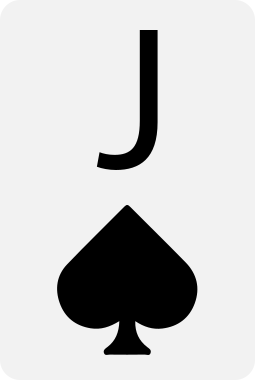
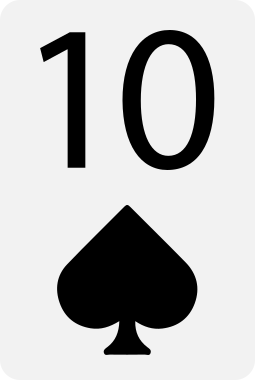
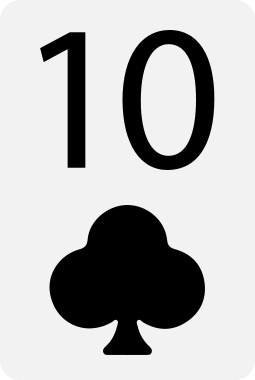
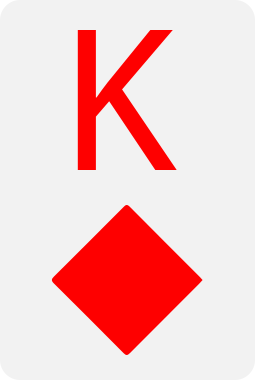
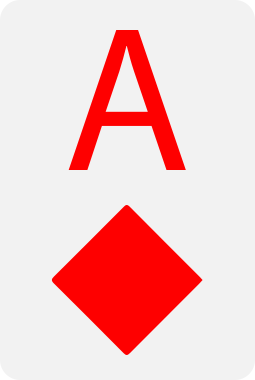
Jack-Ten Offsuit is the strongest offsuit non-broadway connector in Texas Hold’em. Two high cards, exceptional straight potential, and the ability to connect with a wide variety of board textures make it a genuinely versatile hand that plays well across a range of formats and positions. It is not a premium hand, but among the non-premium offsuit holdings it sits near the top of the rankings.
Before the flop, JTo is a comfortable open from most positions and a strong defend from the blinds. Its post-flop playability is high enough that it rarely creates the kind of impossible decisions that weaker offsuit hands do, and its straight equity in particular sets it apart from almost every other non-suited hand.
What These Odds Show for JTo
The straight equity is the defining number for JTo and it is exceptional. At 9.18% by the river, JTo has one of the highest straight probabilities of any starting hand in the game – higher than QJo (7.09%), higher than T8s (7.32%), and competitive with even the strongest suited connectors. On the flop, 1.31% of runouts already complete a straight, rising to 4.36% by the turn. The jack and ten together form the most connected two-card combination possible for an offsuit hand – every straight from ace-high (A-K-Q-J-T) down to seven-high (7-8-9-T-J) includes both cards, giving JTo an unusually wide range of straight-completing boards.
The pair odds peak at 46.84% on the turn and settle at 42.73% by the river – slightly lower than hands with a wider rank spread, reflecting the frequency with which connected boards deliver something better than a single pair. Two pair arrives 22.27% of the time by the river, a solid figure that reflects the two cards’ natural tendency to both connect on coordinated boards.
The overcard table shows a 56.96% chance of an overcard on the flop, rising to 76.31% by the river. With queens, kings and aces all outranking the jack, top pair is frequently under pressure and should rarely be the basis for heavy multi-street commitment. The straight potential is the primary reason to continue on many boards where top pair alone would be a difficult holding.
Hand Strength Summary
- Hand type: Offsuit broadway connector, strong speculative hand
- Relative strength: Upper-middle tier among non-premium hands
- Dominates: Weaker broadway hands (JT beats QT, KT on the right boards), low and medium pairs on connected boards
- Main vulnerability: Overcard pressure from queens, kings and aces; no flush equity; dominated by AJ, AQ, KJ, KQ in kicker confrontations
JTo is the offsuit hand most capable of competing with suited connectors on the strength of its straight equity alone.
How Jack-Ten Offsuit Wins
- Completing a straight – with 9.18% river equity and coverage of every straight from seven-high to ace-high, this is the hand’s premier outcome and the primary reason to play it
- Flopping top pair of jacks or tens and holding up in uncontested pots or against hands that have missed
- Making two pair on coordinated boards (22.27% by the river) when both the jack and ten connect
- Taking uncontested pots with continuation bets on boards that miss opponent ranges entirely
- In multiway pots, completing a straight against opponents holding top pair or overpairs – the implied odds in these situations are excellent
The straight equity deserves particular emphasis. JTo can make straights in both directions from its two hole cards, which means boards containing any combination of seven, eight, nine, queen, king or ace all present straight-making opportunities. No offsuit non-paired hand covers as many straight combinations as JTo.
Main Weaknesses
- No flush equity – the offsuit nature removes an entire category of drawing value, giving up roughly 4–5% equity compared to JTs and significantly reducing semi-bluffing options on suited boards
- Overcard exposure of 76.31% by the river means top pair of jacks or tens is frequently under pressure from higher cards
- Dominated by AJ, KJ, QJ, AT, KT and QT in kicker confrontations – many of which are standard opening hands for opponents
- Straight draws, while frequent, still miss the majority of the time and require discipline to fold when equity does not materialise
- Miss rate of 52.57% on the flop demands selectivity about which boards to continue on
The absence of flush equity is the most tangible cost of playing JTo over JTs. JTs is widely considered one of the best hands in the game; JTo is strong but operates without the flush draw safety net that makes JTs so versatile post-flop.
Best and Worst Flop Textures
Strong flops
- Connected boards giving open-ended straight draws involving both the jack and ten (e.g. Q♥ 9♦ 3♣, K♠ 9♦ 2♥, 8♠ 7♦ 3♣)
- Jack or ten-high boards where top pair is the highest pair on the board with a strong kicker
- Boards where both straight draw directions are active, maximising outs and semi-bluffing equity
Dangerous flops
- Ace or king-high boards where top pair is unavailable and only a draw or weak pair remains
- Flush-heavy boards where opponents have flush draw equity and JTo does not – a meaningful equity disadvantage in multiway pots
- Paired high boards where straight draw outs are partially cancelled and hand reading becomes complex
How It Plays by Position
- Early position: A marginal open in full-ring games – the hand’s value is post-flop and position-dependent, and it is vulnerable to 3-bets from stronger holdings behind
- Middle position: A standard open in most formats; the straight potential and two high cards justify it comfortably
- Late position (button/cutoff): An excellent open – strong straight equity, two high cards for top-pair potential, and fold equity combine to make JTo a consistently profitable button and cutoff hand
- Blinds: A strong defend from the big blind – JTo has sufficient post-flop playability to call wide against late-position opens, and its straight potential means it connects with a wide range of board textures; less attractive from the small blind out of position
JTo rewards positional awareness. The difference between playing it on the button and playing it from early position is substantial, primarily because its post-flop value is drawing-based and draws are most efficiently realised in position.
Common Mistakes with Jack-Ten Offsuit
- Overcommitting with top pair on boards where the overcard exposure is high and opponent aggression suggests a stronger holding
- Treating JTo like JTs – the absence of flush equity is a meaningful constraint that should reduce willingness to continue on suited boards where opponents hold draw equity that JTo cannot match
- Calling 3-bets out of position without the implied odds or board coverage to justify the speculative nature of the hand
- Underestimating the straight equity and folding on boards where a draw justifies continuation – the 9.18% river figure means JTo is frequently in better shape than it appears on connected flops
The most costly error tends to be the reverse of the usual mistake – players sometimes underplay JTo’s straight equity rather than overplaying it, folding on connected boards where the hand has strong drawing equity and should be continuing or semi-bluffing aggressively.
Comparison to Similar Hands
- Stronger than: QTo, KTo (worse straight connectivity despite higher cards), T9o (weaker high card), 98o (weaker cards overall)
- Comparable to: QJo (similar straight profile – QJo has slightly better high-card strength but JTo has marginally better straight connectivity due to two-way coverage)
- Weaker than: JTs (the suited version – roughly 4–5% stronger due to flush equity and straight flush potential; JTs is a top-tier hand while JTo is strong but a step below)
The comparison to QJo is the most instructive at a practical level. QJo has better high-card strength – top pair of queens is a stronger made hand than top pair of jacks – but JTo’s straight connectivity is slightly superior, covering more board textures in both directions. The two hands are close enough in strength that positional and stack-depth considerations often matter more than the hand ranking.
How Jack-Ten Offsuit Performs in Multiway Pots
JTo has a more favourable multiway dynamic than most offsuit hands, primarily due to its straight equity:
- Completed straights win large pots in multiway scenarios and are difficult for opponents to see coming
- Open-ended straight draws retain strong equity even against multiple opponents – eight outs to a straight is competitive in most multiway situations
- The absence of flush equity becomes more costly in multiway pots where suited hands among the field hold drawing equity that JTo cannot match
- Top pair is increasingly difficult to continue with against multiple opponents given the 76.31% river overcard exposure
In multiway pots, JTo plays best as a drawing hand. The straight potential is maximised in large pots where the implied odds when it completes are at their highest, but single-pair holdings should be approached with significant caution against three or more opponents.
FAQ: Jack-Ten Offsuit
Is Jack-Ten Offsuit a good hand?
Yes – it is one of the better non-premium offsuit hands in Texas Hold’em. The 9.18% river straight probability is among the highest of any starting hand, and the two high cards provide additional top-pair value. Its primary limitation is the absence of flush equity.
How does JTo compare to JTs?
JTs is the significantly stronger hand. The suited version adds flush draw equity of roughly 6.5% by the river and straight flush potential, making it one of the best hands in the game. JTo is strong but operates without that safety net, which meaningfully reduces its post-flop versatility.
How often does JTo make a straight?
By the river, JTo completes a straight 9.18% of the time – one of the highest straight probabilities of any starting hand in Texas Hold’em, reflecting the exceptional two-way connectivity of the jack and ten.
Should you 3-bet with JTo?
Occasionally as a bluff from late position, where the hand has enough equity to semi-bluff and enough fold equity to make it profitable. As a value 3-bet, no – JTo does not have sufficient raw strength to 3-bet for value in most situations.
Related Hands